

FISH NUTRITION
441
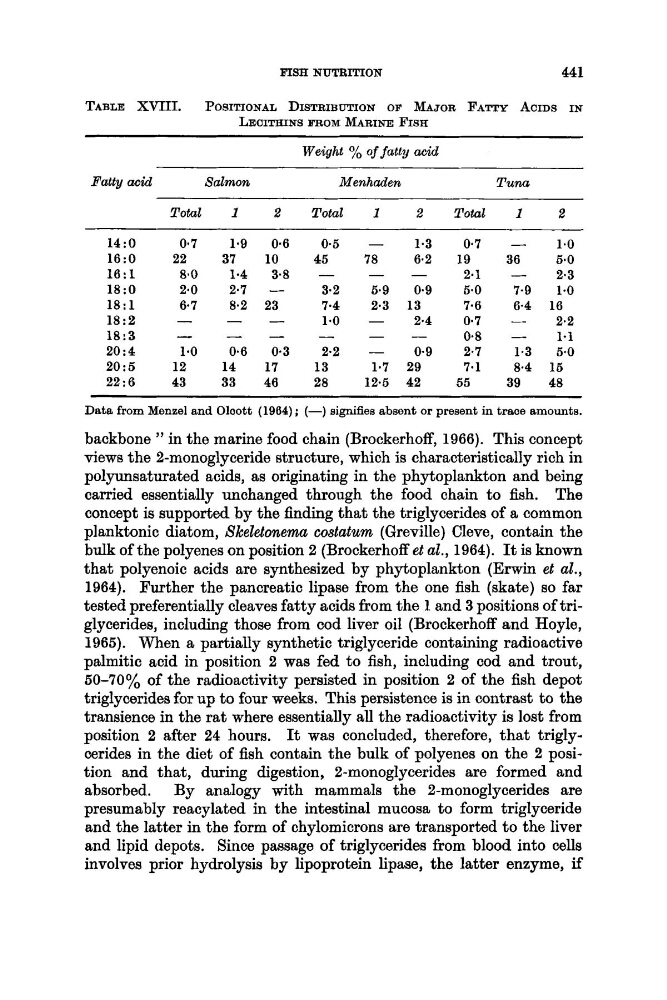
TABLE XmII. POSITIONAL DISTRIBUTION OF MAJOR FATTY ACIDS IN
LECITHINS WROM MARINE FISH
Weight yo of fatty acid
~
~~
Fatty mid
Salmon
Menhaden
Tuna
Total
1
2
Total
1
2
Total
1
2
14:O
16:O
16:l
18:O
18:l
18:2
18:3
20:4
20:6
22:6
0.7
8.0
2.0
6.7
22
1.0
12
43
1.9
1.4
2.7
8.2
37
0.6
14
33
0.6
3.8
10
-
23
0.3
17
46
0.5
46
-
3-2
7.4
1.0
2.2
-
13
28
78
-
5.9
2.3
-
1-7
12.6
1.3
0.7
6.2
19
2.1
0.9
6.0
13
7.6
2.4
0.7
0.8
0.9
2.7
29
‘7.1
42
55
-
-
1.0
36
6.0
2.3
7.9
1.0
6-4 16
2.2
1.1
1.3
6.0
8.4 16
39
48
-
-
-
-
Data from Menzel and Oloott (1964) ; (-) signifles absent or present in traoe amounts.
backbone ” in the marine food chain (Brockerhoff, 1966). This concept
views the 2-monoglyceride structure, which is characteristically rich in
polyunsaturated acids, as originating in the phytoplankton and being
carried essentially unchanged through the food chain to fish. The
concept is supported by the finding that the triglycerides of a common
planktonic diatom, Skeletonem costatum (Greville) Cleve, contain the
bulk of the polyenes on position 2 (Brockerhoff et al., 1964). It is known
that polyenoic acids are synthesized by phytoplankton (Erwin et al.,
1964). Further the pancreatic lipase from the one fish (skate) so far
tested preferentially cleaves fatty acids from the 1 and 3 positions of triglycerides, including those from cod liver oil (Brockerhoff and Hoyle,
1965). When a partially synthetic triglyceride containing radioactive
palmitic acid in position 2 was fed to fish, including cod and trout,
60-70% of the radioactivity persisted in position 2 of the fish depot
triglycerides for up to four weeks. This persistence is in contrast to the
transience in the rat where essentially all the radioactivity is lost from
position 2 after 24 hours. It was concluded, therefore, that triglycerides in the diet of fish contain the bulk of polyenes on the 2 position and that, during digestion, 2-monoglycerides are formed and
absorbed. By analogy with mammals the 2-monoglycerides are
presumably reacylated in the intestinal mucosa to form triglyceride
and the latter in the form of chylomicrons are transported t o the liver
and lipid depots. Since passage of triglycerides from blood into cells
involves prior hydrolysis by lipoprotein lipase, the latter enzyme, if
441
TABLE XmII. POSITIONAL DISTRIBUTION OF MAJOR FATTY ACIDS IN
LECITHINS WROM MARINE FISH
Weight yo of fatty acid
~
~~
Fatty mid
Salmon
Menhaden
Tuna
Total
1
2
Total
1
2
Total
1
2
14:O
16:O
16:l
18:O
18:l
18:2
18:3
20:4
20:6
22:6
0.7
8.0
2.0
6.7
22
1.0
12
43
1.9
1.4
2.7
8.2
37
0.6
14
33
0.6
3.8
10
-
23
0.3
17
46
0.5
46
-
3-2
7.4
1.0
2.2
-
13
28
78
-
5.9
2.3
-
1-7
12.6
1.3
0.7
6.2
19
2.1
0.9
6.0
13
7.6
2.4
0.7
0.8
0.9
2.7
29
‘7.1
42
55
-
-
1.0
36
6.0
2.3
7.9
1.0
6-4 16
2.2
1.1
1.3
6.0
8.4 16
39
48
-
-
-
-
Data from Menzel and Oloott (1964) ; (-) signifles absent or present in traoe amounts.
backbone ” in the marine food chain (Brockerhoff, 1966). This concept
views the 2-monoglyceride structure, which is characteristically rich in
polyunsaturated acids, as originating in the phytoplankton and being
carried essentially unchanged through the food chain to fish. The
concept is supported by the finding that the triglycerides of a common
planktonic diatom, Skeletonem costatum (Greville) Cleve, contain the
bulk of the polyenes on position 2 (Brockerhoff et al., 1964). It is known
that polyenoic acids are synthesized by phytoplankton (Erwin et al.,
1964). Further the pancreatic lipase from the one fish (skate) so far
tested preferentially cleaves fatty acids from the 1 and 3 positions of triglycerides, including those from cod liver oil (Brockerhoff and Hoyle,
1965). When a partially synthetic triglyceride containing radioactive
palmitic acid in position 2 was fed to fish, including cod and trout,
60-70% of the radioactivity persisted in position 2 of the fish depot
triglycerides for up to four weeks. This persistence is in contrast to the
transience in the rat where essentially all the radioactivity is lost from
position 2 after 24 hours. It was concluded, therefore, that triglycerides in the diet of fish contain the bulk of polyenes on the 2 position and that, during digestion, 2-monoglycerides are formed and
absorbed. By analogy with mammals the 2-monoglycerides are
presumably reacylated in the intestinal mucosa to form triglyceride
and the latter in the form of chylomicrons are transported t o the liver
and lipid depots. Since passage of triglycerides from blood into cells
involves prior hydrolysis by lipoprotein lipase, the latter enzyme, if