

432
0. B. COWEY AND J. R. SARQENT
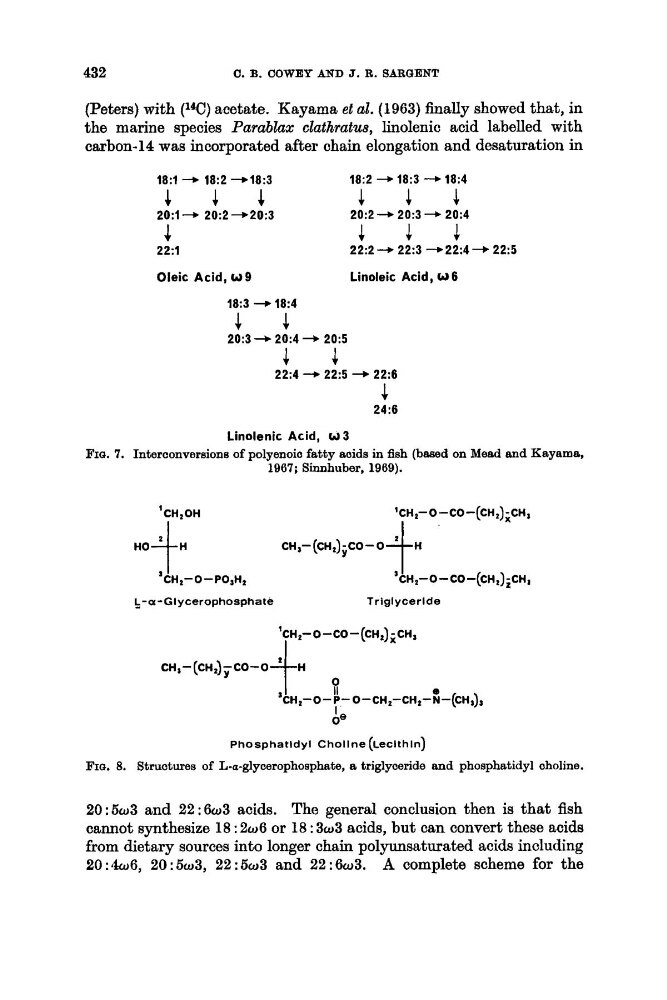
(Peters) with (14C) acetate. Kayama et aZ. (1963) finally showed that, in
the marine species Parablax c~?athratus, linolenic acid labelled with
carbon- 14 was incorporated after chain elongation and desaturation in
ia:i --* 1a:2 --*1a:3
1a:2 + 1a:3 -+ 1a:4
1 1 1
1 1 4
20:2 -+ 20:3 --t 20:4
22:2 --+ 22:3 --*22:4 + 2 2 5
Linoleic Acid, W 6
4 1 4
4
20:1+ 20:2 +20:3
22:l
Oleic Acid, w 9
1833 + 1a:4
1 4
20:3 + 20:4 + 2 0 5
4 1
22:4 --* 2 2 5 + 2 2 6
24:6
4
Linolenic Acid, w 3
FIQ. 7. Interconversions of polyenoio fatty acids in fish (baaed on Meed and Keyama,
1967; Sinnhuber, 1969).
‘CH,OH
~ C H ~ -
o -co-(cH,)~cH,
CH,-0 -P03H2
6-a-Glycerophosphate
Trlglycerlde
‘cH~- o -CO - (CH~);CH,
8
o-cH~-cH~-N-(cH,),
I
0e
Phosphatldyl Chollne (Leclthln)
FIO. 8. Struotures of L-a-glycerophosphate, a triglyoeride and phosphatidyl oholine.
2O:Sw3 and 22:6w3 acids. The general conclusion then is that fish
cannot synthesize 18 : 2w6 or 18 : 3w3 acids, but can convert these acids
from dietary sources into longer chain polyunsaturated acids including
20:4w6, 20:6w3, 22:6w3 and 22:6w3. A complete scheme for the
0. B. COWEY AND J. R. SARQENT
(Peters) with (14C) acetate. Kayama et aZ. (1963) finally showed that, in
the marine species Parablax c~?athratus, linolenic acid labelled with
carbon- 14 was incorporated after chain elongation and desaturation in
ia:i --* 1a:2 --*1a:3
1a:2 + 1a:3 -+ 1a:4
1 1 1
1 1 4
20:2 -+ 20:3 --t 20:4
22:2 --+ 22:3 --*22:4 + 2 2 5
Linoleic Acid, W 6
4 1 4
4
20:1+ 20:2 +20:3
22:l
Oleic Acid, w 9
1833 + 1a:4
1 4
20:3 + 20:4 + 2 0 5
4 1
22:4 --* 2 2 5 + 2 2 6
24:6
4
Linolenic Acid, w 3
FIQ. 7. Interconversions of polyenoio fatty acids in fish (baaed on Meed and Keyama,
1967; Sinnhuber, 1969).
‘CH,OH
~ C H ~ -
o -co-(cH,)~cH,
CH,-0 -P03H2
6-a-Glycerophosphate
Trlglycerlde
‘cH~- o -CO - (CH~);CH,
8
o-cH~-cH~-N-(cH,),
I
0e
Phosphatldyl Chollne (Leclthln)
FIO. 8. Struotures of L-a-glycerophosphate, a triglyoeride and phosphatidyl oholine.
2O:Sw3 and 22:6w3 acids. The general conclusion then is that fish
cannot synthesize 18 : 2w6 or 18 : 3w3 acids, but can convert these acids
from dietary sources into longer chain polyunsaturated acids including
20:4w6, 20:6w3, 22:6w3 and 22:6w3. A complete scheme for the