

402
C. B. COWEY AND J. R. SARGENT
nearly perfectly utilized by them. Mitchell and Block (1946) assessed
the nutritional value of a number of proteins by comparing their essential amino acid composition with that of hen’s egg protein. The chemical
score of the test protein was defined as 100 minus the greatest percentage deficit of any one essential amino acid in that protein compared to its concentration in whole egg protein. Thus the chemical
score of the test protein is determined by that essential amino acid
present in lowest amount compared to its concentration in whole egg
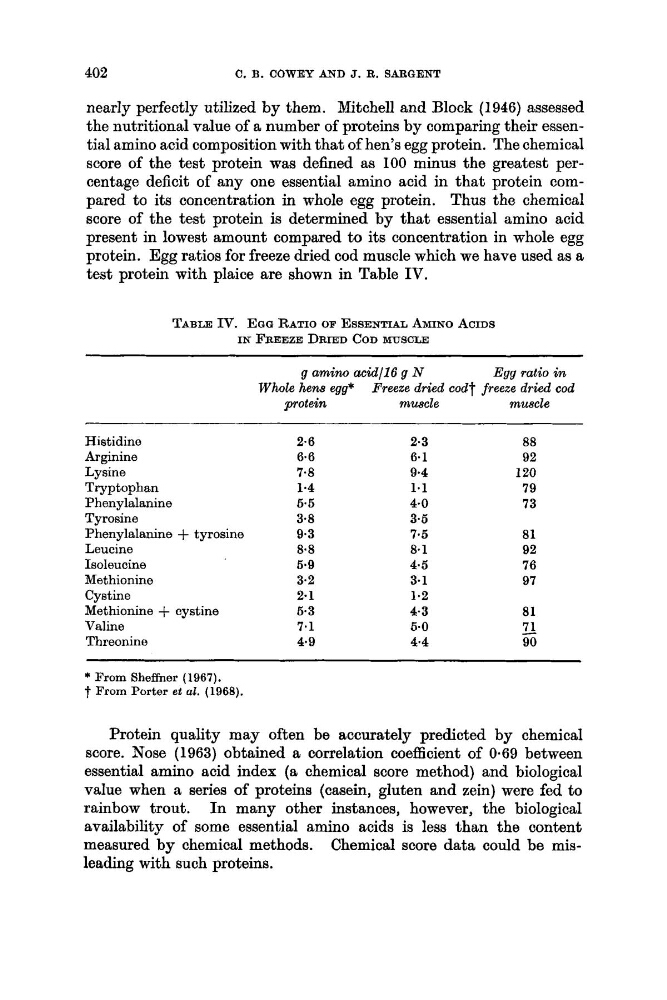
protein. Egg ratios for freeze dried cod muscle which we have used as a
test protein with plaice are shown in Table IV.
TABLE IV. EGG RATIO OF ESSENTIAL AMINO ACIDS
IN FREEZE DRIED COD MUSCLE
g amino acid116 g N
Egg ratio i n
Whole hens egg* Freeze dried cod7 freeze dried cod
protein
muacle
muscle
Histidine
2.6
2- 3
88
Arginine
6.6
6.1
92
Lysine
7-8
9-4
120
Tryptophan
1.4
1.1
I9
Phenylalanine
6.6
4-0
73
Tyrosine
3.8
3-6
Phenylalanine + tyrosine
9.3
1.6
81
Leucine
8.8
8.1
92
Isoleucine
6.9
4.6
76
Methionine
3.2
3.1
91
Cystine
2.1
1.2
Methionine + cystine
6.3
4.3
81
71
Valine
7.1
6.0
Threonine
4.9
4.4
90
-
* From Sheffner (1967).
t From Porter et al. (1968).
Protein quality may often be accurately predicted by chemical
score. Nose (1963) obtained a correlation coefficient of 0.69 between
essential amino acid index (a chemical score method) and biological
value when a series of proteins (casein, gluten and zein) were fed to
rainbow trout. In many other instances, however, the biological
availability of some essential amino acids is less than the content
measured by chemical methods. Chemical score data could be misleading with such proteins.
C. B. COWEY AND J. R. SARGENT
nearly perfectly utilized by them. Mitchell and Block (1946) assessed
the nutritional value of a number of proteins by comparing their essential amino acid composition with that of hen’s egg protein. The chemical
score of the test protein was defined as 100 minus the greatest percentage deficit of any one essential amino acid in that protein compared to its concentration in whole egg protein. Thus the chemical
score of the test protein is determined by that essential amino acid
present in lowest amount compared to its concentration in whole egg
protein. Egg ratios for freeze dried cod muscle which we have used as a
test protein with plaice are shown in Table IV.
TABLE IV. EGG RATIO OF ESSENTIAL AMINO ACIDS
IN FREEZE DRIED COD MUSCLE
g amino acid116 g N
Egg ratio i n
Whole hens egg* Freeze dried cod7 freeze dried cod
protein
muacle
muscle
Histidine
2.6
2- 3
88
Arginine
6.6
6.1
92
Lysine
7-8
9-4
120
Tryptophan
1.4
1.1
I9
Phenylalanine
6.6
4-0
73
Tyrosine
3.8
3-6
Phenylalanine + tyrosine
9.3
1.6
81
Leucine
8.8
8.1
92
Isoleucine
6.9
4.6
76
Methionine
3.2
3.1
91
Cystine
2.1
1.2
Methionine + cystine
6.3
4.3
81
71
Valine
7.1
6.0
Threonine
4.9
4.4
90
-
* From Sheffner (1967).
t From Porter et al. (1968).
Protein quality may often be accurately predicted by chemical
score. Nose (1963) obtained a correlation coefficient of 0.69 between
essential amino acid index (a chemical score method) and biological
value when a series of proteins (casein, gluten and zein) were fed to
rainbow trout. In many other instances, however, the biological
availability of some essential amino acids is less than the content
measured by chemical methods. Chemical score data could be misleading with such proteins.