

FISH NUTRlTlON
399
is added to a basal diet of the ten essential amino acids the growth
increments obtained in rats were equivalent to those given by isonitrogenous mixtures of non-essential amino acids. Clearly the
nitrogen from diammonium citrate was used for non-essential amino
acid synthesis. Urea and glycine were less efficient in this respect than
was diammonium citrate.
The utilization of nitrogenous supplements by chinook salmon was
investigated by DeLong et al. (1969). They fed a basal diet containing
20% protein (a casein, gelatin, amino acid mixture), the overall amino
acid pattern resembling whole egg protein. This was compared with
‘‘ whole egg protein ” at a level of 40% dry diet and with four other
diets similar to the basal diet, except that they were made isonitrogenous with the 40% protein diet by replacing an appropriate
amount of dextrin with one or other of urea, glycine, arginine and
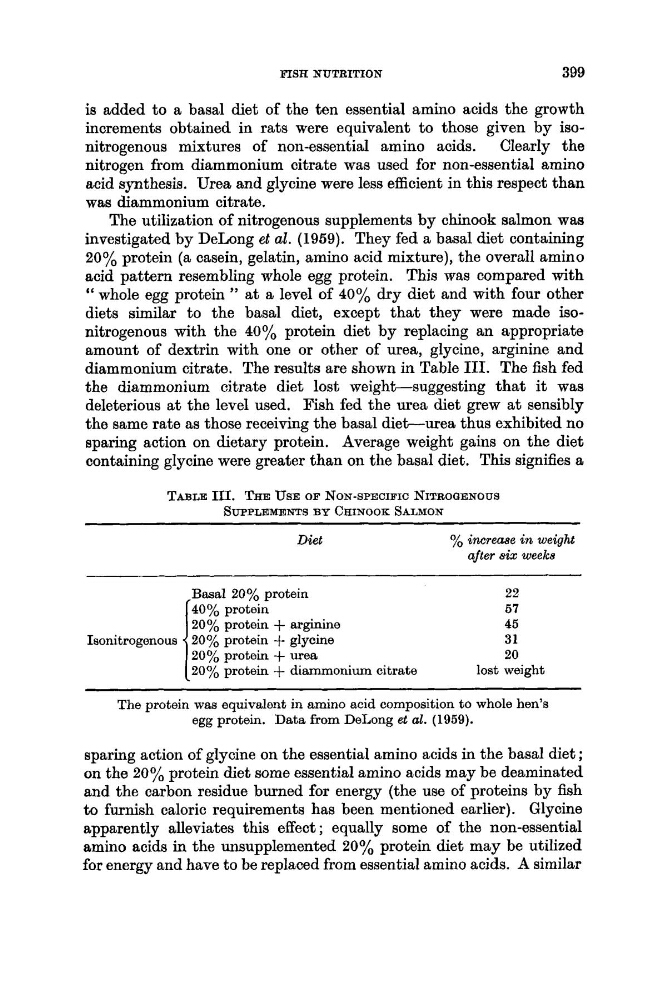
diammonium citrate. The results are shown in Table 111. The fish fed
the diammonium citrate diet lost weighesuggesting that it was
deleterious at the level used. Fish fed the urea diet grew at sensibly
the same rate as those receiving the basal diet-urea thus exhibited no
sparing action on dietary protein. Average weight gains on the diet
containing glycine were greater than on the basal diet. This signifies a
TABLE 111. THE USE OF NON-SPECIFIC NITROQENOUS
SUPPLEMENTS BY CHINOOK SALMON
yo increase in weight
after six weeks
Basal 20% protein
22
20% protein + arginine
45
20% protein + urea
20
40% protein
67
20% protein + glycine
31
20% protein + diammonium citrate
lost weight
~~
The protein was equivalent in amino acid composition to whole hen’s
egg protein. Data from DeLong et al. (1959).
sparing action of glycine on the essential amino acids in the basal diet ;
on the 20% protein diet some essential amino acids may be deaminated
and the carbon residue burned for energy (the use of proteins by fish
to furnish caloric requirements has been mentioned earlier). Glycine
apparently alleviates this effect ; equally some of the non-essential
amino acids in the unsupplemented 20% protein diet may be utilized
for energy and have to be replaced from essential amino acids. A similar
399
is added to a basal diet of the ten essential amino acids the growth
increments obtained in rats were equivalent to those given by isonitrogenous mixtures of non-essential amino acids. Clearly the
nitrogen from diammonium citrate was used for non-essential amino
acid synthesis. Urea and glycine were less efficient in this respect than
was diammonium citrate.
The utilization of nitrogenous supplements by chinook salmon was
investigated by DeLong et al. (1969). They fed a basal diet containing
20% protein (a casein, gelatin, amino acid mixture), the overall amino
acid pattern resembling whole egg protein. This was compared with
‘‘ whole egg protein ” at a level of 40% dry diet and with four other
diets similar to the basal diet, except that they were made isonitrogenous with the 40% protein diet by replacing an appropriate
amount of dextrin with one or other of urea, glycine, arginine and
diammonium citrate. The results are shown in Table 111. The fish fed
the diammonium citrate diet lost weighesuggesting that it was
deleterious at the level used. Fish fed the urea diet grew at sensibly
the same rate as those receiving the basal diet-urea thus exhibited no
sparing action on dietary protein. Average weight gains on the diet
containing glycine were greater than on the basal diet. This signifies a
TABLE 111. THE USE OF NON-SPECIFIC NITROQENOUS
SUPPLEMENTS BY CHINOOK SALMON
yo increase in weight
after six weeks
Basal 20% protein
22
20% protein + arginine
45
20% protein + urea
20
40% protein
67
20% protein + glycine
31
20% protein + diammonium citrate
lost weight
~~
The protein was equivalent in amino acid composition to whole hen’s
egg protein. Data from DeLong et al. (1959).
sparing action of glycine on the essential amino acids in the basal diet ;
on the 20% protein diet some essential amino acids may be deaminated
and the carbon residue burned for energy (the use of proteins by fish
to furnish caloric requirements has been mentioned earlier). Glycine
apparently alleviates this effect ; equally some of the non-essential
amino acids in the unsupplemented 20% protein diet may be utilized
for energy and have to be replaced from essential amino acids. A similar