

FISH NUTRITION
397
Weight
gain a s
initial
weight
vo of
izo
110
100
00
80
70
00
w
40
30
20
30
4 0
60
60
1 0
Protein in the dry diet ( g / l O O g )
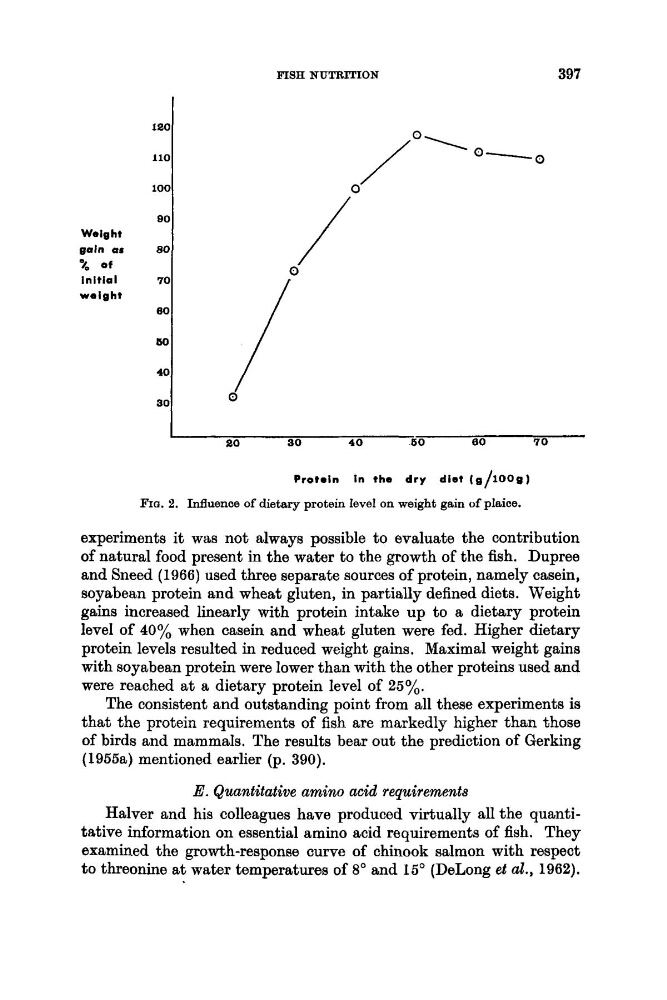
Fro. 2. Muence of dietary protein Ievel on weight gain of plaice.
experiments it was not always possible to evaluate the contribution
of natural food present in the water to the growth of the fish. Dupree
and Sneed (1966) used three separate sources of protein, namely casein,
soyabean protein and wheat gluten, in partially defined diets. Weight
gains increased linearly with protein intake up to a dietary protein
level of 40% when casein and wheat gluten were fed. Higher dietary
protein levels resulted in reduced weight gains. Maximal weight gains
with soyabean protein were lower than with the other proteins used and
were reached at a dietary protein level of 25%.
The consistent and outstanding point from all these experiments is
that the protein requirements of fish are markedly higher than those
of birds and mammals. The results bear out the prediction of Gerking
(1965a) mentioned earlier (p. 390).
E. Quantitative amino acid requirements
Halver and his colleagues have produced virtually all the quantitative information on essential amino acid requirements of fish. They
examined the growth-response curve of chinook salmon with respect
to threonine at water temperatures of 8 ' and 15' (DeLong et al., 1962).
397
Weight
gain a s
initial
weight
vo of
izo
110
100
00
80
70
00
w
40
30
20
30
4 0
60
60
1 0
Protein in the dry diet ( g / l O O g )
Fro. 2. Muence of dietary protein Ievel on weight gain of plaice.
experiments it was not always possible to evaluate the contribution
of natural food present in the water to the growth of the fish. Dupree
and Sneed (1966) used three separate sources of protein, namely casein,
soyabean protein and wheat gluten, in partially defined diets. Weight
gains increased linearly with protein intake up to a dietary protein
level of 40% when casein and wheat gluten were fed. Higher dietary
protein levels resulted in reduced weight gains. Maximal weight gains
with soyabean protein were lower than with the other proteins used and
were reached at a dietary protein level of 25%.
The consistent and outstanding point from all these experiments is
that the protein requirements of fish are markedly higher than those
of birds and mammals. The results bear out the prediction of Gerking
(1965a) mentioned earlier (p. 390).
E. Quantitative amino acid requirements
Halver and his colleagues have produced virtually all the quantitative information on essential amino acid requirements of fish. They
examined the growth-response curve of chinook salmon with respect
to threonine at water temperatures of 8 ' and 15' (DeLong et al., 1962).