

WSH NUTRITION
387
protein diet was transferred to a low protein diet there was a lag
period before nitrogen excretion attained a new (low) equilibrium level
on the low protein diet. Thus for a period more nitrogen was
excreted than was assimilated. When nitrogen equilibrium had been
attained on the low protein diet and the subject reverted to a high
protein diet there was again an excretory lag and the subject excreted
less nitrogen than was ingested, for a time. This lag process and the
fact that the rate of nitrogen excretion falls off exponentially when
mammals are transferred from a nitrogen-containing to a nitrogen-free
diet, pointed to the existence of a protein store in the body.
It has become apparent over the years that this protein store is in
fact the cytoplasmic protein itself and especially the cytoplasmic protein
of soft tissues. In mammals the cytoplasmic protein of these tissues
increases or decreases in amount in concert with similar changes in
dietary protein level. Such effects have been studied by many
workers, studies on rats being reviewed by Ashida (1963). Similar
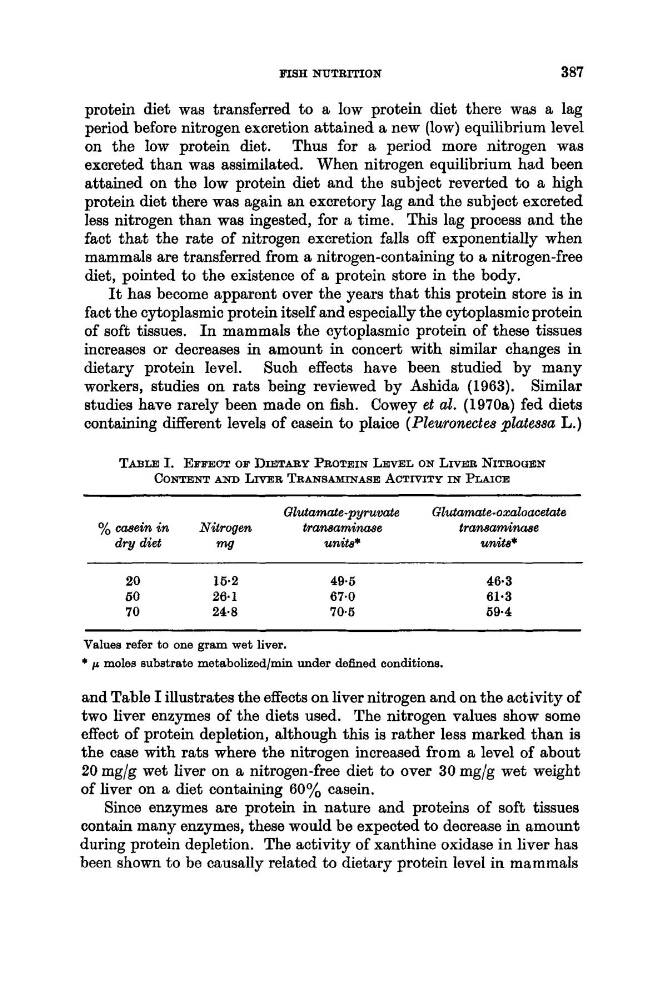
studies have rarely been made on fish. Cowey et al. (1970a) fed diets
containing different levels of casein to pIaice (Pleuronectes platessa L.)
TABLE I. EFFECT OF DIETARY PROTEIN LEVEL ON LIVER NITROUEN
CONTENT AND LIVER TRANSAMINASE ACTIVITY IN PLAICE
Cflutamate-pyrmvate
Glutamate-oxaloacete
yo caeein i n
Nitrogen
transaminme
transaminme
dry diet
unit%*
unii%*
20
15.2
49-6
60
26.1
67-0
70
24.8
70.6
46.3
61.3
69.4
Values refer to one gram wet liver.
* p moles substrate metabolized/min under d e h e d conditions.
and Table I illustrates the effects on liver nitrogen and on the activity of
two liver enzymes of the diets used. The nitrogen values show some
effect of protein depletion, although this is rather less marked than is
the case with rats where the nitrogen increased from a level of about
20 mglg wet liver on a nitrogen-free diet to over 30 mglg wet weight
of liver on a diet containing 60% casein.
Since enzymes are protein in nature and proteins of soft tissues
contain many enzymes, these would be expected to decrease in amount
during protein depletion. The activity of xanthine oxidase in liver has
been shown to be causally related to dietary protein level in mammals
387
protein diet was transferred to a low protein diet there was a lag
period before nitrogen excretion attained a new (low) equilibrium level
on the low protein diet. Thus for a period more nitrogen was
excreted than was assimilated. When nitrogen equilibrium had been
attained on the low protein diet and the subject reverted to a high
protein diet there was again an excretory lag and the subject excreted
less nitrogen than was ingested, for a time. This lag process and the
fact that the rate of nitrogen excretion falls off exponentially when
mammals are transferred from a nitrogen-containing to a nitrogen-free
diet, pointed to the existence of a protein store in the body.
It has become apparent over the years that this protein store is in
fact the cytoplasmic protein itself and especially the cytoplasmic protein
of soft tissues. In mammals the cytoplasmic protein of these tissues
increases or decreases in amount in concert with similar changes in
dietary protein level. Such effects have been studied by many
workers, studies on rats being reviewed by Ashida (1963). Similar
studies have rarely been made on fish. Cowey et al. (1970a) fed diets
containing different levels of casein to pIaice (Pleuronectes platessa L.)
TABLE I. EFFECT OF DIETARY PROTEIN LEVEL ON LIVER NITROUEN
CONTENT AND LIVER TRANSAMINASE ACTIVITY IN PLAICE
Cflutamate-pyrmvate
Glutamate-oxaloacete
yo caeein i n
Nitrogen
transaminme
transaminme
dry diet
unit%*
unii%*
20
15.2
49-6
60
26.1
67-0
70
24.8
70.6
46.3
61.3
69.4
Values refer to one gram wet liver.
* p moles substrate metabolized/min under d e h e d conditions.
and Table I illustrates the effects on liver nitrogen and on the activity of
two liver enzymes of the diets used. The nitrogen values show some
effect of protein depletion, although this is rather less marked than is
the case with rats where the nitrogen increased from a level of about
20 mglg wet liver on a nitrogen-free diet to over 30 mglg wet weight
of liver on a diet containing 60% casein.
Since enzymes are protein in nature and proteins of soft tissues
contain many enzymes, these would be expected to decrease in amount
during protein depletion. The activity of xanthine oxidase in liver has
been shown to be causally related to dietary protein level in mammals