

328
P. S. MEADOWS AND J. I. CAMPBELL
cit. and Kohn (1961) refer to other apposite papers and consider the
biochemistry of these responses. Unfortunately, in no case has the
prey's response to the predator and the predator's response to the prey
been studied in the same pair of species. The comparison would be
worthwhile.
H . Homing
Some intertidal invertebrates migrate from and return to a
recognizable site on the shore, and these movements are usually
termed homing behaviour in contrast to the larger scale horizontal
. ; . d '
%
<, a .:::. :.::::. _,:, . .:.:. .................... .......... .:.:.:.:.:.:. ........... ;:;::;;;:::.. ............. .:.
G"'
L
b (a1
pL(b) (C)
.
5cm
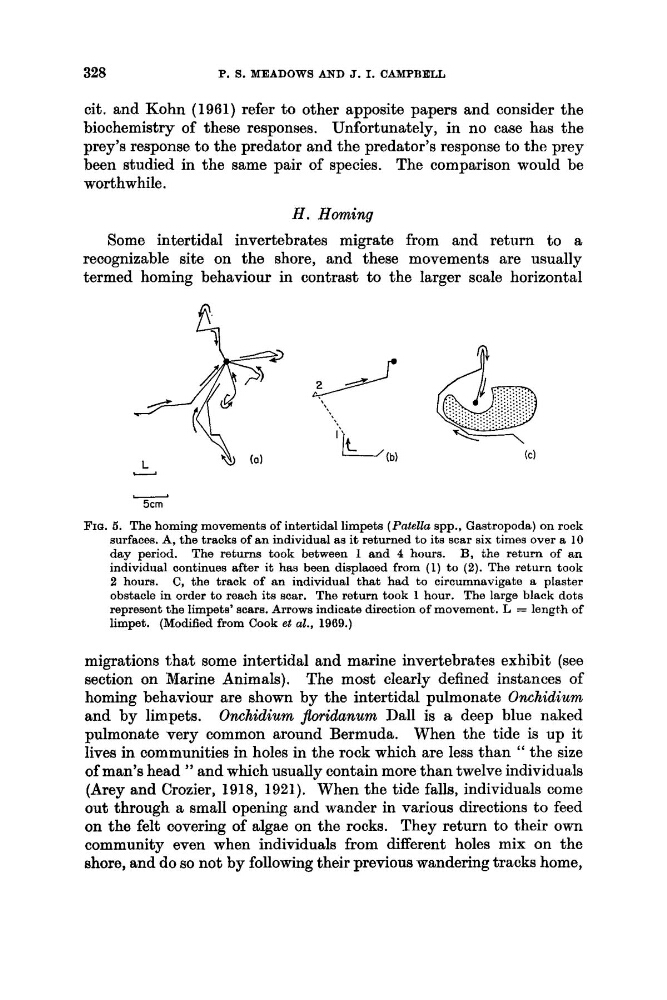
FIG. 6. The homing movements of intertidal limpets (Patella spp., Gastropoda) on rock
surfaces. A, the tracks of an individual as i t returned to its scar six times over a 10
day period.
B, the return of an
individual continues after it has been displaced from (1) to (2). The return took
2 hours. C, the track of an individual that had to circumnavigate a plaster
obstacle in order to reach its scar. The return took 1 hour. The large black dots
represent the limpets' scars. Arrows indicate direction of movement. L = length of
limpet. (Modified from Cook et al., 1969.)
The returns took between 1 and 4 hours.
migrations that some intertidal and marine invertebrates exhibit (see
section on Marine Animals). The most clearly defined instances of
homing behaviour are shown by the intertidal pulmonate Onchidium
and by limpets. Onchidium J'loridanum Dall is a deep blue naked
pulmonate very common around Bermuda. When the tide is up it
lives in communities in holes in the rock which are less than " the size
of man's head ') and which usually contain more than twelve individuals
(Arey and Crozier, 1918, 1921). When the tide falls, individuals come
out through a small opening and wander in various directions to feed
on the felt covering of algae on the rocks. They return to their own
community even when individuals from different holes mix on the
shore, and do so not by following their previous wandering tracks home,
P. S. MEADOWS AND J. I. CAMPBELL
cit. and Kohn (1961) refer to other apposite papers and consider the
biochemistry of these responses. Unfortunately, in no case has the
prey's response to the predator and the predator's response to the prey
been studied in the same pair of species. The comparison would be
worthwhile.
H . Homing
Some intertidal invertebrates migrate from and return to a
recognizable site on the shore, and these movements are usually
termed homing behaviour in contrast to the larger scale horizontal
. ; . d '
%
<, a .:::. :.::::. _,:, . .:.:. .................... .......... .:.:.:.:.:.:. ........... ;:;::;;;:::.. ............. .:.
G"'
L
b (a1
pL(b) (C)
.
5cm
FIG. 6. The homing movements of intertidal limpets (Patella spp., Gastropoda) on rock
surfaces. A, the tracks of an individual as i t returned to its scar six times over a 10
day period.
B, the return of an
individual continues after it has been displaced from (1) to (2). The return took
2 hours. C, the track of an individual that had to circumnavigate a plaster
obstacle in order to reach its scar. The return took 1 hour. The large black dots
represent the limpets' scars. Arrows indicate direction of movement. L = length of
limpet. (Modified from Cook et al., 1969.)
The returns took between 1 and 4 hours.
migrations that some intertidal and marine invertebrates exhibit (see
section on Marine Animals). The most clearly defined instances of
homing behaviour are shown by the intertidal pulmonate Onchidium
and by limpets. Onchidium J'loridanum Dall is a deep blue naked
pulmonate very common around Bermuda. When the tide is up it
lives in communities in holes in the rock which are less than " the size
of man's head ') and which usually contain more than twelve individuals
(Arey and Crozier, 1918, 1921). When the tide falls, individuals come
out through a small opening and wander in various directions to feed
on the felt covering of algae on the rocks. They return to their own
community even when individuals from different holes mix on the
shore, and do so not by following their previous wandering tracks home,