

HABITAT SELECTION BY AQUATIC INVERTEBRATES
(c) inhibition of
later arrivals:
termination
of attack
317
:*6
$ } - - - - - - + verbenone
.
:
$
e
...
’ ; $: :
.
:
: .:
. : $;
. . :
.
.
I
::..::
...
:.. *
.....
. ....
(a) Initial attack
by females
.. .. . 3
.. ..i
:.:::,;
_______ + f u m - v e r b e n ~
frontalin
:.. .. ..
. .. :
. . ...
. ...
. : : . . :
.:....:
......
: : I :
. >..
. * r.....
. . . ...
. . *..
..... ._.. --.--------> a-pinene
. . ..
(b) Regulation
sex ratio
of
Verbenone
7ions-verbml
frontalin
E
. a-pinene
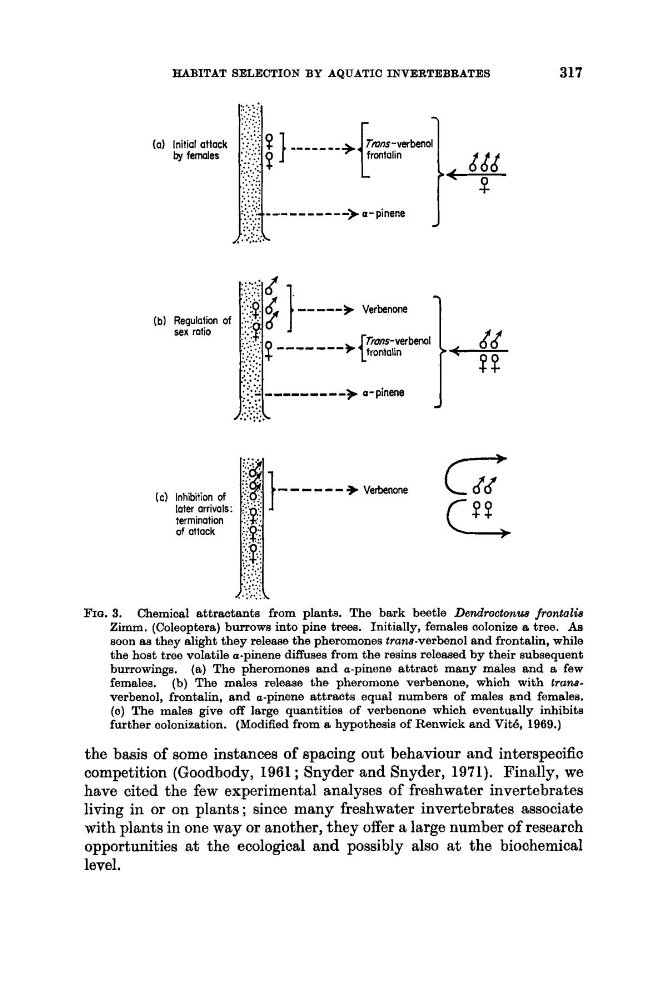
FIQ. 3. Chemical attractants from plants. The bark beetle Dendroctonpla frontalis
Zimm. (Coleoptera) burrows into pine trees. Initially, females colonize a tree. As
soon as they alight they release the pheromones trans-verbenol and frontalin, while
the host tree volatile a-pinene diffuses from the resins released by their subsequent
burrowings. (a) The pheromones and a-pinene attract many males and a few
females. (b) The males release the pheromone verbenone, which with transverbenol, frontalin, and a-pinene attracts equal numbers of males and females.
(c) The males give off large quantities of verbenone which eventually inhibits
further colonization. (Modified from a hypothesis of Renwick and Vit6, 1969.)
the basis of some instances of spacing out behaviour and interspecific
competition (Goodbody, 1961 ; Snyder and Snyder, 1971). Finally, we
have cited the few experimental analyses of freshwater invertebrates
living in or on plants ; since many freshwater invertebrates associate
with plants in one way or another, they offer a large number of research
opportunities at the ecological and possibly also at the biochemical
level.
(c) inhibition of
later arrivals:
termination
of attack
317
:*6
$ } - - - - - - + verbenone
.
:
$
e
...
’ ; $: :
.
:
: .:
. : $;
. . :
.
.
I
::..::
...
:.. *
.....
. ....
(a) Initial attack
by females
.. .. . 3
.. ..i
:.:::,;
_______ + f u m - v e r b e n ~
frontalin
:.. .. ..
. .. :
. . ...
. ...
. : : . . :
.:....:
......
: : I :
. >..
. * r.....
. . . ...
. . *..
..... ._.. --.--------> a-pinene
. . ..
(b) Regulation
sex ratio
of
Verbenone
7ions-verbml
frontalin
E
. a-pinene
FIQ. 3. Chemical attractants from plants. The bark beetle Dendroctonpla frontalis
Zimm. (Coleoptera) burrows into pine trees. Initially, females colonize a tree. As
soon as they alight they release the pheromones trans-verbenol and frontalin, while
the host tree volatile a-pinene diffuses from the resins released by their subsequent
burrowings. (a) The pheromones and a-pinene attract many males and a few
females. (b) The males release the pheromone verbenone, which with transverbenol, frontalin, and a-pinene attracts equal numbers of males and females.
(c) The males give off large quantities of verbenone which eventually inhibits
further colonization. (Modified from a hypothesis of Renwick and Vit6, 1969.)
the basis of some instances of spacing out behaviour and interspecific
competition (Goodbody, 1961 ; Snyder and Snyder, 1971). Finally, we
have cited the few experimental analyses of freshwater invertebrates
living in or on plants ; since many freshwater invertebrates associate
with plants in one way or another, they offer a large number of research
opportunities at the ecological and possibly also at the biochemical
level.