

HABITAT SELEOTION BY AQUATIC INVERTEBRATES
303
larvae may then swim off or stay to continue their investigations over
a more limited area of the bottom (a few mm). Here they re-cross their
tracks a number of times as if making quite sure that the area chosen
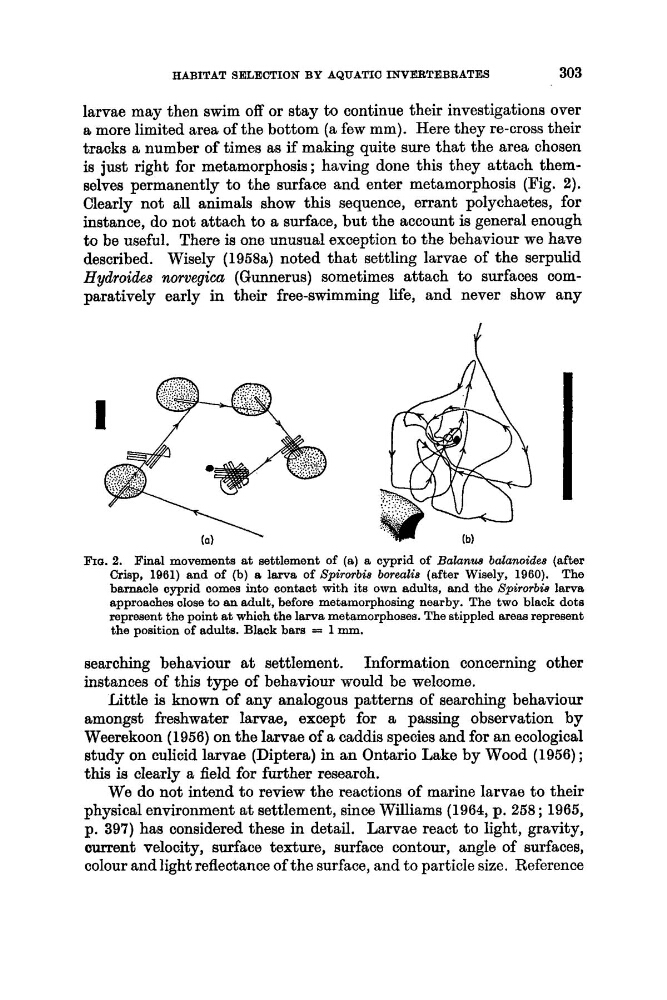
is just right for metamorphosis ; having done this they attach themselves permanently to the surface and enter metamorphosis (Fig. 2).
Clearly not all animals show this sequence, errant polychaetes, for
instance, do not attach to a surface, but the account is general enough
to be useful. There is one unusual exception t o the behaviour we have
described. Wisely (1958a) noted that settling larvae of the serpulid
Hydroides norvegica (Gunnerus) sometimes attach to surfaces comparatively early in their free-swimming life, and never show any
F"3 ..:!:.;,e
.. ......
I
I
(bl
FIG. 2. Final movements at settlement of (a) a cyprid of Balanw balanoidea (after
Crisp, 1061) and of (b) a l m a of Spirorbia borealis (after Wisely, 1960). The
barnacle oyprid comes into contact with its own adults, and the &~?iro~bia larva
approaches close to an adult, before metamorphosing nearby. The two black dots
represent the point at which the larva metamorphoses. The stippled areas represent
the position of adults. Black bars = 1111111.
searching behaviour at settlement. Information concerning other
instances of this type of behaviour would be welcome.
Little is known of any analogous patterns of searching behaviour
amongst freshwater larvae, except for a passing observation by
Weerekoon (1956) on the larvae of a caddis species and for an ecological
study on culicid larvae (Diptera) in an Ontario Lake by Wood (1956) ;
this ia clearly a field for further research.
We do not intend to review the reactions of marine larvae to their
physical environment at settlement, since Williams (1964, p. 258 ; 1965,
p. 397) has considered these in detail. Larvae react to light, gravity,
ourrent velocity, surface texture, surface contour, angle of surfaces,
colour and light reflectance of the surface, and to particle size. Reference
303
larvae may then swim off or stay to continue their investigations over
a more limited area of the bottom (a few mm). Here they re-cross their
tracks a number of times as if making quite sure that the area chosen
is just right for metamorphosis ; having done this they attach themselves permanently to the surface and enter metamorphosis (Fig. 2).
Clearly not all animals show this sequence, errant polychaetes, for
instance, do not attach to a surface, but the account is general enough
to be useful. There is one unusual exception t o the behaviour we have
described. Wisely (1958a) noted that settling larvae of the serpulid
Hydroides norvegica (Gunnerus) sometimes attach to surfaces comparatively early in their free-swimming life, and never show any
F"3 ..:!:.;,e
.. ......
I
I
(bl
FIG. 2. Final movements at settlement of (a) a cyprid of Balanw balanoidea (after
Crisp, 1061) and of (b) a l m a of Spirorbia borealis (after Wisely, 1960). The
barnacle oyprid comes into contact with its own adults, and the &~?iro~bia larva
approaches close to an adult, before metamorphosing nearby. The two black dots
represent the point at which the larva metamorphoses. The stippled areas represent
the position of adults. Black bars = 1111111.
searching behaviour at settlement. Information concerning other
instances of this type of behaviour would be welcome.
Little is known of any analogous patterns of searching behaviour
amongst freshwater larvae, except for a passing observation by
Weerekoon (1956) on the larvae of a caddis species and for an ecological
study on culicid larvae (Diptera) in an Ontario Lake by Wood (1956) ;
this ia clearly a field for further research.
We do not intend to review the reactions of marine larvae to their
physical environment at settlement, since Williams (1964, p. 258 ; 1965,
p. 397) has considered these in detail. Larvae react to light, gravity,
ourrent velocity, surface texture, surface contour, angle of surfaces,
colour and light reflectance of the surface, and to particle size. Reference