

300
P. 9. MEADOWS AND J. I. CAMTBELL
four, the associatiom are not permanent, and the bivalves can reassociate with another individual or even remain free living in the
substratum.
The evidence is conflicting as t o whether these
associations can be explained by different individuals having different
preferences, or by all individuals within a species being indiscriminate
as long as they have one of the four host species. Gage (1966b, p. 84),
although he does not give details of his results, states that the bivalves
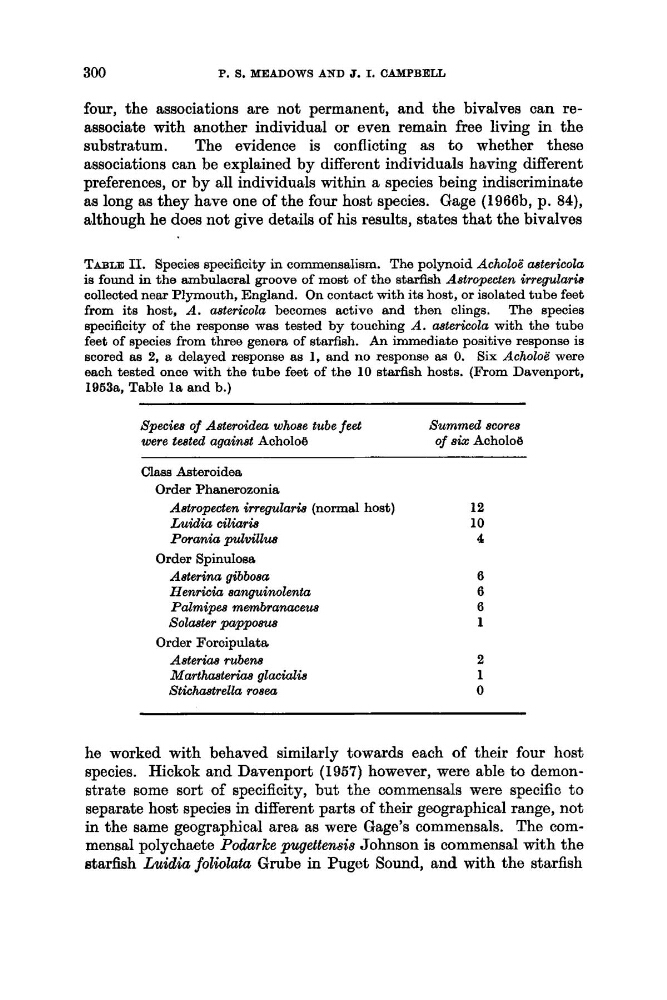
TAB^ PI. Species specificity in commensalism. The polynoid Acholoe astericola
is found in the ambulacral groove of most of the starfish Astropecten irregulark
collected near Plymouth, England. On contact with its host, or isolated tube feet
from its host, A . astericola becomes active and then clings. The species
Specificity of the response was tested by touching A . astericola with the tube
feet of species from three genera of starfish. An immediate positive response is
scored as 2, a delayed response as 1, and no response aa 0. Six Acholoe were
each tested once with the tube feet of the 10 starfish hosts. (From Davenport,
1963a, Table la and b.)
Speciea of Asteroidea whose tube feet
were teated against Acholoe
Summed scores
of six Acholo6
Class Asteroidea
Order Phanerozonia
Astropecten irregularis (normal host)
Luidia cilia&
Porania &villus
Order Spinulosa
Asterina gibbosa
Henricia sanguinolentu
Palmipa rnembranuceua
Solaster pappocrue
Order Forcipulata
Aster& rubens
Marthasterim glacialis
Stichastrella rosea
12
10
4
2
1
0
he worked with behaved similarly towards each of their four host
species. Hickok and Davenport (1967) however, were able to demonstrate some sort of specificity, but the Commensals were specific t o
separate host species in different parts of their geographical range, not
in the same geographical area as were Gage’s commensals. The commensal polychaete Podarke pugettensie Johnson is commensal with the
starfish Luidiafoliolata Grube in Puget Sound, and with the starfish
P. 9. MEADOWS AND J. I. CAMTBELL
four, the associatiom are not permanent, and the bivalves can reassociate with another individual or even remain free living in the
substratum.
The evidence is conflicting as t o whether these
associations can be explained by different individuals having different
preferences, or by all individuals within a species being indiscriminate
as long as they have one of the four host species. Gage (1966b, p. 84),
although he does not give details of his results, states that the bivalves
TAB^ PI. Species specificity in commensalism. The polynoid Acholoe astericola
is found in the ambulacral groove of most of the starfish Astropecten irregulark
collected near Plymouth, England. On contact with its host, or isolated tube feet
from its host, A . astericola becomes active and then clings. The species
Specificity of the response was tested by touching A . astericola with the tube
feet of species from three genera of starfish. An immediate positive response is
scored as 2, a delayed response as 1, and no response aa 0. Six Acholoe were
each tested once with the tube feet of the 10 starfish hosts. (From Davenport,
1963a, Table la and b.)
Speciea of Asteroidea whose tube feet
were teated against Acholoe
Summed scores
of six Acholo6
Class Asteroidea
Order Phanerozonia
Astropecten irregularis (normal host)
Luidia cilia&
Porania &villus
Order Spinulosa
Asterina gibbosa
Henricia sanguinolentu
Palmipa rnembranuceua
Solaster pappocrue
Order Forcipulata
Aster& rubens
Marthasterim glacialis
Stichastrella rosea
12
10
4
2
1
0
he worked with behaved similarly towards each of their four host
species. Hickok and Davenport (1967) however, were able to demonstrate some sort of specificity, but the Commensals were specific t o
separate host species in different parts of their geographical range, not
in the same geographical area as were Gage’s commensals. The commensal polychaete Podarke pugettensie Johnson is commensal with the
starfish Luidiafoliolata Grube in Puget Sound, and with the starfish