

290
P. 8. MEADOWS AND J. I. OAMPBELL
bed for instance, are photopositive (Holmes, 1905; Allee and Stein, 1918;
Hughes, 1966), although this relationship is not always as clear as one
might hope, presumably because of confusion by other environmental
variables. Some bottom living animals are also influenced by the shade
or colour of their background (Brown, 1939; Popham, 1941) while
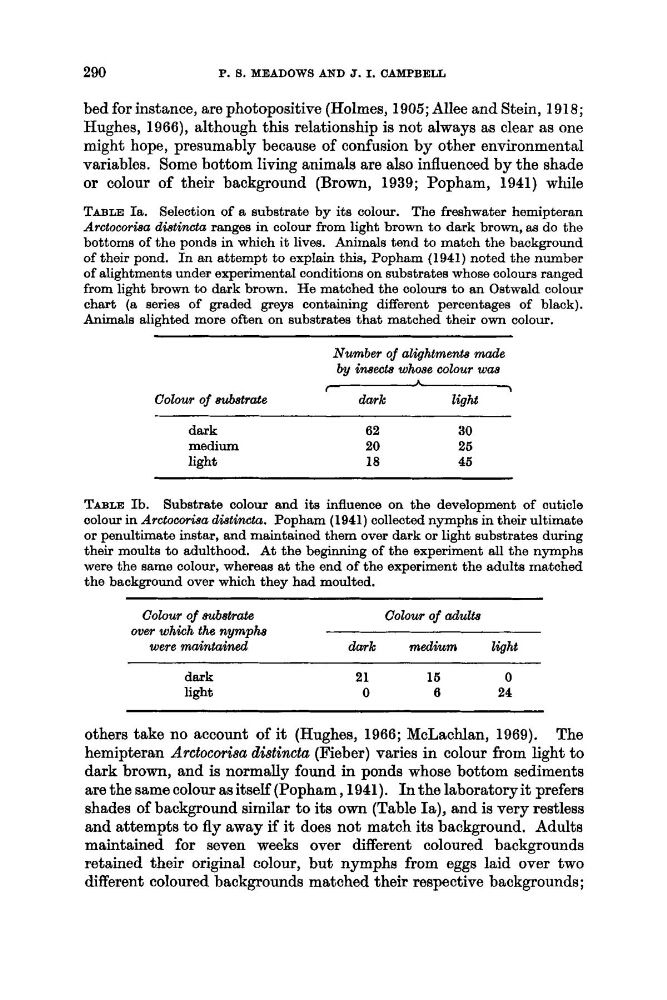
TABLE Ia. Selection of a substrate by its colour. The freshwater hemipteran
Arctocorba dbtincta ranges in colour from light brown to dark brown, as do the
bottoms of the ponds in which it lives. Animals tend to match the background
of their pond. I n an attempt to explain this, Popham (1941) noted the number
of alightments under experimental conditions on substrates whose colours ranged
from light brown to dark brown. He matched the coloura to an Ostwald colour
chart (a series of graded greys containing different percentages of black).
Animals alighted more often on substrates that matched their own colour.
Number of al@htrnents made
by inseots whose colour wm
I
colour of eubetrate
dark
ligh8
dark
medium
light
62
30
20
26
18
46
TABLE Ib. Substrate colour and its influence on the development of cuticle
colour in Arctooorha dbtinota. Popham (1941) collected nymphs in their ultimate
or penultimate instar, and maintained them over dark or light substrates during
their moults to adulthood. At the beginning of the experiment all the nymphs
were the same colour, whereas at the end of the experiment the adults matched
the background over which they had moulted.
COfOUT Of &8~att?
over which the nymph
Colour of adults
were maintained
dark:
medium
leht
dark
light
21
16
0
0
6
24
others take no account of it (Hughes, 1966; McLachlan, 1969). The
hemipteran Arctocorisa distincta (Fieber) varies in colour from light to
dark brown, and is normally found in ponds whose bottom sediments
are the same colour as itself (Popham, 1941). In the laboratoryit prefers
shades of background similar to its own (Table Ia), and is very restless
and attempts to fly away if it does not match its background. Adults
maintained for seven weeks over different coloured backgrounds
retained their original colour, but nymphs from eggs laid over two
different coloured backgrounds matched their respective backgrounds;
P. 8. MEADOWS AND J. I. OAMPBELL
bed for instance, are photopositive (Holmes, 1905; Allee and Stein, 1918;
Hughes, 1966), although this relationship is not always as clear as one
might hope, presumably because of confusion by other environmental
variables. Some bottom living animals are also influenced by the shade
or colour of their background (Brown, 1939; Popham, 1941) while
TABLE Ia. Selection of a substrate by its colour. The freshwater hemipteran
Arctocorba dbtincta ranges in colour from light brown to dark brown, as do the
bottoms of the ponds in which it lives. Animals tend to match the background
of their pond. I n an attempt to explain this, Popham (1941) noted the number
of alightments under experimental conditions on substrates whose colours ranged
from light brown to dark brown. He matched the coloura to an Ostwald colour
chart (a series of graded greys containing different percentages of black).
Animals alighted more often on substrates that matched their own colour.
Number of al@htrnents made
by inseots whose colour wm
I
colour of eubetrate
dark
ligh8
dark
medium
light
62
30
20
26
18
46
TABLE Ib. Substrate colour and its influence on the development of cuticle
colour in Arctooorha dbtinota. Popham (1941) collected nymphs in their ultimate
or penultimate instar, and maintained them over dark or light substrates during
their moults to adulthood. At the beginning of the experiment all the nymphs
were the same colour, whereas at the end of the experiment the adults matched
the background over which they had moulted.
COfOUT Of &8~att?
over which the nymph
Colour of adults
were maintained
dark:
medium
leht
dark
light
21
16
0
0
6
24
others take no account of it (Hughes, 1966; McLachlan, 1969). The
hemipteran Arctocorisa distincta (Fieber) varies in colour from light to
dark brown, and is normally found in ponds whose bottom sediments
are the same colour as itself (Popham, 1941). In the laboratoryit prefers
shades of background similar to its own (Table Ia), and is very restless
and attempts to fly away if it does not match its background. Adults
maintained for seven weeks over different coloured backgrounds
retained their original colour, but nymphs from eggs laid over two
different coloured backgrounds matched their respective backgrounds;