

ASPECTS OF STRESS IN THE TROPICAL MARINE ENVLRONMENT
263
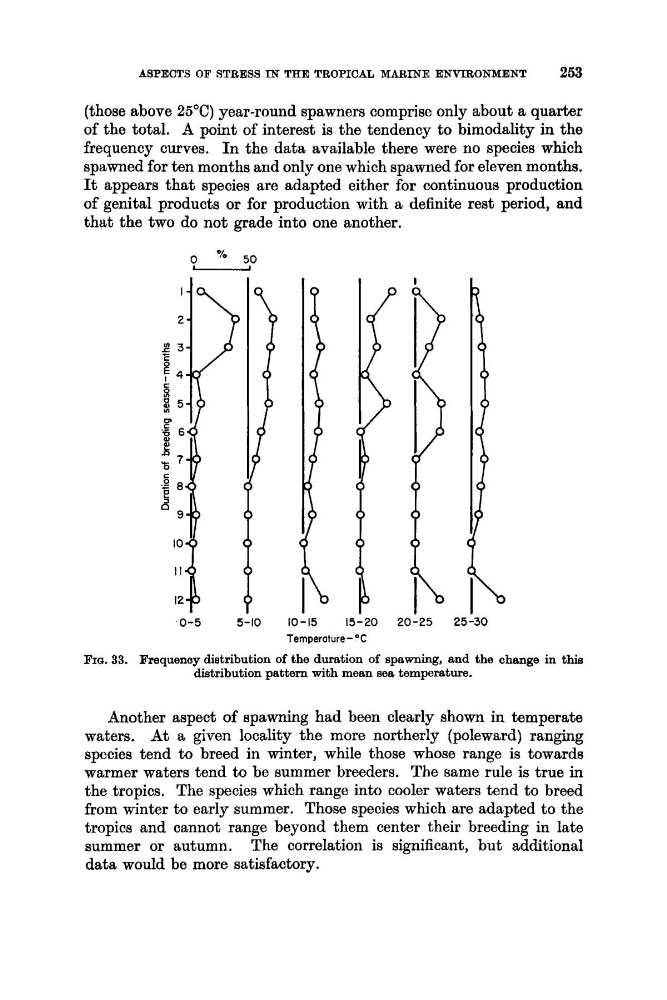
(those above 25OC) year-round spawners comprise only about a quarter
of the total. A point of interest is the tendency to bimodality in the
frequency curves. I n the data available there were no species which
spawned for ten months and only one which spawned for eleven months.
It appears that species are adapted either for continuous production
of genital products or for production with a definite rest period, and
that the two do not grade into one another.
Yo 50
O
-
i
1 0
1 0 - I 5
15-20 20125
25
Temperature- “C
FIG. 33. Frequenoy distribution of the duration of spawning, and the change in this
distribution pattern with mean sea temperature.
Another aspect of spawning had been clearly shown in temperate
waters. At a given locality the more northerly (poleward) ranging
species tend to breed in winter, while those whose range is towards
warmer waters tend to be summer breeders. The same rule is true in
the tropics. The species which range into cooler waters tend to breed
from winter to early summer. Those species which are adapted to the
tropics and cannot range beyond them center their breeding in late
summer or autumn. The correlation is significant, but additional
data would be more satisfactory.
263
(those above 25OC) year-round spawners comprise only about a quarter
of the total. A point of interest is the tendency to bimodality in the
frequency curves. I n the data available there were no species which
spawned for ten months and only one which spawned for eleven months.
It appears that species are adapted either for continuous production
of genital products or for production with a definite rest period, and
that the two do not grade into one another.
Yo 50
O
-
i
1 0
1 0 - I 5
15-20 20125
25
Temperature- “C
FIG. 33. Frequenoy distribution of the duration of spawning, and the change in this
distribution pattern with mean sea temperature.
Another aspect of spawning had been clearly shown in temperate
waters. At a given locality the more northerly (poleward) ranging
species tend to breed in winter, while those whose range is towards
warmer waters tend to be summer breeders. The same rule is true in
the tropics. The species which range into cooler waters tend to breed
from winter to early summer. Those species which are adapted to the
tropics and cannot range beyond them center their breeding in late
summer or autumn. The correlation is significant, but additional
data would be more satisfactory.