

234
HILARY B. MOORE
3W
*
e
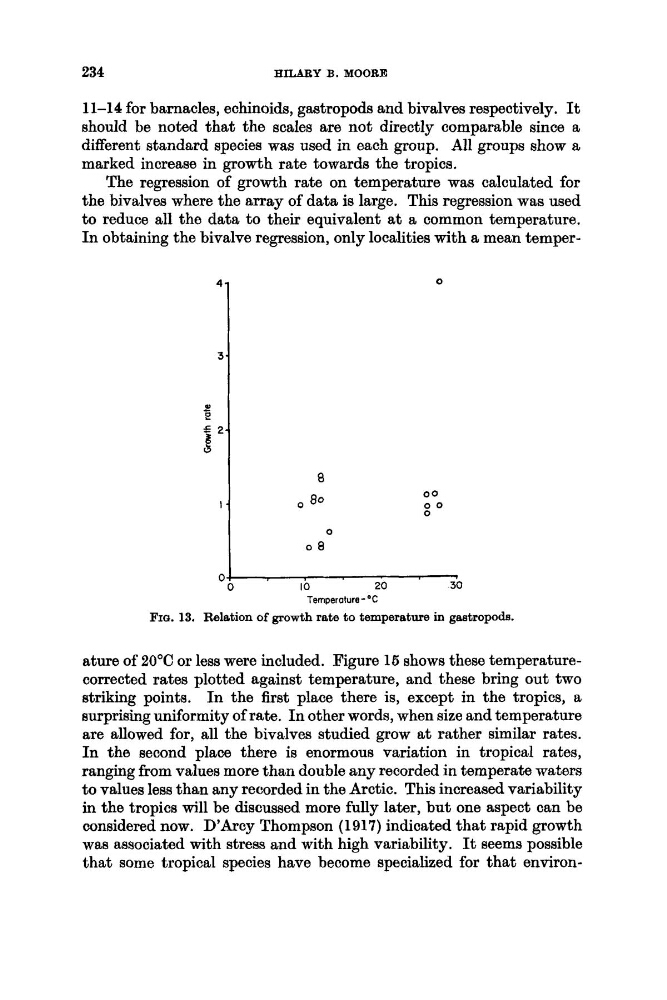
1 1-14 for barnacles, echinoids, gastropods and bivalves respectively. It
should be noted that the scales are not directly comparable since a
different standard species was used in each group. All groups show a
marked increase in growth rate towards the tropics.
The regression of growth rate on temperature was calculated for
the bivalves where the array of data is large. This regression was used
to reduce all the data to their equivalent at a common temperature.
In obtaining the bivalve regression, only localities with a mean temper0
0 0
0 0
0 8
I
,
0
10
20
30
Temperature- ‘C
04
FIU. 13. Relation of growth rate to temperature in gastropods.
ature of 20°C or less were included. Figure 16 shows these temperaturecorrected rates plotted against temperature, and these bring out two
striking points. In the fist place there is, except in the tropics, a
surprising uniformity of rate. In other words, when size and temperature
are allowed for, all the bivalves studied grow at rather similar rates.
In the second place there is enormous variation in tropical rates,
ranging from values more than double any recorded in temperate waters
to values less than any recorded in the Arctic. This increased variability
in the tropics will be discussed more fully later, but one aspect can be
considered now. D’Arcy Thompson (1917) indicated that rapid growth
was associated with stress and with high variability. It seems possible
that some tropical species have become specialized for that environ-
HILARY B. MOORE
3W
*
e
1 1-14 for barnacles, echinoids, gastropods and bivalves respectively. It
should be noted that the scales are not directly comparable since a
different standard species was used in each group. All groups show a
marked increase in growth rate towards the tropics.
The regression of growth rate on temperature was calculated for
the bivalves where the array of data is large. This regression was used
to reduce all the data to their equivalent at a common temperature.
In obtaining the bivalve regression, only localities with a mean temper0
0 0
0 0
0 8
I
,
0
10
20
30
Temperature- ‘C
04
FIU. 13. Relation of growth rate to temperature in gastropods.
ature of 20°C or less were included. Figure 16 shows these temperaturecorrected rates plotted against temperature, and these bring out two
striking points. In the fist place there is, except in the tropics, a
surprising uniformity of rate. In other words, when size and temperature
are allowed for, all the bivalves studied grow at rather similar rates.
In the second place there is enormous variation in tropical rates,
ranging from values more than double any recorded in temperate waters
to values less than any recorded in the Arctic. This increased variability
in the tropics will be discussed more fully later, but one aspect can be
considered now. D’Arcy Thompson (1917) indicated that rapid growth
was associated with stress and with high variability. It seems possible
that some tropical species have become specialized for that environ-