

232
HILARY B. MOORE
60 -
50 -
40 -
B
. ,
f 30tissue weight rather than a linear dimension, since shapes vary so
widely. However, we have assumed that, within a species, weight is
linearly related to the cube of a chosen linear dimension. We have
usable data on four groups : bivalves, gastropods, echinoids and sessile
barnacles. The bivalve data are by far the most extensive. Within
each group we have arbitrarily selected a standard species, and in the
case of bivalves this is Pecten irradians. For the selected locality its
length, dry tissue weight and age at sexual maturity are known.
Suppose we are determining the growth rate of Tellina martinicensis
which matures at an age of twelve months, a length of 1.0 cm and a
tissue weight of 0.0150 g. For the Pecten we have the equation:
length (cm) = 4.6128 qweight (g).
The length of a Pecten with a tissue weight of -0160 g would therefore
be 1.1371 cm.
From Bonner (1966) we have calculated a general equation relating
length to age at sexual maturity.
log,, age (months) = -4426 + -8038 log,, length (cm)
Solution of this for the standard Pecten gives a value of ~5738, and
for the Pecten equivalent to the Tellina of -1693. Using the ratio of
“1
0
0
0
0
0
0
00
0
0
0
0
‘1 1 ,
0 0
0
0
0
5
1 0
15
20
25
30
Temperature - O C
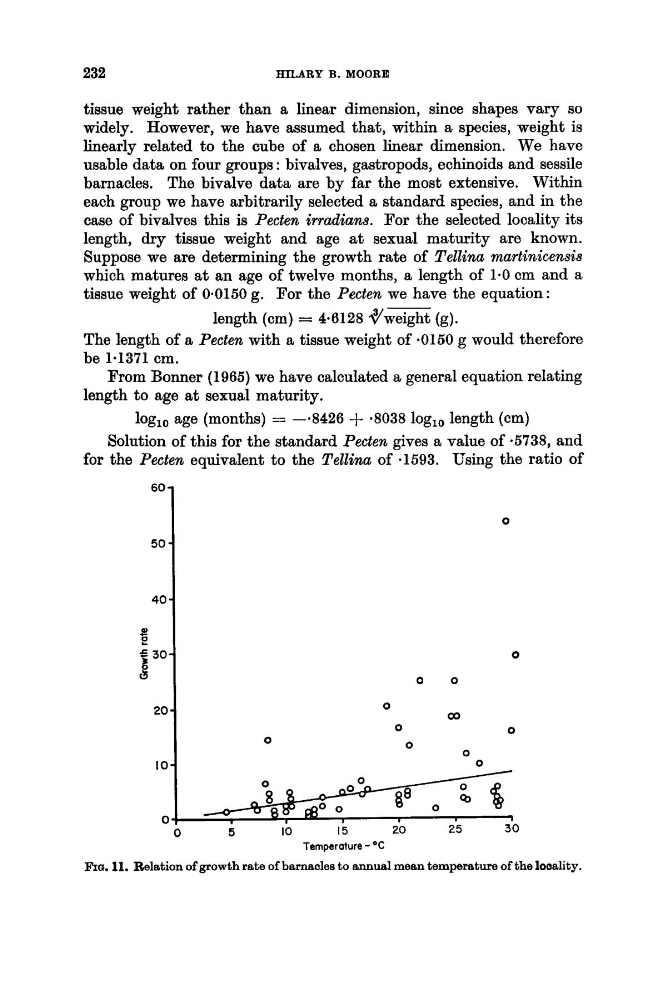
FIG. 11. Relation of growth rate of barnacles to annue;l mean temperature of the looality.
HILARY B. MOORE
60 -
50 -
40 -
B
. ,
f 30tissue weight rather than a linear dimension, since shapes vary so
widely. However, we have assumed that, within a species, weight is
linearly related to the cube of a chosen linear dimension. We have
usable data on four groups : bivalves, gastropods, echinoids and sessile
barnacles. The bivalve data are by far the most extensive. Within
each group we have arbitrarily selected a standard species, and in the
case of bivalves this is Pecten irradians. For the selected locality its
length, dry tissue weight and age at sexual maturity are known.
Suppose we are determining the growth rate of Tellina martinicensis
which matures at an age of twelve months, a length of 1.0 cm and a
tissue weight of 0.0150 g. For the Pecten we have the equation:
length (cm) = 4.6128 qweight (g).
The length of a Pecten with a tissue weight of -0160 g would therefore
be 1.1371 cm.
From Bonner (1966) we have calculated a general equation relating
length to age at sexual maturity.
log,, age (months) = -4426 + -8038 log,, length (cm)
Solution of this for the standard Pecten gives a value of ~5738, and
for the Pecten equivalent to the Tellina of -1693. Using the ratio of
“1
0
0
0
0
0
0
00
0
0
0
0
‘1 1 ,
0 0
0
0
0
5
1 0
15
20
25
30
Temperature - O C
FIG. 11. Relation of growth rate of barnacles to annue;l mean temperature of the looality.