

ASPEUTS OF STRESS IN THE TROPICAL MARINE ENVIRONMENT
223
1-9._ o 1.8a
E
? 1.70
.b
ln
1.51.4 T
to shore as possible. Both curves show the same trend of maximum tidal
range in temperate seas and very low values in polar seas. The range is
low in the tropics, with some increase at the highest temperatures,
although not to the temperate level.
For organisms living in the intertidal zone there is another aspect
of tidal differences which may be significant. A n attached or relatively
non-motile organism living other than near mid-tide level is subject not
only to the daily or twice daily alternation of exposure and immersion
but also to a twice monthly cycle of variation of the proportion of the
time it is immersed. I n the case of semidiurnal tides, the greater the
difference between spring and neap tidal ranges, the less stable the
1
2-01
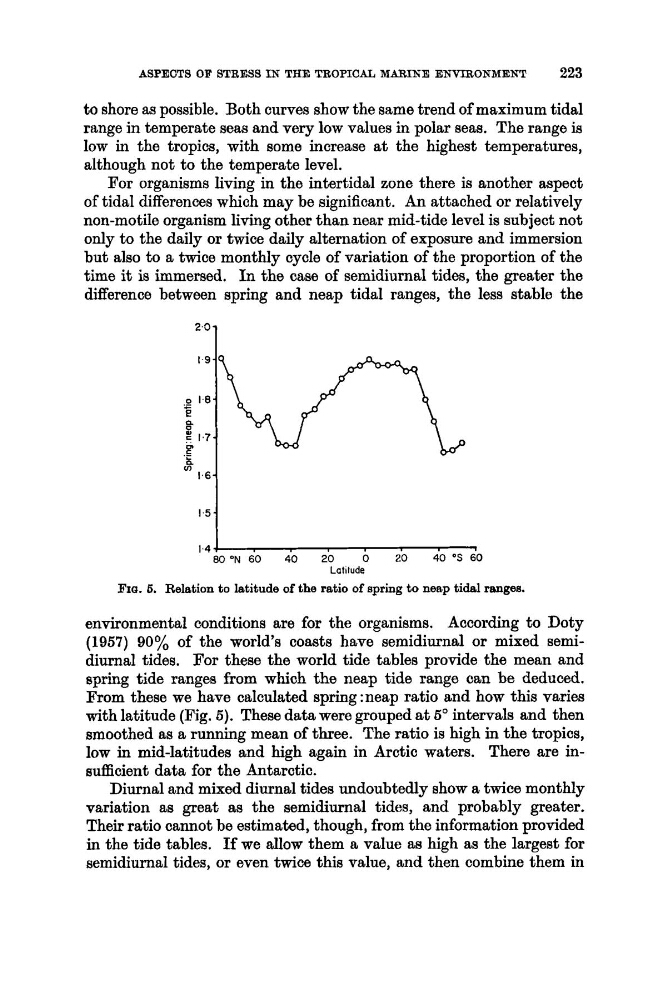
environmental conditions are for the organisms. According to Doty
(1967) 90% of the world's coasts have semidiurnal or mixed semidiurnal tides. For these the world tide tables provide the mean and
spring tide ranges from which the neap tide range can be deduced.
From these we have calculated spring : neap ratio and how this varies
with latitude (Fig. 6). These data were grouped at 6" intervals and then
smoothed as a running mean of three. The ratio is high in the tropics,
low in mid-latitudes and high again in Arctic waters. There are insufficient data for the Antarctic.
Diurnal and mixed diurnal tides undoubtedly show a twice monthly
variation as great as the semidiurnal tides, and probably greater.
Their ratio cannot be estimated, though, from the information provided
in the tide tables. If we allow them a value as high as the largest for
semidiurnal tides, or even twice this value, and then combine them in
223
1-9._ o 1.8a
E
? 1.70
.b
ln
1.51.4 T
to shore as possible. Both curves show the same trend of maximum tidal
range in temperate seas and very low values in polar seas. The range is
low in the tropics, with some increase at the highest temperatures,
although not to the temperate level.
For organisms living in the intertidal zone there is another aspect
of tidal differences which may be significant. A n attached or relatively
non-motile organism living other than near mid-tide level is subject not
only to the daily or twice daily alternation of exposure and immersion
but also to a twice monthly cycle of variation of the proportion of the
time it is immersed. I n the case of semidiurnal tides, the greater the
difference between spring and neap tidal ranges, the less stable the
1
2-01
environmental conditions are for the organisms. According to Doty
(1967) 90% of the world's coasts have semidiurnal or mixed semidiurnal tides. For these the world tide tables provide the mean and
spring tide ranges from which the neap tide range can be deduced.
From these we have calculated spring : neap ratio and how this varies
with latitude (Fig. 6). These data were grouped at 6" intervals and then
smoothed as a running mean of three. The ratio is high in the tropics,
low in mid-latitudes and high again in Arctic waters. There are insufficient data for the Antarctic.
Diurnal and mixed diurnal tides undoubtedly show a twice monthly
variation as great as the semidiurnal tides, and probably greater.
Their ratio cannot be estimated, though, from the information provided
in the tide tables. If we allow them a value as high as the largest for
semidiurnal tides, or even twice this value, and then combine them in