

A?STARUl'IU BBlNTHOS
137
algae. There are admittedly few species, although some belong to
peculiar, and as yet poorly understood genera. The contrast between
the extremely rich development of very large brown algae such as
Durviltea, Macrocystis and Lessonia forming a thick fringe around Subantarctic coasts and the bare ice-scoured rocks and white ice shelves of
the Antarctic, is of course obvious to all investigators.
Considering the collecting techniques available, and the fact that so
few algologists worked in the Antarctic, it is not surprising that knowledge was slowly gained.
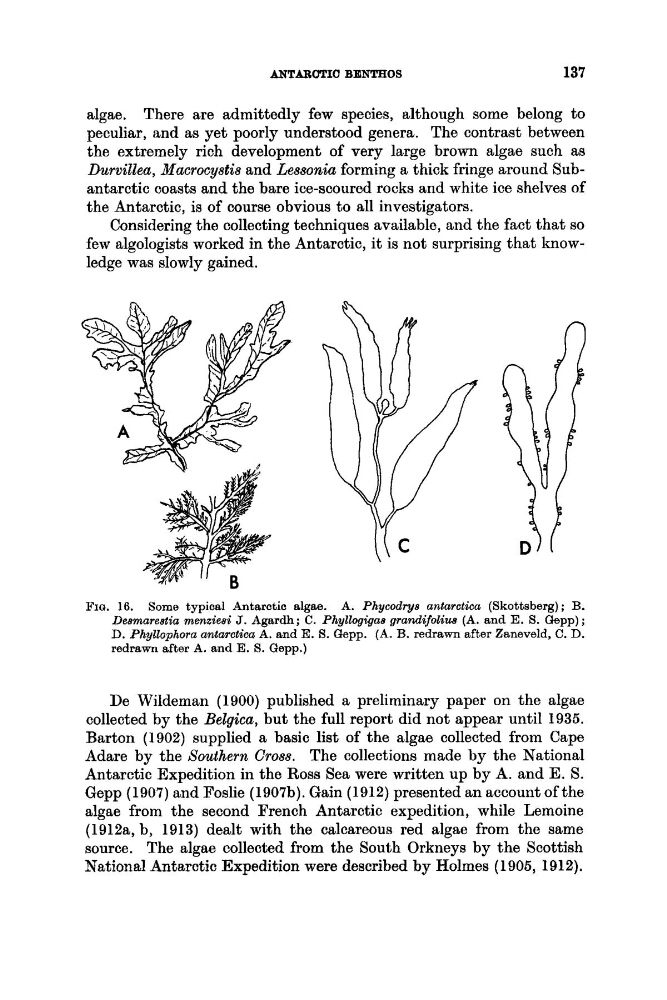
FIG. 16. Some typical Antarctic algae. A. Phycodrya antarctica (Skottsberg) ; B.
Deamarealia menzieai J. Agardh; C . Phyllogigaa grandijoliua (A. and E. S. Gepp) ;
D. ~ ~ y l ~ ~ ~ o ~ a
antarctica A. and E. 5. Gepp. (A. B. redrawn after Zaneveld, C. D.
redrawn after A. and E. S. Gepp.)
De Wildeman (1900) published a preliminary paper on the algae
collected by the Belgica, but the full report did not appear until 1935.
Barton (1902) supplied a basic list of the algae collected from Cape
Adare by the Southern Cross. The collections made by the National
Antarctic Expedition in the Ross Sea were written up by A. and E. S.
Gepp (1907) and Foslie (1907b). Gain (1912) presented an account of the
algae from the second French Antarctic expedition, while Lemoine
(1912a, b, 1913) dealt with the calcareous red algae from the same
source. The algae collected from the South Orkneys by the Scottish
National Antarctic Expedition were described by Holmes (1905, 1912).
137
algae. There are admittedly few species, although some belong to
peculiar, and as yet poorly understood genera. The contrast between
the extremely rich development of very large brown algae such as
Durviltea, Macrocystis and Lessonia forming a thick fringe around Subantarctic coasts and the bare ice-scoured rocks and white ice shelves of
the Antarctic, is of course obvious to all investigators.
Considering the collecting techniques available, and the fact that so
few algologists worked in the Antarctic, it is not surprising that knowledge was slowly gained.
FIG. 16. Some typical Antarctic algae. A. Phycodrya antarctica (Skottsberg) ; B.
Deamarealia menzieai J. Agardh; C . Phyllogigaa grandijoliua (A. and E. S. Gepp) ;
D. ~ ~ y l ~ ~ ~ o ~ a
antarctica A. and E. 5. Gepp. (A. B. redrawn after Zaneveld, C. D.
redrawn after A. and E. S. Gepp.)
De Wildeman (1900) published a preliminary paper on the algae
collected by the Belgica, but the full report did not appear until 1935.
Barton (1902) supplied a basic list of the algae collected from Cape
Adare by the Southern Cross. The collections made by the National
Antarctic Expedition in the Ross Sea were written up by A. and E. S.
Gepp (1907) and Foslie (1907b). Gain (1912) presented an account of the
algae from the second French Antarctic expedition, while Lemoine
(1912a, b, 1913) dealt with the calcareous red algae from the same
source. The algae collected from the South Orkneys by the Scottish
National Antarctic Expedition were described by Holmes (1905, 1912).