

ANTARCTfU BENTHOS
123
with I‘ white blood ” and the “ giant fish of the Antarctic ” are noted
in subsequent sections.
The fishes of South Georgia are treated incidentally in many of the
papers listed above. Contributions referring solely to South Georgia
have been Hubbs (1934), 01sen (1954, 1955) and Carrara (1955).
A valuable, well balanced account of the development of our
knowledge of Antarctic fishes was given by Andriashev (1965), followed
by a general account of the composition and distribution of the fauna.
The whole style of this contribution together with its carefully chosen
illustrations and bibliography make it a most useful source of information for the biologist who is not an expert on fishes.
1. Composition of the benthic fish fauna of Antarctica
(after Andriashev, 1965)
A relatively few families are represented in the Antarctic fauna
Family Myxinidae. One species of the hag fish Myxine has been
proper.
taken on one occasion near the South Shetlands.
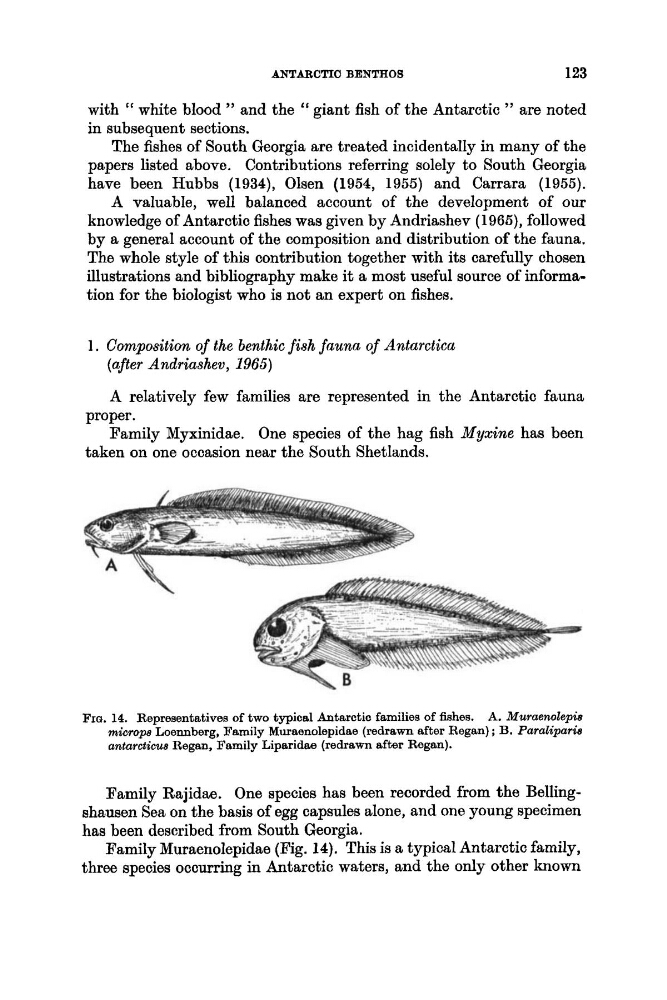
FIG. 14. Representatives of two typical Antarctic families of jishes. A. Muraenolepk
microp8 Loennberg, Family Muraenolepidae (redrawn after Regan) ; B. Paraliparb
antaTCtiCU8 Regan, Family Liparidae (redrawn after Regan).
Family Rajidae. One species has been recorded from the Bellingshausen Sea on the basis of egg capsules alone, and one young specimen
has been described from South Georgia.
Family Muraenolepidae (Fig. 14). This is a typical Antarctic family,
three species occurring in Antarctic waters, and the only other known
123
with I‘ white blood ” and the “ giant fish of the Antarctic ” are noted
in subsequent sections.
The fishes of South Georgia are treated incidentally in many of the
papers listed above. Contributions referring solely to South Georgia
have been Hubbs (1934), 01sen (1954, 1955) and Carrara (1955).
A valuable, well balanced account of the development of our
knowledge of Antarctic fishes was given by Andriashev (1965), followed
by a general account of the composition and distribution of the fauna.
The whole style of this contribution together with its carefully chosen
illustrations and bibliography make it a most useful source of information for the biologist who is not an expert on fishes.
1. Composition of the benthic fish fauna of Antarctica
(after Andriashev, 1965)
A relatively few families are represented in the Antarctic fauna
Family Myxinidae. One species of the hag fish Myxine has been
proper.
taken on one occasion near the South Shetlands.
FIG. 14. Representatives of two typical Antarctic families of jishes. A. Muraenolepk
microp8 Loennberg, Family Muraenolepidae (redrawn after Regan) ; B. Paraliparb
antaTCtiCU8 Regan, Family Liparidae (redrawn after Regan).
Family Rajidae. One species has been recorded from the Bellingshausen Sea on the basis of egg capsules alone, and one young specimen
has been described from South Georgia.
Family Muraenolepidae (Fig. 14). This is a typical Antarctic family,
three species occurring in Antarctic waters, and the only other known