

98
R. K. DELL
depth at which the outer limit of the shelf occurs elsewhere). Of these
41 species 22 have been found only in the area of the Antarctic Peninsula
and the South Shetlands, the only area close to the continent where
anything approaching a littoral fauna occurs. The proportion of Antarctic molluscs which can be considered exclusively shallow-water is
remarkably low. Of the 303 species considered, no less than 130 species
are confined to depths between 180 and 800 m and an additional 114
species span the depth of 180 m, occurring between some limit between
0 and 800m. This analysis shows the points often made concerning
the Antarctic fauna. There is a very small element confined to shallow
water. The archibenthal (or bathyal) fauna is extremely well represented (1 80-800 m). The element in the fauna which may be considered
either as shelf species which have invaded the slope, or slope species
which have invaded the shelf, is remarkably high.
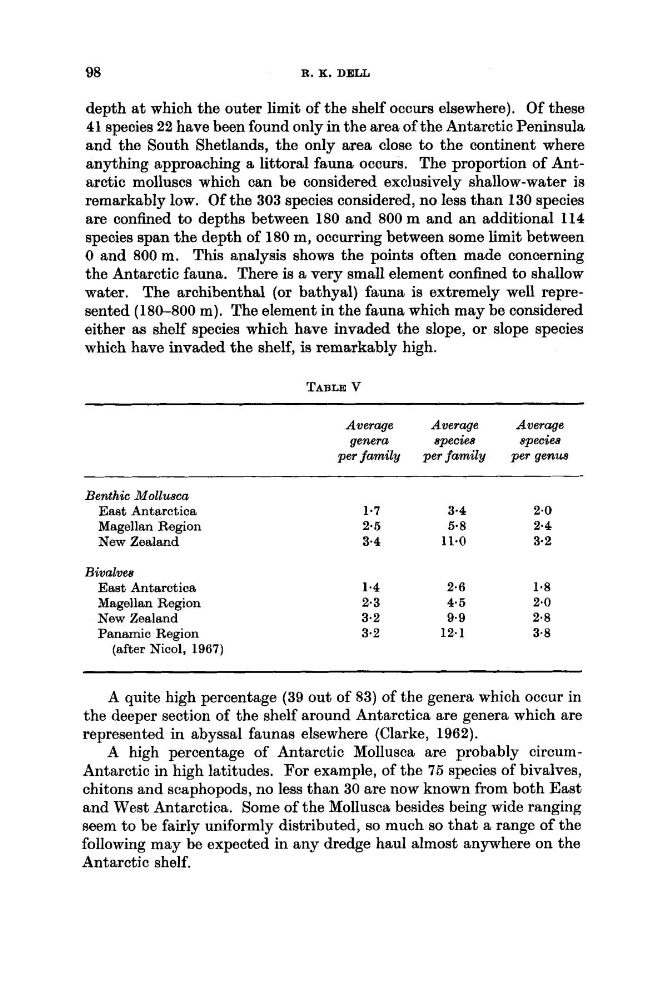
TABLE V
Average
Average
Average
per family
per family
per genus
genera
~peciea
8PpeCie-9
Benthic Mollusca
East Antarctica
Magellan Region
New Zealand
Bivalves
East Antarctica
Magellan Region
New Zealand
Panamic Region
(after Nicol, 1967)
1.7
3-4
2.0
2.5
5.8
2.4
3.4
11.0
3.2
1.4
2.6
1.8
2.3
4.5
2.0
3.2
9.9
2.8
3.2
12.1
3.8
A quite high percentage (39 out of 83) of the genera which occur in
the deeper section of the shelf around Antarctica are genera which are
represented in abyssal faunas elsewhere (Clarke, 1962).
A high percentage of Antarctic Mollusca are probably circumAntarctic in high latitudes. For example, of the 75 species of bivalves,
chitons and scaphopods, no less than 30 are now known from both East
and West Antarctica. Some of the Mollusca besides being wide ranging
seem to be fairly uniformly distributed, so much so that a range of the
following may be expected in any dredge haul almost anywhere on the
Antarctic shelf.
R. K. DELL
depth at which the outer limit of the shelf occurs elsewhere). Of these
41 species 22 have been found only in the area of the Antarctic Peninsula
and the South Shetlands, the only area close to the continent where
anything approaching a littoral fauna occurs. The proportion of Antarctic molluscs which can be considered exclusively shallow-water is
remarkably low. Of the 303 species considered, no less than 130 species
are confined to depths between 180 and 800 m and an additional 114
species span the depth of 180 m, occurring between some limit between
0 and 800m. This analysis shows the points often made concerning
the Antarctic fauna. There is a very small element confined to shallow
water. The archibenthal (or bathyal) fauna is extremely well represented (1 80-800 m). The element in the fauna which may be considered
either as shelf species which have invaded the slope, or slope species
which have invaded the shelf, is remarkably high.
TABLE V
Average
Average
Average
per family
per family
per genus
genera
~peciea
8PpeCie-9
Benthic Mollusca
East Antarctica
Magellan Region
New Zealand
Bivalves
East Antarctica
Magellan Region
New Zealand
Panamic Region
(after Nicol, 1967)
1.7
3-4
2.0
2.5
5.8
2.4
3.4
11.0
3.2
1.4
2.6
1.8
2.3
4.5
2.0
3.2
9.9
2.8
3.2
12.1
3.8
A quite high percentage (39 out of 83) of the genera which occur in
the deeper section of the shelf around Antarctica are genera which are
represented in abyssal faunas elsewhere (Clarke, 1962).
A high percentage of Antarctic Mollusca are probably circumAntarctic in high latitudes. For example, of the 75 species of bivalves,
chitons and scaphopods, no less than 30 are now known from both East
and West Antarctica. Some of the Mollusca besides being wide ranging
seem to be fairly uniformly distributed, so much so that a range of the
following may be expected in any dredge haul almost anywhere on the
Antarctic shelf.