

THE BIOLOGY OF ASCIDIANS
43
certainly withstands salinities lower than the 23%, recorded since it has
been taken from parts of the St. Lucie estuary, Florida, with values as
low as lo%,, and even lower at certain tidal states (Gunter and Hall,
1963). Other species known to survive diluted sea water are Ecteinascidia turbinuta Herdman, found by Calder et al. (1966) at 22-47%, and
Styeb coriacea which withstands 15%, (Diehl, 1957). S. coriacea and
Dendroha grossularia live and breed in the Baltic Sea at a salinity
of about 12%, (Dybern, 1969~). According to C. Monniot (1965s)
pyurid species are excluded from areas with salinities below about
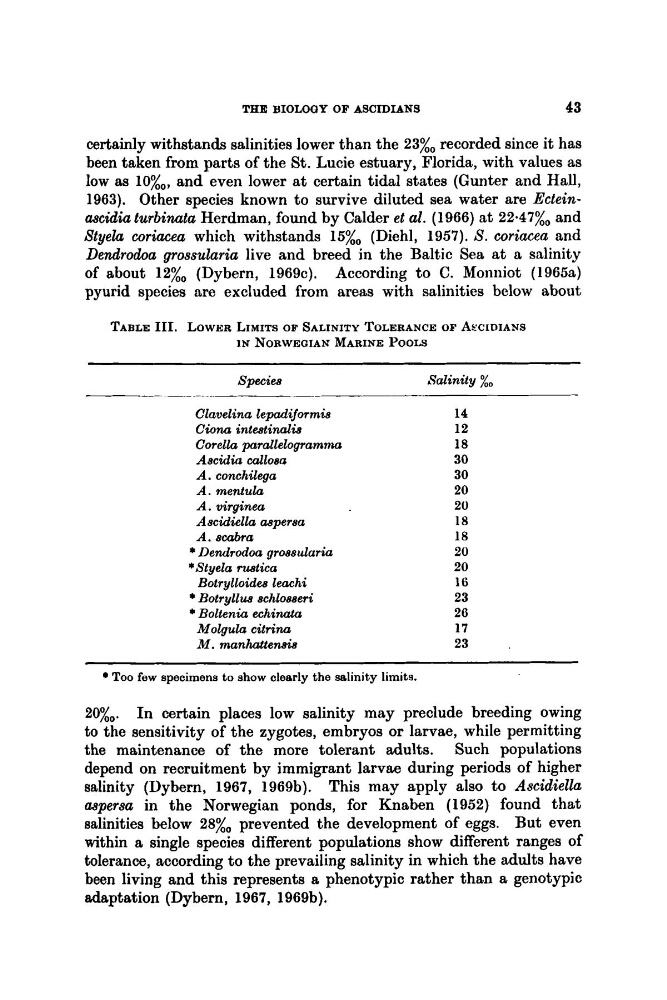
TABLE 111. LOWER LIMITS OF SALINITY TOLERANCE OF AVCIDIANS
IN NORWEQIAN MARINE POOLS
~~
specie.
Salinity x0
Clavelina lepadijormia
Cwna inteatinalie
Corella parallelogramma
Ascidia callosa
A . conchilega
A . mentula
A . virginea
Ascidiella aapersa
A . scubra
* Dendrodoa grossularia
*Styela ruatica
Botrylloides leachi
* Botryllua schlosseri
* Boltenia echinata
Molgula citrina
M . manhatten&
14
12
18
30
30
20
20
18
18
20
20
16
23
26
17
23
~
~~
~~~
~
Too few specimens to show clearly the salinity limits.
20%,. In certain places low salinity may preclude breeding owing
to the sensitivity of the zygotes, embryos or larvae, while permitting
the maintenance of the more tolerant adults. Such populations
depend on recruitment by immigrant larvae during periods of higher
salinity (Dybern, 1967, 196913). This may apply also to Ascidiella
mpersa in the Norwegian ponds, for Knaben (1952) found that
salinities below 28%, prevented the development of eggs. But even
within a single species different populations show different ranges of
tolerance, according to the prevailing salinity in which the adults have
been living and this represents a phenotypic rather than a genotypic
adaptation (Dybern, 1967, 1969b).
43
certainly withstands salinities lower than the 23%, recorded since it has
been taken from parts of the St. Lucie estuary, Florida, with values as
low as lo%,, and even lower at certain tidal states (Gunter and Hall,
1963). Other species known to survive diluted sea water are Ecteinascidia turbinuta Herdman, found by Calder et al. (1966) at 22-47%, and
Styeb coriacea which withstands 15%, (Diehl, 1957). S. coriacea and
Dendroha grossularia live and breed in the Baltic Sea at a salinity
of about 12%, (Dybern, 1969~). According to C. Monniot (1965s)
pyurid species are excluded from areas with salinities below about
TABLE 111. LOWER LIMITS OF SALINITY TOLERANCE OF AVCIDIANS
IN NORWEQIAN MARINE POOLS
~~
specie.
Salinity x0
Clavelina lepadijormia
Cwna inteatinalie
Corella parallelogramma
Ascidia callosa
A . conchilega
A . mentula
A . virginea
Ascidiella aapersa
A . scubra
* Dendrodoa grossularia
*Styela ruatica
Botrylloides leachi
* Botryllua schlosseri
* Boltenia echinata
Molgula citrina
M . manhatten&
14
12
18
30
30
20
20
18
18
20
20
16
23
26
17
23
~
~~
~~~
~
Too few specimens to show clearly the salinity limits.
20%,. In certain places low salinity may preclude breeding owing
to the sensitivity of the zygotes, embryos or larvae, while permitting
the maintenance of the more tolerant adults. Such populations
depend on recruitment by immigrant larvae during periods of higher
salinity (Dybern, 1967, 196913). This may apply also to Ascidiella
mpersa in the Norwegian ponds, for Knaben (1952) found that
salinities below 28%, prevented the development of eggs. But even
within a single species different populations show different ranges of
tolerance, according to the prevailing salinity in which the adults have
been living and this represents a phenotypic rather than a genotypic
adaptation (Dybern, 1967, 1969b).