

THE BIOLOGY OF WOOD-BORING TEREDINID MOLLUSCS
463
Watson et aZ. (1936) and Clapp (1946) who found correlations between
fouling and borer infestation, the former inhibiting the settlement of
borers by serving either as a mechanical barrier for shipworm larvae or
by utilizing them as food. Of the different groups o i fouling organisms,
the barnacles are perhaps the most effective agents hindering attachment of shipworm larvae (Anon, 1943; Redgrave, 1920; Von Schrenk,
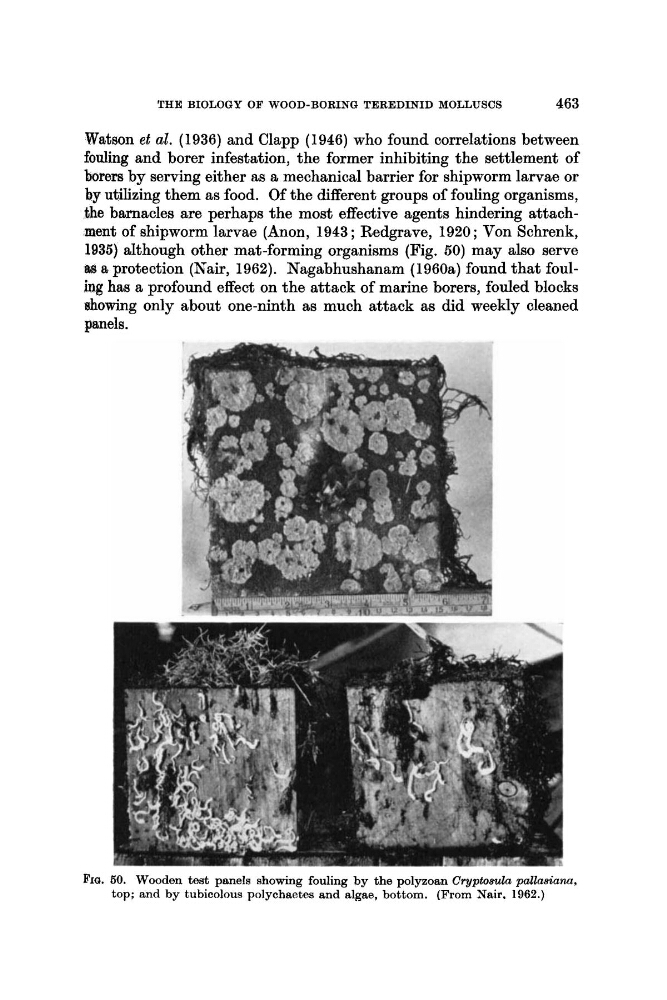
1935) although other mat-forming organisms (Fig. 50) may also serve
t w a protection (Nair, 1962). Nagabhushanam (1960a) found that fouling has a profound effect on the attack of marine borers, fouled blocks
ehowing only about one-ninth as much attack as did weekly cleaned
panels.
ha. 60. Wooden test panels showing fouling by the polyzoan Cryptosula pallasiana,
top; and by tubioolous polychaetes and algae, bottom. (From Nair. 1962.)
463
Watson et aZ. (1936) and Clapp (1946) who found correlations between
fouling and borer infestation, the former inhibiting the settlement of
borers by serving either as a mechanical barrier for shipworm larvae or
by utilizing them as food. Of the different groups o i fouling organisms,
the barnacles are perhaps the most effective agents hindering attachment of shipworm larvae (Anon, 1943; Redgrave, 1920; Von Schrenk,
1935) although other mat-forming organisms (Fig. 50) may also serve
t w a protection (Nair, 1962). Nagabhushanam (1960a) found that fouling has a profound effect on the attack of marine borers, fouled blocks
ehowing only about one-ninth as much attack as did weekly cleaned
panels.
ha. 60. Wooden test panels showing fouling by the polyzoan Cryptosula pallasiana,
top; and by tubioolous polychaetes and algae, bottom. (From Nair. 1962.)