

THE BIOLOGY OF ASCIDIANS
33
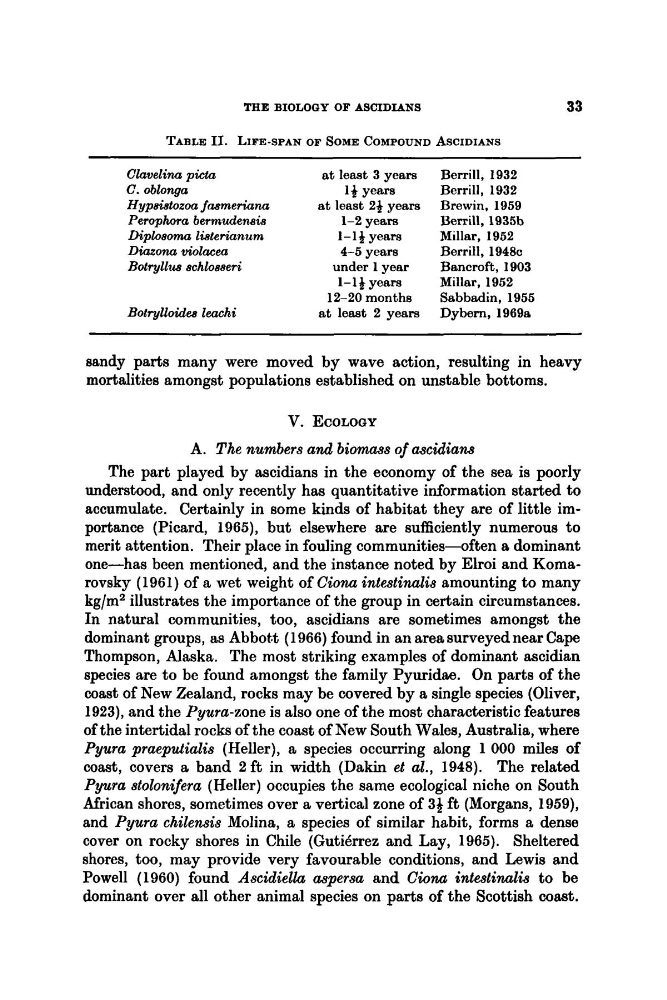
TABLE 11. LIFE-SPAN OF SOME COMPOUND ASCIDIANS
Clavelinu picta
C . oblonga
Hyp8iatozoa faameriuna
Perophota bermdensis
D i p l o e m lblerianum
Diazona violacea
Bott$h sch~oeseri
Botrylloidea leachi
at least 3 years
13 years
at least 24 years
1-2 years
1-1+ years
4-5 years
under 1 year
1- 1 + years
12-20 months
at least 2 years
Berrill, 1932
Berrill, 1932
Brewin, 1959
Berrill, 1935b
Millar, 1952
Berrill, 194%
Bancroft, 1903
Millar, 1952
Sabbadin, 1955
Dybern, 1969s
sandy parts many were moved by wave action, resulting in heavy
mortalities amongst populations established on unstable bottoms.
V. ECOLOGY
A. The numbers and biomass of mcidians
The part played by ascidians in the economy of the sea is poorly
understood, and only recently has quantitative information started to
accumulate. Certainly in some kinds of habitat they are of little importance (Picard, 1965), but elsewhere are sufficiently numerous to
merit attention. Their place in fouling communities-often a dominant
one-has been mentioned, and the instance noted by Elroi and Komarovsky (1961) of a wet weight of Ciona intestinulis amounting to many
kg/m2 illustrates the importance of the group in certain circumstances.
In natural communities, too, ascidians are sometimes amongst the
dominant groups, as Abbott (1 966) found in an area surveyed near Cape
Thompson, Alaska. The most striking examples of dominant ascidian
species are to be found amongst the family Pyuridaa. On parts of the
coast of New Zealand, rocks may be covered by a single species (Oliver,
1923), and the Pyura-zone is also one of the most characteristic features
of the intertidal rocks of the coast of New South Wales, Australia, where
Pyura praeputialis (Heller), a species occurring along 1 000 miles of
coast, covers a band 2 f t in width (Dakin et al., 1948). The related
Pyura stolonifera (Heller) occupies the same ecological niche on South
African shores, sometimes over a vertical zone of 34 ft (Morgans, 1959),
and Pyura chilensis Molina, a species of similar habit, forms a dense
cover on rocky shores in Chile (Gutihez and Lay, 1965). Sheltered
shores, too, may provide very favourable conditions, and Lewis and
Powell (1960) found Ascidiella aspersa and Ciom intestidis to be
dominant over all other animal species on parts of the Scottish coast.
33
TABLE 11. LIFE-SPAN OF SOME COMPOUND ASCIDIANS
Clavelinu picta
C . oblonga
Hyp8iatozoa faameriuna
Perophota bermdensis
D i p l o e m lblerianum
Diazona violacea
Bott$h sch~oeseri
Botrylloidea leachi
at least 3 years
13 years
at least 24 years
1-2 years
1-1+ years
4-5 years
under 1 year
1- 1 + years
12-20 months
at least 2 years
Berrill, 1932
Berrill, 1932
Brewin, 1959
Berrill, 1935b
Millar, 1952
Berrill, 194%
Bancroft, 1903
Millar, 1952
Sabbadin, 1955
Dybern, 1969s
sandy parts many were moved by wave action, resulting in heavy
mortalities amongst populations established on unstable bottoms.
V. ECOLOGY
A. The numbers and biomass of mcidians
The part played by ascidians in the economy of the sea is poorly
understood, and only recently has quantitative information started to
accumulate. Certainly in some kinds of habitat they are of little importance (Picard, 1965), but elsewhere are sufficiently numerous to
merit attention. Their place in fouling communities-often a dominant
one-has been mentioned, and the instance noted by Elroi and Komarovsky (1961) of a wet weight of Ciona intestinulis amounting to many
kg/m2 illustrates the importance of the group in certain circumstances.
In natural communities, too, ascidians are sometimes amongst the
dominant groups, as Abbott (1 966) found in an area surveyed near Cape
Thompson, Alaska. The most striking examples of dominant ascidian
species are to be found amongst the family Pyuridaa. On parts of the
coast of New Zealand, rocks may be covered by a single species (Oliver,
1923), and the Pyura-zone is also one of the most characteristic features
of the intertidal rocks of the coast of New South Wales, Australia, where
Pyura praeputialis (Heller), a species occurring along 1 000 miles of
coast, covers a band 2 f t in width (Dakin et al., 1948). The related
Pyura stolonifera (Heller) occupies the same ecological niche on South
African shores, sometimes over a vertical zone of 34 ft (Morgans, 1959),
and Pyura chilensis Molina, a species of similar habit, forms a dense
cover on rocky shores in Chile (Gutihez and Lay, 1965). Sheltered
shores, too, may provide very favourable conditions, and Lewis and
Powell (1960) found Ascidiella aspersa and Ciom intestidis to be
dominant over all other animal species on parts of the Scottish coast.