

TEE BIOLOGY OF WOOD-BORING TEREDINID MOLLUSCS
405
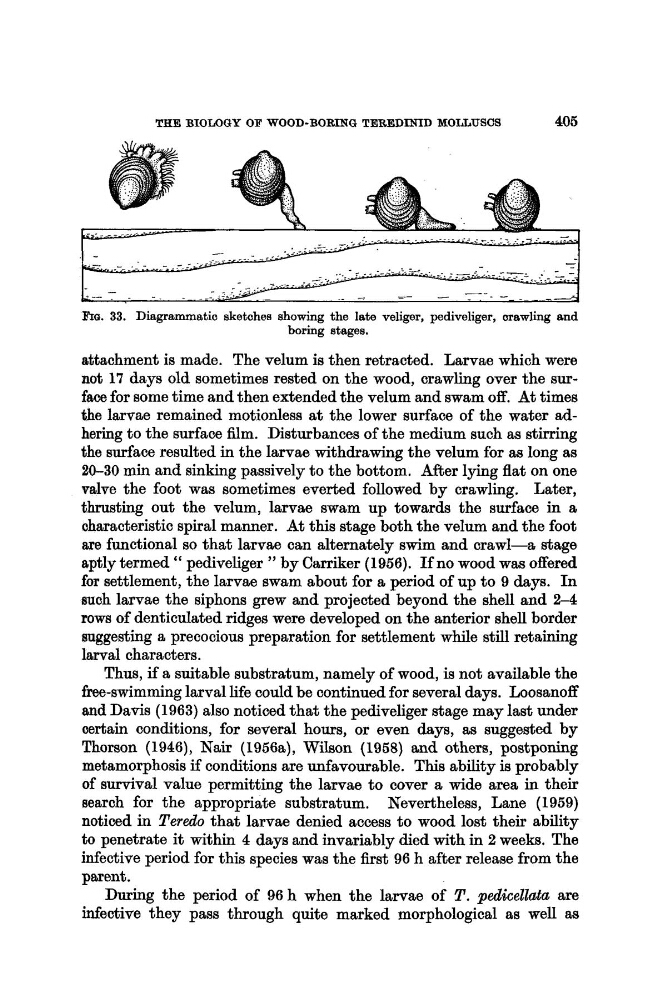
FIG. 33. Diagrammatic sketches showing the late veliger, pediveliger, arawling and
boring stages.
attachment is made. The velum is then retracted. Larvae which were
not 17 days old sometimes rested on the wood, crawling over the surface for some time and then extended the velum and swam off. At times
the larvae remained motionless at the lower surface of the water adhering to the surface film. Disturbances of the medium such as stirring
the surface resulted in the larvae withdrawing the velum for as long as
20-30 min and sinking passively to the bottom. After lying flat on one
valve the foot was sometimes everted followed by crawling. Later,
thrusting out the velum, larvae swam up towards the surface in a
characteristic spiral manner. At this stage both the velum and the foot
are functional so that larvae can alternately swim and crawl-a stage
aptly termed " pediveliger " by Carriker (1956). If no wood was offered
for settlement, the larvae swam about for a period of up to 9 days. I n
such larvae the siphons grew and projected beyond the shell and 2-4
rows of denticulated ridges were developed on the anterior shell border
suggesting a precocious preparation for settlement while still retaining
larval characters.
Thus, if a suitable substratum, namely of wood, is not available the
free-swimming larval life could be continued for several days. Loosanoff
and Davis (1963) also noticed that the pediveliger stage may last under
certain conditions, for several hours, or even days, as suggested by
Thorson (1946), Nair (1956a), Wilson (1958) and others, postponing
metamorphosis if conditions are unfavourable. This ability is probably
of survival value permitting the larvae to cover a wide area in their
search for the appropriate substratum. Nevertheless, Lane (1959)
noticed in Teredo that larvae denied access to wood lost their ability
to penetrate it within 4 days and invariably died with in 2 weeks. The
infective period for this species was the first 96 h after release from the
parent.
During the period of 96 h when the larvae of T . pedicellata are
infective they pass through quite marked morphological as well as
405
FIG. 33. Diagrammatic sketches showing the late veliger, pediveliger, arawling and
boring stages.
attachment is made. The velum is then retracted. Larvae which were
not 17 days old sometimes rested on the wood, crawling over the surface for some time and then extended the velum and swam off. At times
the larvae remained motionless at the lower surface of the water adhering to the surface film. Disturbances of the medium such as stirring
the surface resulted in the larvae withdrawing the velum for as long as
20-30 min and sinking passively to the bottom. After lying flat on one
valve the foot was sometimes everted followed by crawling. Later,
thrusting out the velum, larvae swam up towards the surface in a
characteristic spiral manner. At this stage both the velum and the foot
are functional so that larvae can alternately swim and crawl-a stage
aptly termed " pediveliger " by Carriker (1956). If no wood was offered
for settlement, the larvae swam about for a period of up to 9 days. I n
such larvae the siphons grew and projected beyond the shell and 2-4
rows of denticulated ridges were developed on the anterior shell border
suggesting a precocious preparation for settlement while still retaining
larval characters.
Thus, if a suitable substratum, namely of wood, is not available the
free-swimming larval life could be continued for several days. Loosanoff
and Davis (1963) also noticed that the pediveliger stage may last under
certain conditions, for several hours, or even days, as suggested by
Thorson (1946), Nair (1956a), Wilson (1958) and others, postponing
metamorphosis if conditions are unfavourable. This ability is probably
of survival value permitting the larvae to cover a wide area in their
search for the appropriate substratum. Nevertheless, Lane (1959)
noticed in Teredo that larvae denied access to wood lost their ability
to penetrate it within 4 days and invariably died with in 2 weeks. The
infective period for this species was the first 96 h after release from the
parent.
During the period of 96 h when the larvae of T . pedicellata are
infective they pass through quite marked morphological as well as