

26
R. H. MlLLAR
only 1-3 cm in 45 days, but later in the summer grew to 4-5 cm in the
same time. Similarly, Corella willmerianu in coastal waters of Washington, U.S.A., completes its life in 5 months if it settles in time to grow
rapidly during summer but takes 7-8 months if growing more slowly in
winter (Lambert, 1968). Under favourable conditions, growth to sexual
maturity is rapid, and specimens of Molgula manhattensis only three
weeks old can release eggs (Grave, 1933). Faster growth, earlier death,
and a quicker succession of generations appear to be characteristic of life
in warm water and, in the almost total absence of information on available food, temperature is justifiably regarded as of priinc importance.
In British waters Cionu lives for 12-18 months (Orton, 1914, 1920;
Millar, 1952), but in the tropics for only a few months and in sub-Arctic
waters probably for a few years (Dybern, 1965). Curiously enough it is
known to survive for two or more years at Marseilles (PkrAs, 1946) and
at Millport, Scotland, young specimens brought in from the sea lived in
the aquarium to an age of about 38 years (personal unpublished record).
Other solitary ascidians have been less studied but appear to have
similar life cycles. Ascidiella aspersa (Miiller) lives for 12-18 months in
British waters (Millar, 1952; Gage, 1966), but on the Norwegian coast
its life varies from one to three years, according to water temperature
(Dybern, 1969a). Corella parallelogramma is also essentially an annual,
but Ascidia mentula Muller may live for at least three years (Dybern,
1969a). Millar (1954b) found that Dendrodoa grossuluria has a life span
of 18-24 months on British coasts, and that three generations arc
simultaneously present in the population. The maximum age of
Styela coriacea is about 20 months, and three or four generations are
produced annually (Diehl, 1957).
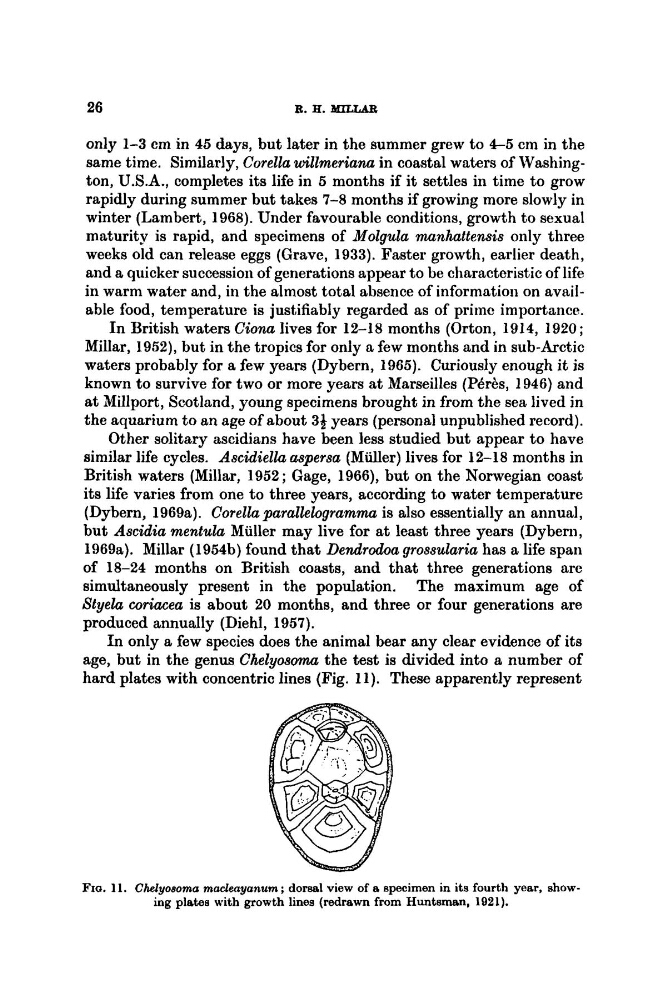
In only a few species does the animal bear any clear evidence of its
age, but in the genus Chelyosoma the test is divided into a number of
hard plates with concentric lines (Fig. 11). These apparently represent
Fro. 11. Cklyosorno rnacleayanvrn ; dorsal view of e specimen in its fourth year, showing plates with growth lines (redrawn from Huntsman, 1921).
R. H. MlLLAR
only 1-3 cm in 45 days, but later in the summer grew to 4-5 cm in the
same time. Similarly, Corella willmerianu in coastal waters of Washington, U.S.A., completes its life in 5 months if it settles in time to grow
rapidly during summer but takes 7-8 months if growing more slowly in
winter (Lambert, 1968). Under favourable conditions, growth to sexual
maturity is rapid, and specimens of Molgula manhattensis only three
weeks old can release eggs (Grave, 1933). Faster growth, earlier death,
and a quicker succession of generations appear to be characteristic of life
in warm water and, in the almost total absence of information on available food, temperature is justifiably regarded as of priinc importance.
In British waters Cionu lives for 12-18 months (Orton, 1914, 1920;
Millar, 1952), but in the tropics for only a few months and in sub-Arctic
waters probably for a few years (Dybern, 1965). Curiously enough it is
known to survive for two or more years at Marseilles (PkrAs, 1946) and
at Millport, Scotland, young specimens brought in from the sea lived in
the aquarium to an age of about 38 years (personal unpublished record).
Other solitary ascidians have been less studied but appear to have
similar life cycles. Ascidiella aspersa (Miiller) lives for 12-18 months in
British waters (Millar, 1952; Gage, 1966), but on the Norwegian coast
its life varies from one to three years, according to water temperature
(Dybern, 1969a). Corella parallelogramma is also essentially an annual,
but Ascidia mentula Muller may live for at least three years (Dybern,
1969a). Millar (1954b) found that Dendrodoa grossuluria has a life span
of 18-24 months on British coasts, and that three generations arc
simultaneously present in the population. The maximum age of
Styela coriacea is about 20 months, and three or four generations are
produced annually (Diehl, 1957).
In only a few species does the animal bear any clear evidence of its
age, but in the genus Chelyosoma the test is divided into a number of
hard plates with concentric lines (Fig. 11). These apparently represent
Fro. 11. Cklyosorno rnacleayanvrn ; dorsal view of e specimen in its fourth year, showing plates with growth lines (redrawn from Huntsman, 1921).