

380
I?. BALAKRISHNAN NAIR AND M. SARASWATHY
than a septum between the inhalant and exhalant chambers (Turner,
1966). The descending lamellae extend almost horizontally in Teredo
norvegica instead of downwards as in Bankia gouldi (Sigerfoos, 1908)
and in Teredo megotara (Purchon, 1941). I n Nausitora hedleyi, conditions are generally similar to those in Teredo megotara even though
the descending lamellae pass outwards. The marginal groove, though
reported in all species studied in detail, varies. In some it is deep and
well defined, in others like Nausitora hedleyi it is very shallow and too
insignificant to appear in transverse sections. In Xylophaga also the
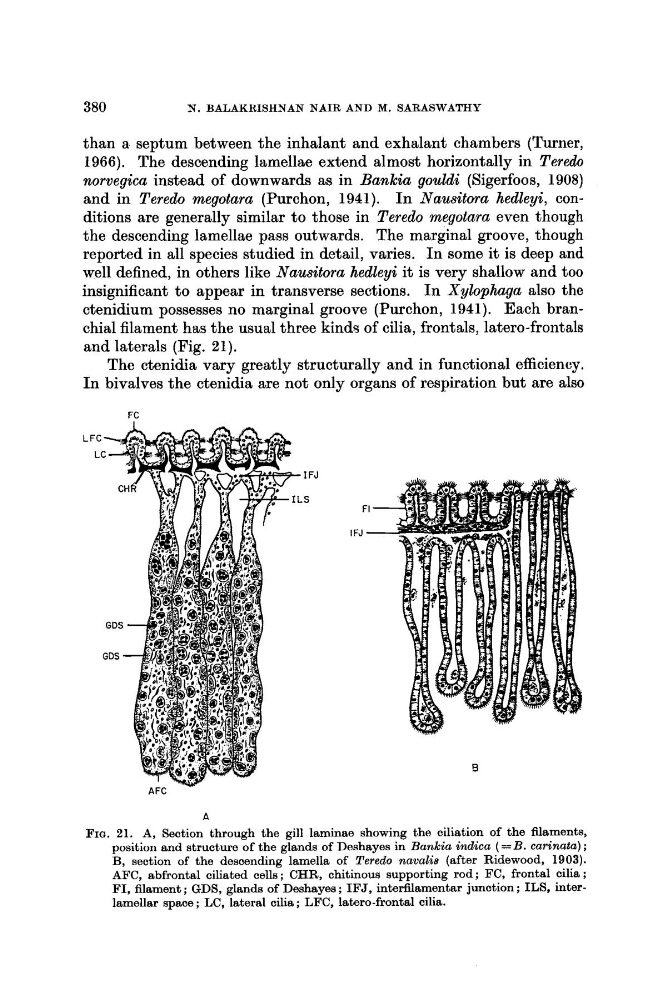
ctenidium possesses no marginal groove (Purchon, 1941). Each branchial filament has the usual three kinds of cilia, frontals, latero-frontals
and laterals (Fig. 21).
The ctenidia vary greatly structurally and in functional eficiency.
In bivalves the ctenidia are not only organs of respiration but are also
FC
, I F J
.s
FI
IFJ -
A
FIG. 21. A, Section through the gill laminae showing the ciliation of the filaments,
position and structure of the glands of Deshayes in Bankia indica ( = B. carinata) ;
B, section of the descending lamella of Teredo navalis (after Ridewood, 1903).
AFC, abfrontal ciliated cells; CHR, chitinous supporting rod; FC, frontal cilia ;
FI, filament; GDS, glands of Deshayes; IFJ, interfilamentar junction; ILS, interlamellar space ; LC, lateral cilia ; LFC, latero-frontal cilia.
I?. BALAKRISHNAN NAIR AND M. SARASWATHY
than a septum between the inhalant and exhalant chambers (Turner,
1966). The descending lamellae extend almost horizontally in Teredo
norvegica instead of downwards as in Bankia gouldi (Sigerfoos, 1908)
and in Teredo megotara (Purchon, 1941). I n Nausitora hedleyi, conditions are generally similar to those in Teredo megotara even though
the descending lamellae pass outwards. The marginal groove, though
reported in all species studied in detail, varies. In some it is deep and
well defined, in others like Nausitora hedleyi it is very shallow and too
insignificant to appear in transverse sections. In Xylophaga also the
ctenidium possesses no marginal groove (Purchon, 1941). Each branchial filament has the usual three kinds of cilia, frontals, latero-frontals
and laterals (Fig. 21).
The ctenidia vary greatly structurally and in functional eficiency.
In bivalves the ctenidia are not only organs of respiration but are also
FC
, I F J
.s
FI
IFJ -
A
FIG. 21. A, Section through the gill laminae showing the ciliation of the filaments,
position and structure of the glands of Deshayes in Bankia indica ( = B. carinata) ;
B, section of the descending lamella of Teredo navalis (after Ridewood, 1903).
AFC, abfrontal ciliated cells; CHR, chitinous supporting rod; FC, frontal cilia ;
FI, filament; GDS, glands of Deshayes; IFJ, interfilamentar junction; ILS, interlamellar space ; LC, lateral cilia ; LFC, latero-frontal cilia.