

THE BIOLOGY OF WOOD-BOBING TEREDINID MOLLUSCS
373
Bankia indica, Nausitora hedleyi, Teredo furcifera and Teredora gregoreyli
(= Teredora princesae) are given by Nair (1957a), and Saraswathy and
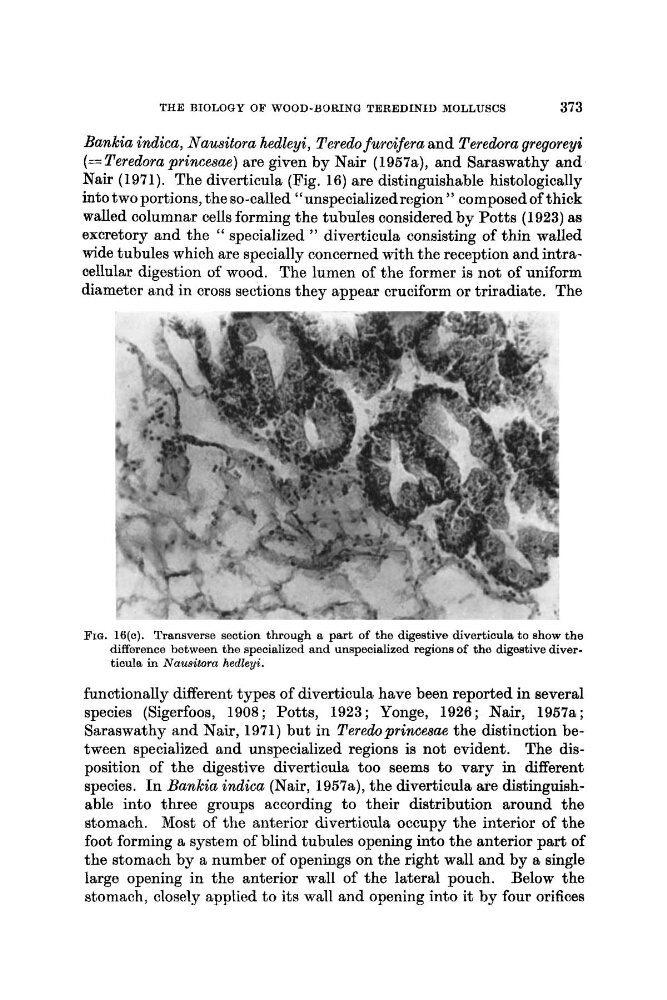
Nair (1971). The diverticula (Fig. 16) are distinguishable histologically
into two portions, the so-called “unspecializedregion ” composed of thick
walled columnar cells forming the tubules considered by Potts (1923) as
excretory and the “ specialized ” diverticula consisting of thin walled
wide tubules which are specially concerned with the reception and intracellular digestion of wood. The lumen of the former is not of uniform
diameter and in cross sections they appear cruciform or triradiate. The
FIG. 16(c). Transverse section through a part of the digestive diverticula to show the
difference hetween the specialized and unspecialized regions of the digestive diverticula in Nuusitom hedleyi.
functionally different types of diverticula have been reported in several
species (Sigerfoos, 1908 ; Potts, 1923 ; Yonge, 1926 ; Nair, 1957a ;
Saraswathy and Nair, 1971) but in Teredoprincesue the distinction between specialized and unspecialized regions is not evident. The disposition of the digestive diverticula too seems to vary in different
species. In Bankia indica (Nair, 1957a), the diverticula are distinguishable into three groups according to their distribution around the
stomach. Most of the anterior diverticula occupy the interior of the
foot forming a system of blind tubules opening in%o the anterior part of
the stomach by a number of openings on the right wall and by a single
large opening in the anterior wall of the lateral pouch. Below the
stomach, closely applied to its wall and opening into it by four orifices
373
Bankia indica, Nausitora hedleyi, Teredo furcifera and Teredora gregoreyli
(= Teredora princesae) are given by Nair (1957a), and Saraswathy and
Nair (1971). The diverticula (Fig. 16) are distinguishable histologically
into two portions, the so-called “unspecializedregion ” composed of thick
walled columnar cells forming the tubules considered by Potts (1923) as
excretory and the “ specialized ” diverticula consisting of thin walled
wide tubules which are specially concerned with the reception and intracellular digestion of wood. The lumen of the former is not of uniform
diameter and in cross sections they appear cruciform or triradiate. The
FIG. 16(c). Transverse section through a part of the digestive diverticula to show the
difference hetween the specialized and unspecialized regions of the digestive diverticula in Nuusitom hedleyi.
functionally different types of diverticula have been reported in several
species (Sigerfoos, 1908 ; Potts, 1923 ; Yonge, 1926 ; Nair, 1957a ;
Saraswathy and Nair, 1971) but in Teredoprincesue the distinction between specialized and unspecialized regions is not evident. The disposition of the digestive diverticula too seems to vary in different
species. In Bankia indica (Nair, 1957a), the diverticula are distinguishable into three groups according to their distribution around the
stomach. Most of the anterior diverticula occupy the interior of the
foot forming a system of blind tubules opening in%o the anterior part of
the stomach by a number of openings on the right wall and by a single
large opening in the anterior wall of the lateral pouch. Below the
stomach, closely applied to its wall and opening into it by four orifices