

THE BIOLOGY OB WOOD-BORING TEREDINID MOLLUSCS
363
In Teredothyra and Lyrodus massa the stalk extends only to the base of
the inner element and is usually hollow (Turner,. 1966).
4. T h e calcareous lining
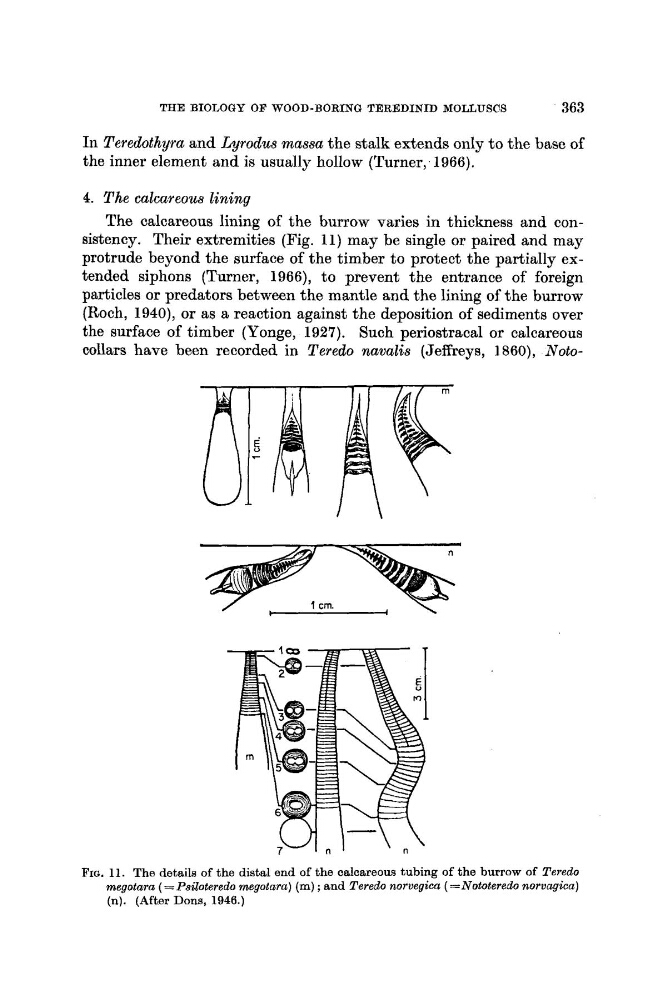
The calcareous lining of the burrow varies in thickness and consistency. Their extremities (Fig. 11) may be single or paired and may
protrude beyond the surface of the timber to protect the partially extended siphons (Turner, 1966), to prevent the entrance of foreign
particles or predators between the mantle and the lining of the burrow
(Roch, 1940), or as a reaction against the deposition of sediments over
the surface of timber (Yonge, 1927). Such periostracal or calcareous
collars have been recorded in Teredo navalis (Jefieys, 1860), NotoFIG. 11. The details of the distal end of the calcareous tubing of the burrow of Teredo
megotara (= Psiloteredo megotara) (m) ; and Teredo noruegica ( =Nototeredo norvagica)
(n). (After Dons, 1946.)
363
In Teredothyra and Lyrodus massa the stalk extends only to the base of
the inner element and is usually hollow (Turner,. 1966).
4. T h e calcareous lining
The calcareous lining of the burrow varies in thickness and consistency. Their extremities (Fig. 11) may be single or paired and may
protrude beyond the surface of the timber to protect the partially extended siphons (Turner, 1966), to prevent the entrance of foreign
particles or predators between the mantle and the lining of the burrow
(Roch, 1940), or as a reaction against the deposition of sediments over
the surface of timber (Yonge, 1927). Such periostracal or calcareous
collars have been recorded in Teredo navalis (Jefieys, 1860), NotoFIG. 11. The details of the distal end of the calcareous tubing of the burrow of Teredo
megotara (= Psiloteredo megotara) (m) ; and Teredo noruegica ( =Nototeredo norvagica)
(n). (After Dons, 1946.)