

20
R. H. MLLdR
a
. a
9 1 0
size). But since the larval yolk remains largely unused, to be carried
over into the adult stage (Berrill, 1950), the energy available to the
larva to maintain its swimming bears little relation to the amount of
visible yolk.
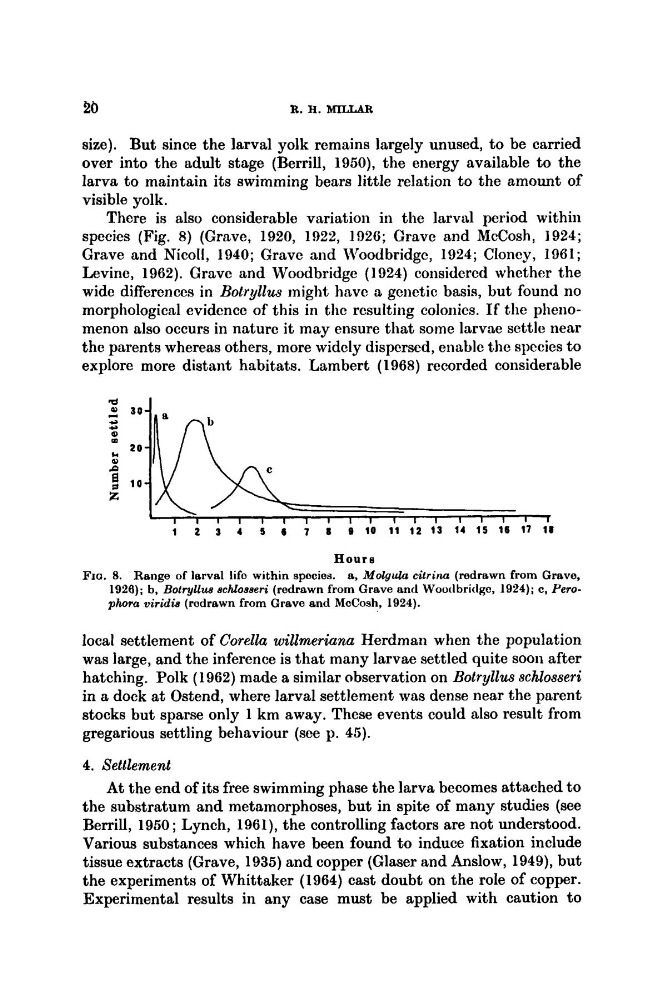
There is also considerable variation in the larval period within
species (Fig. 8) (Grave, 1920, 1822, 102G; Gravc and McCosh, 1924;
Grave and Nicoll, 1940; Grave and Woodbridgc, 1024; Cloney, 1961;
Levine, 1962). Grave and Woodbridge (1024) considered whether the
wide differences in Botrgllus might have a gcnctic basis, but found no
morphological evidence of this in thc resulting colonies. If the phenomenon also occurs in nature i t may ensure that some larvae settle near
the parents whereas others, more widely dispersed, eiiablc the spccics to
explore more distant habitats. Lambert ( 1968) recorded considerable
Hours
Fro. 8. Range of larval life within species. a, Molgula cifrina (redrawn from Grave,
1926); b, Eolryllus achloaaeri (redrawn from Grave and Wooclbritlgc, 1924); c, Perophom viridia (rodrawn from Grave and McCosh, 1924).
local settlement of Corella willmeriana Herdman when the population
was large, and the inference is that many larvae settled quite soon after
hatching. Polk (1962) made a similar observation on Botryllus schlosseri
in a dock at Ostend, where larval settlement was dense near the parent
stocks but sparse only 1 km away. These events could also result from
gregarious settling behaviour (see p. 48).
4. Settlement
At the end of its free swimming phase the larva becomes attached to
the substratum and metamorphoses, but in spite of many studies (see
Berrill, 1950 ; Lynch, 1961), the controlling factors are not understood.
Various substances which have been found to induce fixation include
tissue extracts (Grave, 1935) and copper (Glaser and Anslow, 1949), but
the experiments of Whittaker (1964) cast doubt on the role of copper.
Experimental results in any case must be applied with caution to
R. H. MLLdR
a
. a
9 1 0
size). But since the larval yolk remains largely unused, to be carried
over into the adult stage (Berrill, 1950), the energy available to the
larva to maintain its swimming bears little relation to the amount of
visible yolk.
There is also considerable variation in the larval period within
species (Fig. 8) (Grave, 1920, 1822, 102G; Gravc and McCosh, 1924;
Grave and Nicoll, 1940; Grave and Woodbridgc, 1024; Cloney, 1961;
Levine, 1962). Grave and Woodbridge (1024) considered whether the
wide differences in Botrgllus might have a gcnctic basis, but found no
morphological evidence of this in thc resulting colonies. If the phenomenon also occurs in nature i t may ensure that some larvae settle near
the parents whereas others, more widely dispersed, eiiablc the spccics to
explore more distant habitats. Lambert ( 1968) recorded considerable
Hours
Fro. 8. Range of larval life within species. a, Molgula cifrina (redrawn from Grave,
1926); b, Eolryllus achloaaeri (redrawn from Grave and Wooclbritlgc, 1924); c, Perophom viridia (rodrawn from Grave and McCosh, 1924).
local settlement of Corella willmeriana Herdman when the population
was large, and the inference is that many larvae settled quite soon after
hatching. Polk (1962) made a similar observation on Botryllus schlosseri
in a dock at Ostend, where larval settlement was dense near the parent
stocks but sparse only 1 km away. These events could also result from
gregarious settling behaviour (see p. 48).
4. Settlement
At the end of its free swimming phase the larva becomes attached to
the substratum and metamorphoses, but in spite of many studies (see
Berrill, 1950 ; Lynch, 1961), the controlling factors are not understood.
Various substances which have been found to induce fixation include
tissue extracts (Grave, 1935) and copper (Glaser and Anslow, 1949), but
the experiments of Whittaker (1964) cast doubt on the role of copper.
Experimental results in any case must be applied with caution to