

320
D. H. CUSHWO
Wedge. An interesting point is that the most prominent part of the
sperm whale catches in the Canary Current comes from the extension of
the current into the North Equatorial Current and from the Guinea
Dome. This suggests that the sperm whales do not in fact aggregate in
the coastal upwellings themselves but in the offshore divergences. The
whales were caught off Angola and the Congo rather than off South
Africa and South-West Africa ; they were caught in the Peru Oceanic
Current rather than the Peru Coastal Current, in the offshore divergences
of the Madagasar Wedge, in those of the North Equatorial Current in
the Atlantic, and in those of the South Equatorial Current in the
Pacific. Thus the sperm whale must be a truly oceanic animal like the
tuna and may be excluded to some extent from the coastal upwellings
themselves ; indeed they may be excluded from much of the California
Current by the grey whale. There are two anomalies in this interpretation of the chart of sperm whale catches, in the North Pacific and
in the North Atlantic, south-east of Japan and south-east of Nantucket.
The latter may be a function of the nearness of the home port, but the
former is difhult to explain, being a little too far south of the divergences of the Kuroshio extension.
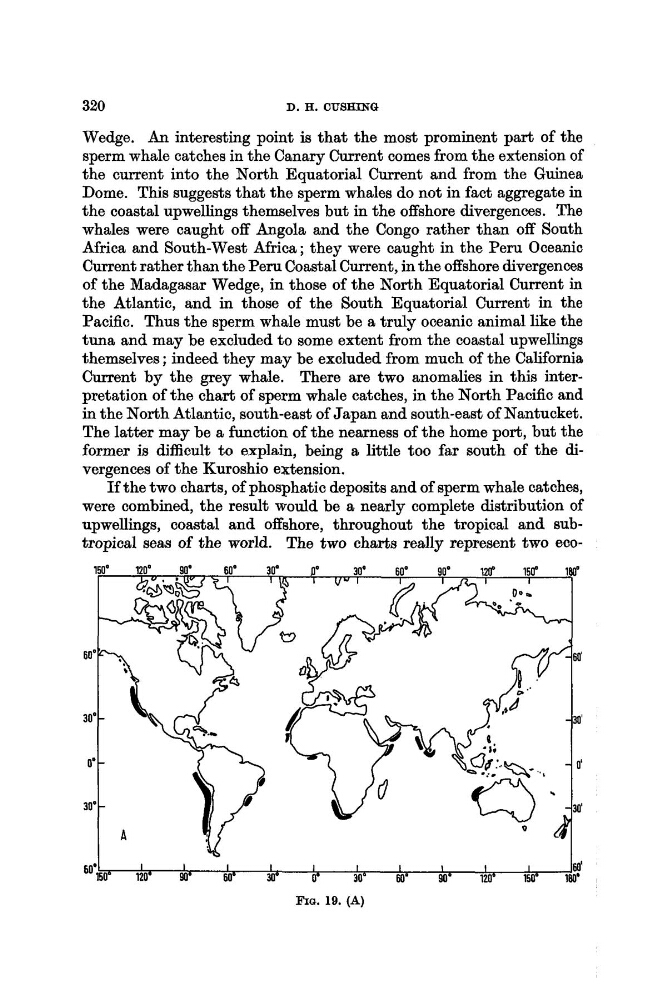
If the two charts, of phosphatic deposits and of sperm whale catches,
were combined, the result would be a nearly complete distribution of
upwellings, coastal and offshore, throughout the tropical and subtropical seas of the world. The two charts really represent two ecoFIG. 19. (A)
D. H. CUSHWO
Wedge. An interesting point is that the most prominent part of the
sperm whale catches in the Canary Current comes from the extension of
the current into the North Equatorial Current and from the Guinea
Dome. This suggests that the sperm whales do not in fact aggregate in
the coastal upwellings themselves but in the offshore divergences. The
whales were caught off Angola and the Congo rather than off South
Africa and South-West Africa ; they were caught in the Peru Oceanic
Current rather than the Peru Coastal Current, in the offshore divergences
of the Madagasar Wedge, in those of the North Equatorial Current in
the Atlantic, and in those of the South Equatorial Current in the
Pacific. Thus the sperm whale must be a truly oceanic animal like the
tuna and may be excluded to some extent from the coastal upwellings
themselves ; indeed they may be excluded from much of the California
Current by the grey whale. There are two anomalies in this interpretation of the chart of sperm whale catches, in the North Pacific and
in the North Atlantic, south-east of Japan and south-east of Nantucket.
The latter may be a function of the nearness of the home port, but the
former is difhult to explain, being a little too far south of the divergences of the Kuroshio extension.
If the two charts, of phosphatic deposits and of sperm whale catches,
were combined, the result would be a nearly complete distribution of
upwellings, coastal and offshore, throughout the tropical and subtropical seas of the world. The two charts really represent two ecoFIG. 19. (A)