

UPWELLING AND THE PRODUCTION OF FISH
317
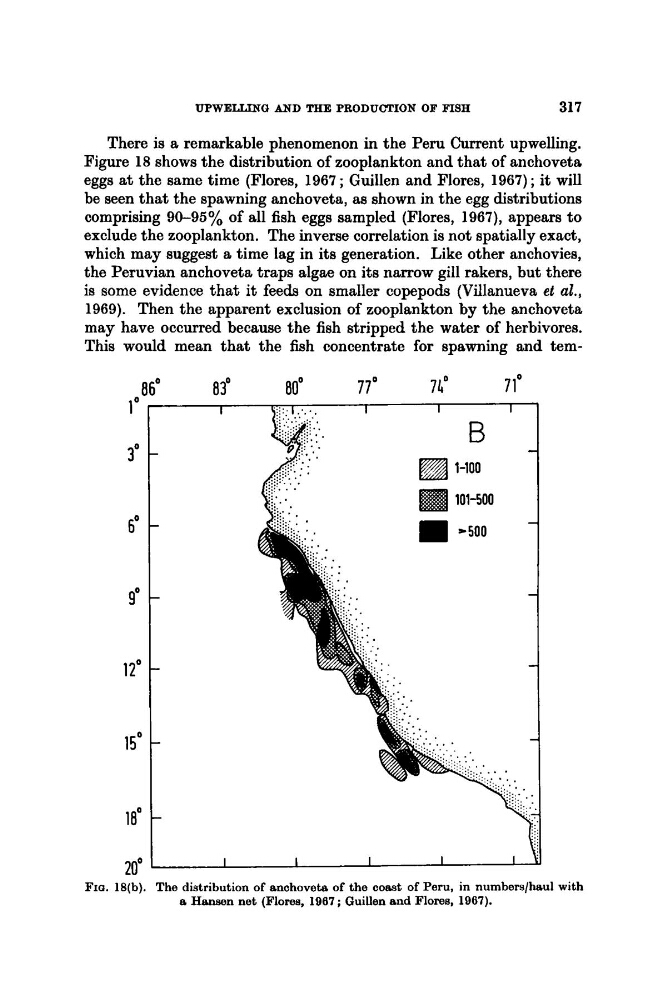
There is a remarkable phenomenon in the Peru Current upwelling.
Figure 18 shows the distribution of zooplankton and that of anchoveta
eggs at the same time (Flores, 1967 ; Guillen and Flores, 1967) ; it will
be seen that the spawning anchoveta, a8 shown in the egg distributions
comprising 90-95% of all fish eggs sampled (Flores, 1967), appears to
exclude the zooplankton. The inverse correlation is not spatially exact,
which may suggest a time lag in its generation. Like other anchovies,
the Peruvian anchoveta traps algae on its narrow gill rakers, but there
is some evidence that it feeds on smaller copepods (Villanueva et aE.,
1969). Then the apparent exclusion of zooplankton by the anchoveta
may have occurred because the fish stripped the water of herbivores.
This would mean that the fish concentrate for spawning and temB
1-100
101-500
,500
2oo
FIQ. 18(b). The distribution of anchoveta of the coast of Peru, in numbers/haul with
a Hensen net (Flores, 1967 ; Guillen and Flores, 1967).
317
There is a remarkable phenomenon in the Peru Current upwelling.
Figure 18 shows the distribution of zooplankton and that of anchoveta
eggs at the same time (Flores, 1967 ; Guillen and Flores, 1967) ; it will
be seen that the spawning anchoveta, a8 shown in the egg distributions
comprising 90-95% of all fish eggs sampled (Flores, 1967), appears to
exclude the zooplankton. The inverse correlation is not spatially exact,
which may suggest a time lag in its generation. Like other anchovies,
the Peruvian anchoveta traps algae on its narrow gill rakers, but there
is some evidence that it feeds on smaller copepods (Villanueva et aE.,
1969). Then the apparent exclusion of zooplankton by the anchoveta
may have occurred because the fish stripped the water of herbivores.
This would mean that the fish concentrate for spawning and temB
1-100
101-500
,500
2oo
FIQ. 18(b). The distribution of anchoveta of the coast of Peru, in numbers/haul with
a Hensen net (Flores, 1967 ; Guillen and Flores, 1967).