

202
D. H. CUSHINQ
in the zooplankton distributions in the South Equatorial Current in the
region of the Marquesas Islands. From Fig. 5B, showing the zooplankton distributions, it is also possible to see where the Equatorial
Countercurrent runs, at about 5-8"N, where there is a long rib of low
density right across the Pacific. This is not surprising, for in general the
countercurrent is a region of convergence at most seasons (Hidaka and
Ogawa, 1958). In the northern summer there are convergences along
nearly the whole length of the Equatorial Countercurrent ; the same is
true during the winter, but the convergences are broken by patches of
divergence in the west. In the southern summer there are extensive
divergences in the South Equatorial Current ; in the North Equatorial
Current, in the northern summer, there are also divergences, but they
are less extensive, indeed less than in the northern winter.
5' s
0"
5"
10"
15'
2 0 ' N
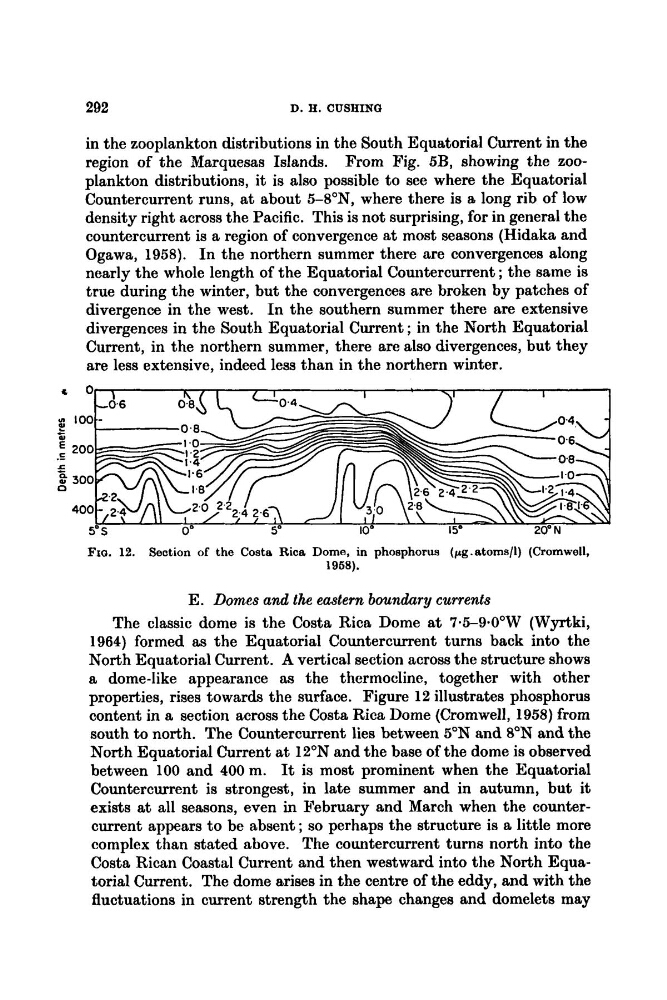
Fro. 12. Section of the Costa Rica Dome, in phosphorus (pg.atoms/l) (Cromwell,
1968).
E. Domes and the eastern boundary currents
The classic dome is the Costa Rica Dome at 7-5-9-OoW (Wyrtki,
1964) formed as the Equatorial Countercurrent turns back into the
North Equatorial Current. A vertical section across the structure shows
a dome-like appearance as the thermocline, together with other
properties, rises towards the surface. Figure 12 illustrates phosphorus
content in a section across the Costa Rica Dome (Cromwell, 1958) from
south to north. The Countercurrent lies between 5"N and 8"N and the
North Equatorial Current at 12ON and the base of the dome is observed
between 100 and 400m. It is most prominent when the Equatorial
Countercurrent is strongest, in late summer and in autumn, but it
exists at all seasons, even in February and March when the countercurrent appears to be absent ; so perhaps the structure is a little more
complex than stated above. The countercurrent turns north into the
Costa Rican Coastal Current and then westward into the North Equatorial Current. The dome arises in the centre of the eddy, and with the
fluctuations in current strength the shape changes and domelets may
D. H. CUSHINQ
in the zooplankton distributions in the South Equatorial Current in the
region of the Marquesas Islands. From Fig. 5B, showing the zooplankton distributions, it is also possible to see where the Equatorial
Countercurrent runs, at about 5-8"N, where there is a long rib of low
density right across the Pacific. This is not surprising, for in general the
countercurrent is a region of convergence at most seasons (Hidaka and
Ogawa, 1958). In the northern summer there are convergences along
nearly the whole length of the Equatorial Countercurrent ; the same is
true during the winter, but the convergences are broken by patches of
divergence in the west. In the southern summer there are extensive
divergences in the South Equatorial Current ; in the North Equatorial
Current, in the northern summer, there are also divergences, but they
are less extensive, indeed less than in the northern winter.
5' s
0"
5"
10"
15'
2 0 ' N
Fro. 12. Section of the Costa Rica Dome, in phosphorus (pg.atoms/l) (Cromwell,
1968).
E. Domes and the eastern boundary currents
The classic dome is the Costa Rica Dome at 7-5-9-OoW (Wyrtki,
1964) formed as the Equatorial Countercurrent turns back into the
North Equatorial Current. A vertical section across the structure shows
a dome-like appearance as the thermocline, together with other
properties, rises towards the surface. Figure 12 illustrates phosphorus
content in a section across the Costa Rica Dome (Cromwell, 1958) from
south to north. The Countercurrent lies between 5"N and 8"N and the
North Equatorial Current at 12ON and the base of the dome is observed
between 100 and 400m. It is most prominent when the Equatorial
Countercurrent is strongest, in late summer and in autumn, but it
exists at all seasons, even in February and March when the countercurrent appears to be absent ; so perhaps the structure is a little more
complex than stated above. The countercurrent turns north into the
Costa Rican Coastal Current and then westward into the North Equatorial Current. The dome arises in the centre of the eddy, and with the
fluctuations in current strength the shape changes and domelets may