

214
D. a. CUSHMd
they live in 350-400 m. So, as the upwelling season progresses the fish
could ride north in the countercurrent and perhaps return to spawn in
the California Current. The extraordinary point is that they spawn in
the south when the larvae can take advantage of the upwelling and they
migrate north to feed in the upwelling off Oregon and Washington much
later on in the year; so the adults live in the upwelling regions for
6 months or more during the year. Although the hake ranges from
Cape San Lucas to Kodiak Island off the southern coast of Alaska, it is
likely that the stock is retained within the upwelling area by means of
the current/countercurrent mechanism. The sardines used to move
northward during the summer in much the same way as far as British
Columbia. Longhurst (1967) has noticed that during warm years, when
TABLE I1
~~
1955
1960
(a) Engraulidae
Clupeidae
Carangidae
Scorpaenidae
Gadidao
Scombridae
Bothidae
Pleuroncctidae
(b) Bathylagidae
Gonostomatidae
Myctophidae
39-9
3.7
3.5
8.6
1 6 2
0.5
0.5
0- 6
5.2
3-8
9- 1
57.9
1.8
1.1
3- 1
6.5
0.3
1.5
0.1
6.5
7.4
10.4
upwelling is less intense, in the period 1957-60, the larvae of the pelagic
crab, Pleuroncodes planipes Stimpson, drifted much farther north ;
perhaps they were carried north in the inshore surface countercurrent.
Thus, from the point of view of the unity of stock, an upwelling area
provides mechanisms by which fish can be retained in an extensive
region, of about the distances over which fish can easily migrate
(500-1 000 miles; Harden Jones, 1968).
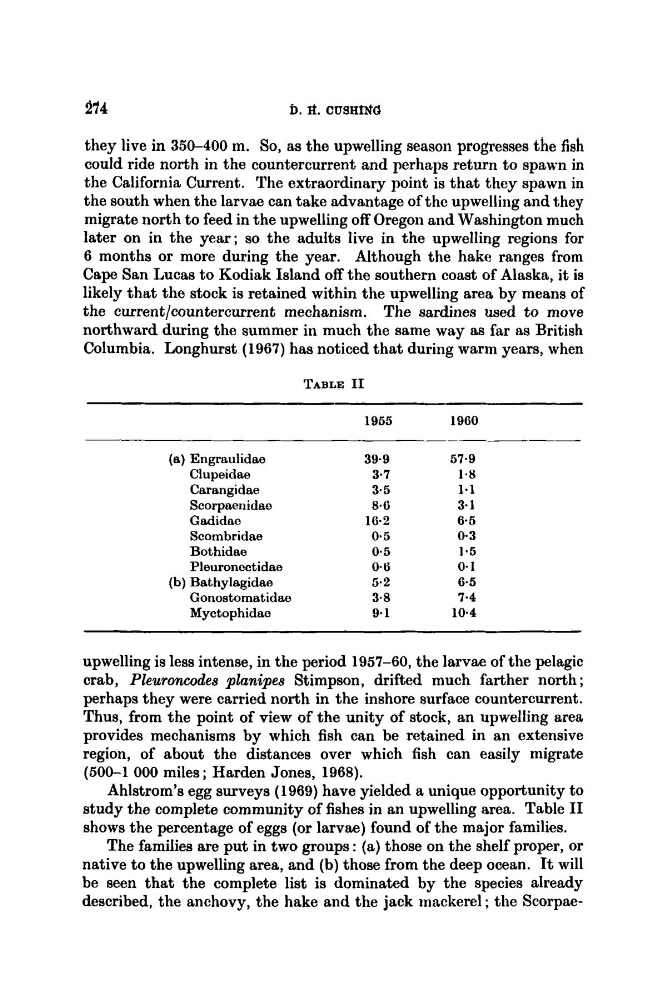
Ahlstrom’s egg surveys (1969) have yielded a unique opportunity to
study the complete community of fishes in an upwelling area. Table I1
shows the percentage of eggs (or larvae) found of the major families.
The families are put in two groups : (a) those on the shelf proper, or
native to the upwelling area, and (b) those from the deep ocean. It will
be seen that the complete list is dominated by the species already
described, the anchovy, the hake and the jack mackerel ; the Scorpae-
D. a. CUSHMd
they live in 350-400 m. So, as the upwelling season progresses the fish
could ride north in the countercurrent and perhaps return to spawn in
the California Current. The extraordinary point is that they spawn in
the south when the larvae can take advantage of the upwelling and they
migrate north to feed in the upwelling off Oregon and Washington much
later on in the year; so the adults live in the upwelling regions for
6 months or more during the year. Although the hake ranges from
Cape San Lucas to Kodiak Island off the southern coast of Alaska, it is
likely that the stock is retained within the upwelling area by means of
the current/countercurrent mechanism. The sardines used to move
northward during the summer in much the same way as far as British
Columbia. Longhurst (1967) has noticed that during warm years, when
TABLE I1
~~
1955
1960
(a) Engraulidae
Clupeidae
Carangidae
Scorpaenidae
Gadidao
Scombridae
Bothidae
Pleuroncctidae
(b) Bathylagidae
Gonostomatidae
Myctophidae
39-9
3.7
3.5
8.6
1 6 2
0.5
0.5
0- 6
5.2
3-8
9- 1
57.9
1.8
1.1
3- 1
6.5
0.3
1.5
0.1
6.5
7.4
10.4
upwelling is less intense, in the period 1957-60, the larvae of the pelagic
crab, Pleuroncodes planipes Stimpson, drifted much farther north ;
perhaps they were carried north in the inshore surface countercurrent.
Thus, from the point of view of the unity of stock, an upwelling area
provides mechanisms by which fish can be retained in an extensive
region, of about the distances over which fish can easily migrate
(500-1 000 miles; Harden Jones, 1968).
Ahlstrom’s egg surveys (1969) have yielded a unique opportunity to
study the complete community of fishes in an upwelling area. Table I1
shows the percentage of eggs (or larvae) found of the major families.
The families are put in two groups : (a) those on the shelf proper, or
native to the upwelling area, and (b) those from the deep ocean. It will
be seen that the complete list is dominated by the species already
described, the anchovy, the hake and the jack mackerel ; the Scorpae-