

IJPWELLINO AND THE PRODUCTION OF FISH
259
(1952) showed off Nova Scotia. But there are biological reasons why
upwelling is only noticeable, in biological terms, in tropical and subtropical seas as will be explained below ; in the cool water, rising from
below, a quasi-temperate production cycle is generated, which is in
sharp contrast (in its high production) to the steady state system of
tropical waters.
Kilometres
0
0 0 Surface drift towards the equotor
o o Countercurrent towords the pole
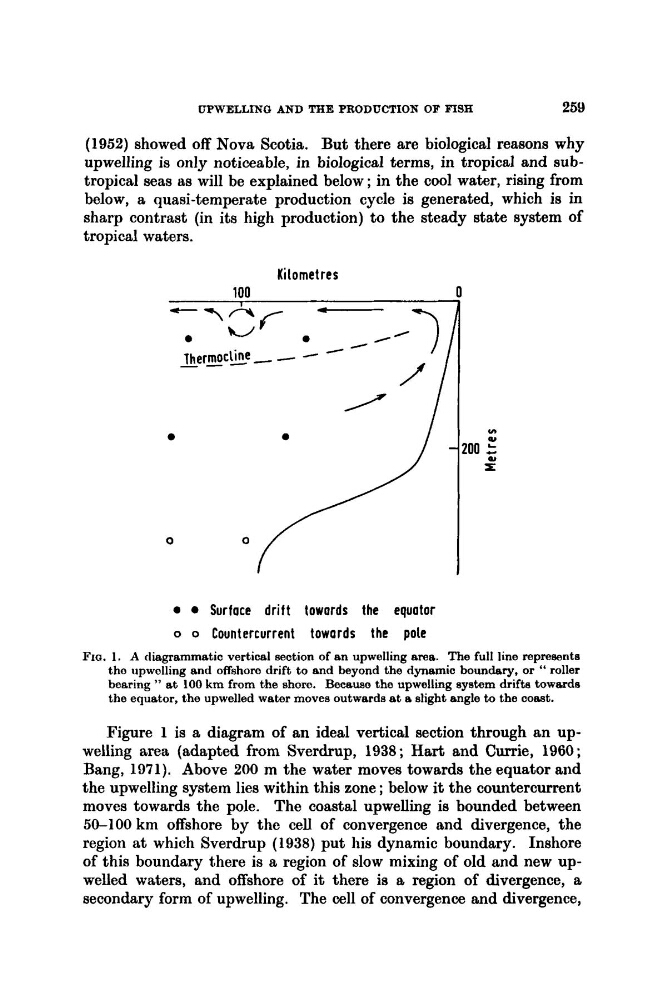
FIQ. 1. A diagrammatic vertical section of an upwelling area. The full line represents
tho upwolling and offshore drift to and beyond the dynamic boundary. or " roller
bearing " at 100 km from the shore. Because the upwelling system drifts towards
the equator, the upwelled water moves outwards at a slight angle to the coast.
Figure 1 is a diagram of an ideal vertical section through an upwelling area (adapted from Sverdrup, 1938; Hart and Currie, 1960;
Bang, 1071). Above 200 m the water moves towards the equator and
the upwelling system lies within this zone ; below it the countercurrent
moves towards the pole. The coastal upwelling is bounded between
50-100 km offshore by the cell of convergence and divergence, the
region at which Sverdrup (1938) put his dynamic boundary. Inshore
of this boundary there is a region of slow mixing of old and new upwelled waters, and offshore of it there is a region of divergence, a
secondary form of upwelling. The cell of convergence and divergence,
259
(1952) showed off Nova Scotia. But there are biological reasons why
upwelling is only noticeable, in biological terms, in tropical and subtropical seas as will be explained below ; in the cool water, rising from
below, a quasi-temperate production cycle is generated, which is in
sharp contrast (in its high production) to the steady state system of
tropical waters.
Kilometres
0
0 0 Surface drift towards the equotor
o o Countercurrent towords the pole
FIQ. 1. A diagrammatic vertical section of an upwelling area. The full line represents
tho upwolling and offshore drift to and beyond the dynamic boundary. or " roller
bearing " at 100 km from the shore. Because the upwelling system drifts towards
the equator, the upwelled water moves outwards at a slight angle to the coast.
Figure 1 is a diagram of an ideal vertical section through an upwelling area (adapted from Sverdrup, 1938; Hart and Currie, 1960;
Bang, 1071). Above 200 m the water moves towards the equator and
the upwelling system lies within this zone ; below it the countercurrent
moves towards the pole. The coastal upwelling is bounded between
50-100 km offshore by the cell of convergence and divergence, the
region at which Sverdrup (1938) put his dynamic boundary. Inshore
of this boundary there is a region of slow mixing of old and new upwelled waters, and offshore of it there is a region of divergence, a
secondary form of upwelling. The cell of convergence and divergence,