

TAURINE IN MARINE INVERTEBRATES
200
150
100
i
I n
a .
Z
50
-
-
-
-
I
I
o-x
/ lb 20 30
237
'5
i0
i
u C
.L
a
2
z5
0
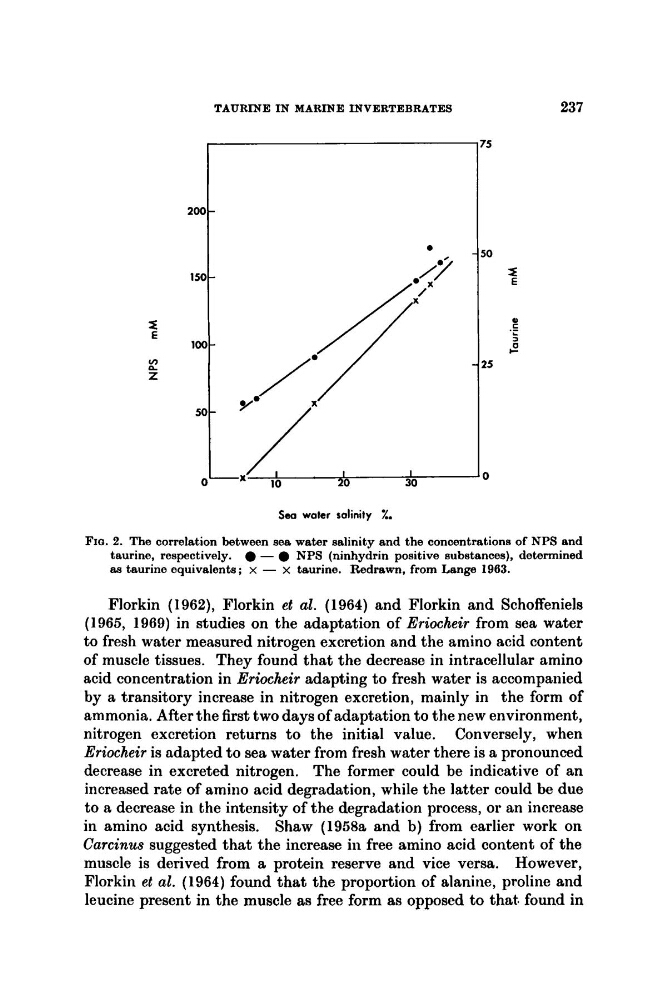
FIQ. 2. The correlation between sea water salinity and the concentrations of NPS and
-
NPS (ninhydrin positive substances), determined
taurine, respectively.
as taurine equivalents; x - x taurine. Redrawn, from Lange 1963.
Florkin (1962), Florkin et al. (1964) and Florkin and Schoffeniels
(1965, 1969) in studies on the adaptation of Eriocheir from sea water
to fresh water measured nitrogen excretion and the amino acid content
of muscle tissues. They found that the decrease in intracellular amino
acid concentration in Eriocheir adapting to fresh water is accompanied
by a transitory increase in nitrogen excretion, mainly in the form of
ammonia. After the first two days of adaptation to the new environment,
nitrogen excretion returns t o the initial value. Conversely, when
Eriocheir is adapted to sea water from fresh water there is a pronounced
decrease in excreted nitrogen. The former could be indicative of an
increased rate of amino acid degradation, while the latter could be due
to a decrease in the intensity of the degradation process, or an increase
in amino acid synthesis. Shew (1958a and b) from earlier work on
Carcinus suggested that the increase in free amino acid content of the
muscle is derived from a protein reserve and vice versa. However,
Florkin et al. (1964) found that the proportion of alanine, proline and
leucine present in the muscle as free form as opposed to that. found in
200
150
100
i
I n
a .
Z
50
-
-
-
-
I
I
o-x
/ lb 20 30
237
'5
i0
i
u C
.L
a
2
z5
0
FIQ. 2. The correlation between sea water salinity and the concentrations of NPS and
-
NPS (ninhydrin positive substances), determined
taurine, respectively.
as taurine equivalents; x - x taurine. Redrawn, from Lange 1963.
Florkin (1962), Florkin et al. (1964) and Florkin and Schoffeniels
(1965, 1969) in studies on the adaptation of Eriocheir from sea water
to fresh water measured nitrogen excretion and the amino acid content
of muscle tissues. They found that the decrease in intracellular amino
acid concentration in Eriocheir adapting to fresh water is accompanied
by a transitory increase in nitrogen excretion, mainly in the form of
ammonia. After the first two days of adaptation to the new environment,
nitrogen excretion returns t o the initial value. Conversely, when
Eriocheir is adapted to sea water from fresh water there is a pronounced
decrease in excreted nitrogen. The former could be indicative of an
increased rate of amino acid degradation, while the latter could be due
to a decrease in the intensity of the degradation process, or an increase
in amino acid synthesis. Shew (1958a and b) from earlier work on
Carcinus suggested that the increase in free amino acid content of the
muscle is derived from a protein reserve and vice versa. However,
Florkin et al. (1964) found that the proportion of alanine, proline and
leucine present in the muscle as free form as opposed to that. found in