

TAURINE I N MARINE INVERTEBRATES
225
Ta.ble VII). However, by repeating the taurine S35 injection with
material of higher specific activity they were able to detect a slight
amount of radioactive sulphur in taurocyamine after 12 h. In one ease
in the following experiments in vitro they were able to show transamidination between arginine and taurine. 0.004 p mole of taurocyamine was recorded in a sample containing 100 p moles of arginine,
5 p moles of taurine and 0.61 g freshweight worm tissue.
Taurocyamine is a guanidinc derivative (2-guanidocthanc-sulphonic
acid) and its occurrence in Arenieola muscle together with the absence
of any other guanidinc derivative, suggested that its function was, like
that of any other guanidine derivative found in muscle, that of a - P
acceptor in muscular contraction. This theory is supported by the
fact that its phosphagen (phosphotaurocyamine) was also found (Thoai
et al., 1953a and b). This was later confirmed by Griffiths et al. (unpublished work quoted by Ennor and Morrison, 1958) who found the
same phosphagen in Phuscolosoma moduliferum and ArenicolG assimilis
Ehlers. Phosphotaurocyamine appears to havc a more limited distribution than taurocyaminc. Curiously, taurocyamine has not been reported
in adult Audouinia although it is so rich in taurine (Kurtz and Luck,
1935). However, it has been found in the egg (Robin et al., 1956).
NH N P03H1
NHa
/
\
+ ADP + HN = C
/
\
HN = C
NH-CH,-CHZ-SO,H
NH-CHZ-CHS-SO jH
PHOSPHOTAUROCYAMINE
TAUROCYAMINE
+ ATP
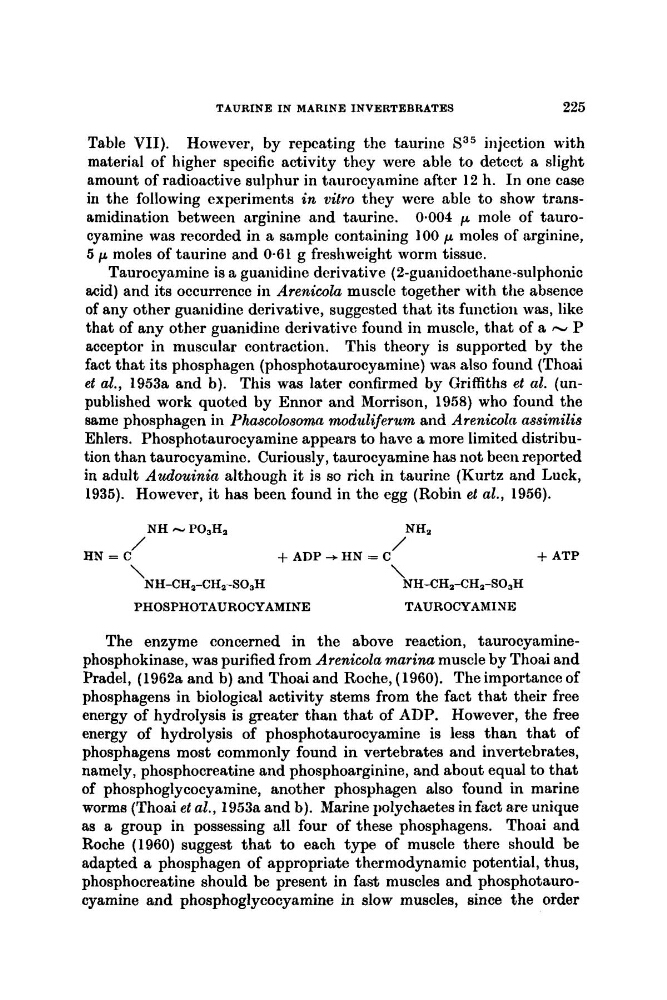
The enzyme concerned in the above reaction, taurocyaminephosphokinase, was purified from Arenicola marina muscle by Thoai and
Pradel, (1962a and b) and Thoai and Roche, (1960). The importance of
phosphagens in biological activity stems from the fact that their free
energy of hydrolysis is greater than that of ADP. However, the free
energy of hydrolysis of phosphotaurocyaminc is less than that of
phosphagens most commonly found in vertebrates and invertebrates,
namely, phosphocreatine and phosphoarginine, and about equal to that
of phosphoglycocyamine, another phosyhagcn also found in marine
worms (Thoai et al., 1953a and b). Marine polychaetes in fact are unique
as a group in possessing all four of these phosphagens. Thoai and
Roche (1960) suggest that to each type of muscle there should be
adapted a phosphagen of appropriate thermodynamic potential, thus,
phosphocreatine should be present in fast muscles and phosphotaurocyamine and phosphoglycocyamine in slow muscles, since the order
225
Ta.ble VII). However, by repeating the taurine S35 injection with
material of higher specific activity they were able to detect a slight
amount of radioactive sulphur in taurocyamine after 12 h. In one ease
in the following experiments in vitro they were able to show transamidination between arginine and taurine. 0.004 p mole of taurocyamine was recorded in a sample containing 100 p moles of arginine,
5 p moles of taurine and 0.61 g freshweight worm tissue.
Taurocyamine is a guanidinc derivative (2-guanidocthanc-sulphonic
acid) and its occurrence in Arenieola muscle together with the absence
of any other guanidinc derivative, suggested that its function was, like
that of any other guanidine derivative found in muscle, that of a - P
acceptor in muscular contraction. This theory is supported by the
fact that its phosphagen (phosphotaurocyamine) was also found (Thoai
et al., 1953a and b). This was later confirmed by Griffiths et al. (unpublished work quoted by Ennor and Morrison, 1958) who found the
same phosphagen in Phuscolosoma moduliferum and ArenicolG assimilis
Ehlers. Phosphotaurocyamine appears to havc a more limited distribution than taurocyaminc. Curiously, taurocyamine has not been reported
in adult Audouinia although it is so rich in taurine (Kurtz and Luck,
1935). However, it has been found in the egg (Robin et al., 1956).
NH N P03H1
NHa
/
\
+ ADP + HN = C
/
\
HN = C
NH-CH,-CHZ-SO,H
NH-CHZ-CHS-SO jH
PHOSPHOTAUROCYAMINE
TAUROCYAMINE
+ ATP
The enzyme concerned in the above reaction, taurocyaminephosphokinase, was purified from Arenicola marina muscle by Thoai and
Pradel, (1962a and b) and Thoai and Roche, (1960). The importance of
phosphagens in biological activity stems from the fact that their free
energy of hydrolysis is greater than that of ADP. However, the free
energy of hydrolysis of phosphotaurocyaminc is less than that of
phosphagens most commonly found in vertebrates and invertebrates,
namely, phosphocreatine and phosphoarginine, and about equal to that
of phosphoglycocyamine, another phosyhagcn also found in marine
worms (Thoai et al., 1953a and b). Marine polychaetes in fact are unique
as a group in possessing all four of these phosphagens. Thoai and
Roche (1960) suggest that to each type of muscle there should be
adapted a phosphagen of appropriate thermodynamic potential, thus,
phosphocreatine should be present in fast muscles and phosphotaurocyamine and phosphoglycocyamine in slow muscles, since the order