

TAURINE IN MARINE INVERTEBRATES
219
although taurine in the liver was lost. However, to act, brain decarboxylase requires pyridoxine (Davison, 1956 ; Jacobsen and Smith,
1963; Jacobsen et al., 1964). The presence of this brain isoenzyme
explains why taurine is not completely absent from urine in pyridoxine deficient animals as had been thought previously (Blaschko
et al., 1953) but continues to be excreted in small quantities.
The oxidation of hypotaurine t o taurine was first demonstrated by
Cavallini et al. (1954) when they injected rats with hypotaurine. They
were unable to show this in vitro using a homogenate of rat organs.
Eldjarn and Sverdrup (1955) and Eldjarn et al. (1956) confirmed these
experiments when they found that following the injection of hypotaurine S35 into the rat they could recover most of the radioactivity in
the urine as sulphate and taurine. The oxidation of hypotsurineto
taurine is very rapid and labelled taurine exceeding the amount of
labelled hypotaurine in the body is present in urine 30 minutes after
injection. The formation of sulphate from taurine is probably very
limited in the rat and the formation of sulphate from hypotaurine is via
another reaction.
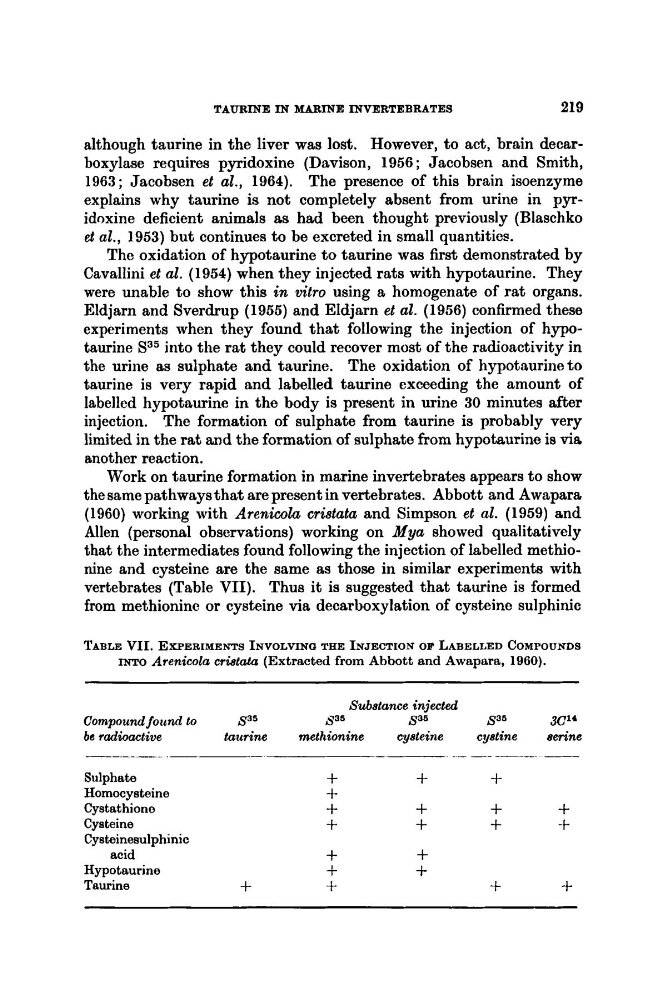
Work on taurine formation in marine invertebrates appears to show
the same pathways that are present in vertebrates. Abbott and Awapara
(1960) working with Arenicola cristata and Simpson et al. (1959) and
Allen (personal observations) working on Mya showed qualitatively
that the intermediates found following the injection of labelled methionine and cysteine are the same as those in similar experiments with
vertebrates (Table VII). Thus it is suggested that taurine is formed
from methionine or cysteine via decarboxylation of cysteine sulphinic
TABLE VII. EXPERIMENTS INVOLVING THE INJECTION OF LABELLED COMPOUNDS
INTO Arenicola cri.&z!u (Extracted from Abbott and Awapara, 1960).
Subetunce injected
Compound found to
5 3 5
d36
5 3 6
536
3C"
be radioactive
taurine
methionine
cyeteine
cyetine
eehne
Sulphate
+
+
+
Homocysteine
+
Cystathiono
+
+
+
+
Cysteine
+
+
+
+
acid
+
+
Hypotaurine
+
+
Taurine
+
+
+
+
Cysteinesulphinic
219
although taurine in the liver was lost. However, to act, brain decarboxylase requires pyridoxine (Davison, 1956 ; Jacobsen and Smith,
1963; Jacobsen et al., 1964). The presence of this brain isoenzyme
explains why taurine is not completely absent from urine in pyridoxine deficient animals as had been thought previously (Blaschko
et al., 1953) but continues to be excreted in small quantities.
The oxidation of hypotaurine t o taurine was first demonstrated by
Cavallini et al. (1954) when they injected rats with hypotaurine. They
were unable to show this in vitro using a homogenate of rat organs.
Eldjarn and Sverdrup (1955) and Eldjarn et al. (1956) confirmed these
experiments when they found that following the injection of hypotaurine S35 into the rat they could recover most of the radioactivity in
the urine as sulphate and taurine. The oxidation of hypotsurineto
taurine is very rapid and labelled taurine exceeding the amount of
labelled hypotaurine in the body is present in urine 30 minutes after
injection. The formation of sulphate from taurine is probably very
limited in the rat and the formation of sulphate from hypotaurine is via
another reaction.
Work on taurine formation in marine invertebrates appears to show
the same pathways that are present in vertebrates. Abbott and Awapara
(1960) working with Arenicola cristata and Simpson et al. (1959) and
Allen (personal observations) working on Mya showed qualitatively
that the intermediates found following the injection of labelled methionine and cysteine are the same as those in similar experiments with
vertebrates (Table VII). Thus it is suggested that taurine is formed
from methionine or cysteine via decarboxylation of cysteine sulphinic
TABLE VII. EXPERIMENTS INVOLVING THE INJECTION OF LABELLED COMPOUNDS
INTO Arenicola cri.&z!u (Extracted from Abbott and Awapara, 1960).
Subetunce injected
Compound found to
5 3 5
d36
5 3 6
536
3C"
be radioactive
taurine
methionine
cyeteine
cyetine
eehne
Sulphate
+
+
+
Homocysteine
+
Cystathiono
+
+
+
+
Cysteine
+
+
+
+
acid
+
+
Hypotaurine
+
+
Taurine
+
+
+
+
Cysteinesulphinic