

TAURINE IN MARINE INVERTEBRATES
21 1
Walker (1952) verified the results of Awapara et al. (1950), and found
even larger amounts in the tissues of the cow. Taurine in conjugation
with cholic a.cid in bile salts is commonly thought of as an cmulsifier of
fat in vcrtebrates. Haslewood and Wootton (1950) and Jacobsen and
Smith (1968) who tabulated all the information on bile salts to theso
dates show that, with the Elasmobranchia as a possible exception,
taurine is the conjugate in most vertebrate groups. However, it is now
evident that it has other functions in addition to this (Jacobsen and
Smith 1968). That it is an end product of sulphur amino-acid metabolism is clear, but, its presence in quantity in muscle and nerve tissues
suggests that it has other important functions.
It was first found in invertebrates by Valenciennes and Frdmy
(1855) who discovered it in abundance in the muscle of oysters and
cuttlefish and then suggested that it probably had a much wider
distribution than had been thought, a surmise that was to be amply
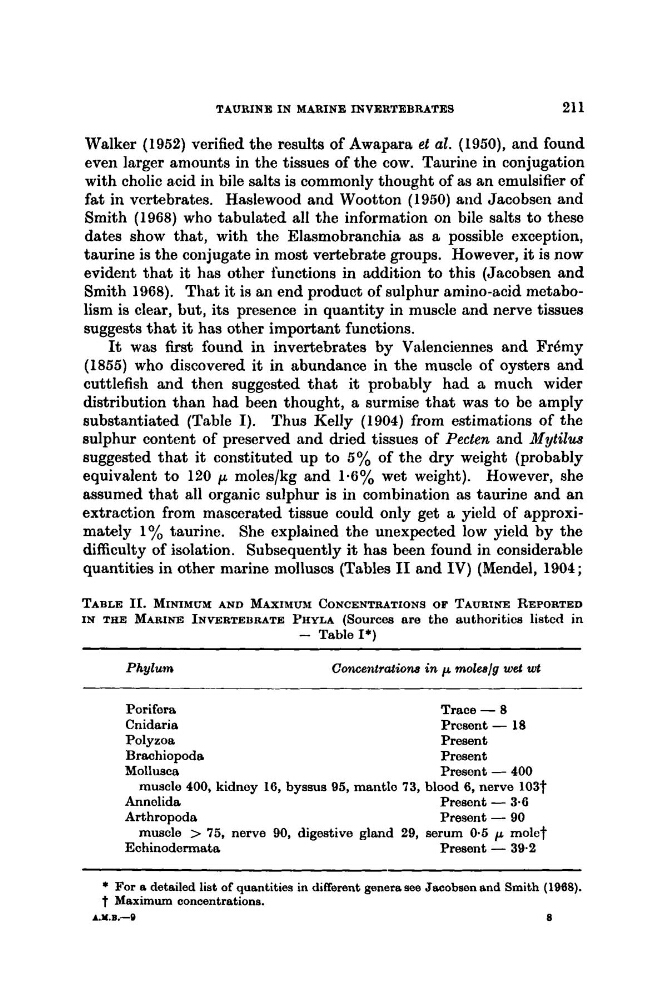
substantiated (Table I). Thus Kelly (1904) from estimations of the
sulphur content of preserved and dried tissues of Pecten and Mytilus
suggested that it constituted up to 5% of the dry weight (probably
equivalent to 120 p moles/kg and 1.6% wet weight). However, she
assumed that all organic sulphur is in combination as taurine and an
extraction from mascerated tissue could only get a yield of approximately 1% taurine. She explained the unexpected low yield by the
difficulty of isolation. Subsequently it has been found in considerable
quantities in other marine molluscs (Tables I1 and IV) (Mendel, 1904 ;
TABLE 11. MINIMUM AND MAxIrvrvnr CONCENTRATIONS or TAURINE REPORTED
IN THE MARINE INVERTEBRATE PHYLA (Sources are the authoritics listcd in
- Table I*)
Phylum
Concentrations in p rnoleelg wet wt
Porifora
Trace - 8
Cnidaria
Present - 18
POly208
Present
Brachiopoda
Present
Molluscs
Present - 400
Annelid8
Prescnt - 3.6
Arthropoda
Present - 90
Echinodennata
Present - 39.2
muscle 400, kidnoy 16, byssus 95, mantlo 73, blood 6, nerve 103t
muscle > 75, nerve 90, digestive gland 29, serum 0-6 p molct
* For a detailed list of quantities in different generasee Jacobsen and Smith (1968).
t Maximum concentrations.
A.Y.B.-0
8
21 1
Walker (1952) verified the results of Awapara et al. (1950), and found
even larger amounts in the tissues of the cow. Taurine in conjugation
with cholic a.cid in bile salts is commonly thought of as an cmulsifier of
fat in vcrtebrates. Haslewood and Wootton (1950) and Jacobsen and
Smith (1968) who tabulated all the information on bile salts to theso
dates show that, with the Elasmobranchia as a possible exception,
taurine is the conjugate in most vertebrate groups. However, it is now
evident that it has other functions in addition to this (Jacobsen and
Smith 1968). That it is an end product of sulphur amino-acid metabolism is clear, but, its presence in quantity in muscle and nerve tissues
suggests that it has other important functions.
It was first found in invertebrates by Valenciennes and Frdmy
(1855) who discovered it in abundance in the muscle of oysters and
cuttlefish and then suggested that it probably had a much wider
distribution than had been thought, a surmise that was to be amply
substantiated (Table I). Thus Kelly (1904) from estimations of the
sulphur content of preserved and dried tissues of Pecten and Mytilus
suggested that it constituted up to 5% of the dry weight (probably
equivalent to 120 p moles/kg and 1.6% wet weight). However, she
assumed that all organic sulphur is in combination as taurine and an
extraction from mascerated tissue could only get a yield of approximately 1% taurine. She explained the unexpected low yield by the
difficulty of isolation. Subsequently it has been found in considerable
quantities in other marine molluscs (Tables I1 and IV) (Mendel, 1904 ;
TABLE 11. MINIMUM AND MAxIrvrvnr CONCENTRATIONS or TAURINE REPORTED
IN THE MARINE INVERTEBRATE PHYLA (Sources are the authoritics listcd in
- Table I*)
Phylum
Concentrations in p rnoleelg wet wt
Porifora
Trace - 8
Cnidaria
Present - 18
POly208
Present
Brachiopoda
Present
Molluscs
Present - 400
Annelid8
Prescnt - 3.6
Arthropoda
Present - 90
Echinodennata
Present - 39.2
muscle 400, kidnoy 16, byssus 95, mantlo 73, blood 6, nerve 103t
muscle > 75, nerve 90, digestive gland 29, serum 0-6 p molct
* For a detailed list of quantities in different generasee Jacobsen and Smith (1968).
t Maximum concentrations.
A.Y.B.-0
8