

PLANKTON IN NITROGEN AND PHOSPHORUS CYCLES
163
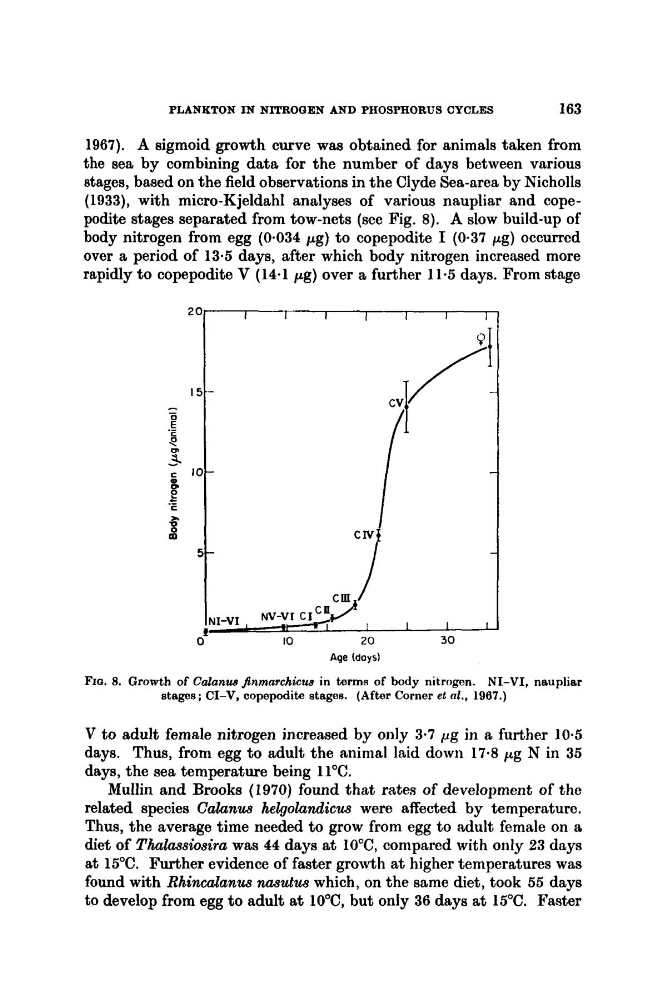
1967). A sigmoid growth curve was obtained for animals taken from
the sea by combining data for the number of days between various
stages, based on the field observations in the Clyde Sea-area by Nicholls
(1933), with micro-Kjeldahl analyses of various naupliar and copepodite stages separated from tow-nets (see Fig. 8). A slow build-up of
body nitrogen from egg (0.034 pg) to copepodite I (0.37 pg) occurred
over a period of 13-5 days, after which body nitrogen increased more
rapidly to copepodite V (14.1 pg) over a further 11.5 days. From stage
Age (doys)
FIQ. 8. Growth of Calanua jinmarchicw, in terms of body nitrogen. NI-VI, naupliar
stages; CI-V, copepodite stages. (After Corner el al., 1967.)
V to adult female nitrogen increased by only 3.7 pg in a further 10.5
days. Thus, from egg to adult the animal laid down 17.8 pg N in 35
days, the sea temperature being 11°C.
Mullin and Brooks (1970) found that rates of development of the
related species Calanus helgolandicus were affected by temperature.
Thus, the average time needed to grow from egg to adult female on a
diet of Thalassiosira was 44 days at lO"C, compared with only 23 days
at 15°C. Further evidence of faster growth at higher temperatures was
found with Rhincalanus nasutus which, on the same diet, took 55 days
to develop from egg to adult at lO"C, but only 36 days at 15OC. Faster
163
1967). A sigmoid growth curve was obtained for animals taken from
the sea by combining data for the number of days between various
stages, based on the field observations in the Clyde Sea-area by Nicholls
(1933), with micro-Kjeldahl analyses of various naupliar and copepodite stages separated from tow-nets (see Fig. 8). A slow build-up of
body nitrogen from egg (0.034 pg) to copepodite I (0.37 pg) occurred
over a period of 13-5 days, after which body nitrogen increased more
rapidly to copepodite V (14.1 pg) over a further 11.5 days. From stage
Age (doys)
FIQ. 8. Growth of Calanua jinmarchicw, in terms of body nitrogen. NI-VI, naupliar
stages; CI-V, copepodite stages. (After Corner el al., 1967.)
V to adult female nitrogen increased by only 3.7 pg in a further 10.5
days. Thus, from egg to adult the animal laid down 17.8 pg N in 35
days, the sea temperature being 11°C.
Mullin and Brooks (1970) found that rates of development of the
related species Calanus helgolandicus were affected by temperature.
Thus, the average time needed to grow from egg to adult female on a
diet of Thalassiosira was 44 days at lO"C, compared with only 23 days
at 15°C. Further evidence of faster growth at higher temperatures was
found with Rhincalanus nasutus which, on the same diet, took 55 days
to develop from egg to adult at lO"C, but only 36 days at 15OC. Faster