

PLANKTON IN NITROQEN AND PHOSPHORUS CYCLES
139
of this was unassimilated. Thus, at the peak of the diatom bloom the
assimilation efficiency of the animals was only about 30%, a value
close to that based on the calculations of Harvey et al. (1936) and Harvey
(1950). This similarity is regarded as significant by Beklemishev (1962).
Nevertheless, Riley made clear that his conclusions were to a large
degree speculative, and more recent studies on the physiology and
feeding behaviour of zooplankton indicate that several of his assumptions were-of necessity-oversimplified.
Thus, in Riley’s analysis all
the zooplankton were treated as herbivores, whereas it is now known
that at least some of the animals present when the zooplankton reached
its peak in mid-May (cyclopoids and Metridia spp.) could also have
made use of animal diets. The use of respiration data obtained with
a single species, Calanus jinmarchicus, in order t o calculate the body
carbon used daily by a mixed population of zooplankton, is another
obvious oversimplification, although admittedly the species was well
represented (Riley and Bumpus, 1946). Moreover, there is now evidence
that the respiration rate of Calanus jinmarchicus may be increased
when the animals are actively feeding on high concentrations of plant
food (Corner et al., 1965). In addition, Riley’s estimate of the daily
food requirements of the animals does not seem to have included the
quantity of captured food invested in growth, as well as that lost
through respiration. Finally, basic in Riley’s analysis is the assumption
that zooplankton organisms filter a constant volume of sea water
irrespective of the amount of food material present : each animal eats
a constant fraction of the phytoplankton population daily. However,
recent studies with marine copepods have shown that filtering rates
decrease with increasing food concentration, the amount of food
ingested rising to a plateau and then falling (Mullin, 1963; Haq, 1967).
The variation in filtering rate with food concentration has been discussed by Conover (1968) who, referring to the work of Ivlev with fish,
points out that the rate of increase of the food consumed, dR, with
an increase in the concentration of food available, dp, is proportional
to the difference between the maximum ration, R,,,, and the actual
ration, R. Thus:
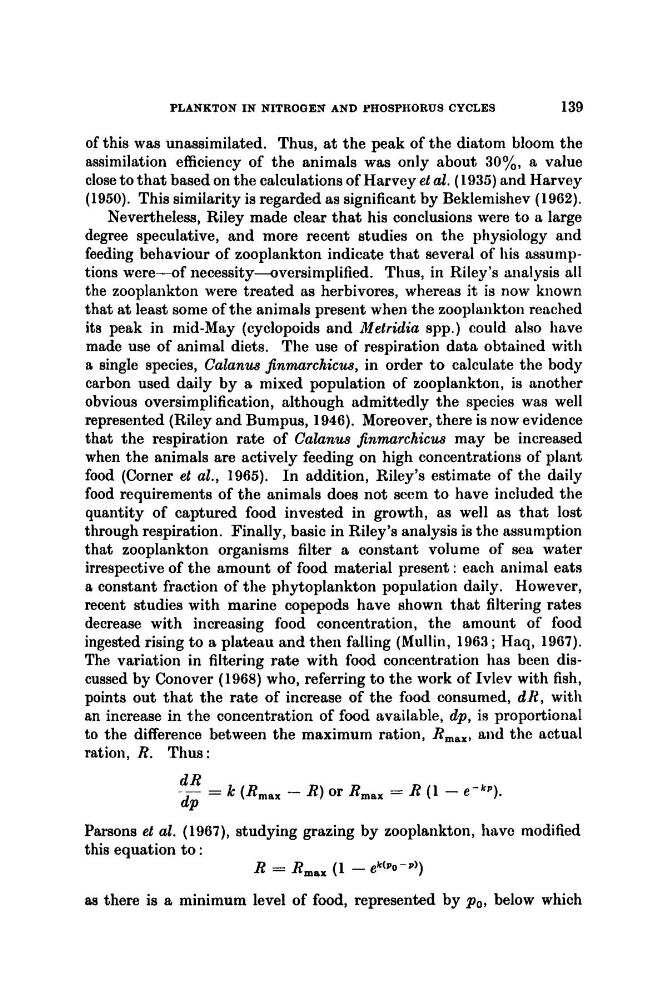
d R
- -
= k (R,,, - R) or R,,, = R (1 - e - k p ) .
dP
Parsons et al. (1967), studying grazing by zooplankton, have modified
this equation to :
R = R,,, (1 - e k ( P 0 - p ) 1
a .
9 there is a. minimum level of food, represented by p o , below which
139
of this was unassimilated. Thus, at the peak of the diatom bloom the
assimilation efficiency of the animals was only about 30%, a value
close to that based on the calculations of Harvey et al. (1936) and Harvey
(1950). This similarity is regarded as significant by Beklemishev (1962).
Nevertheless, Riley made clear that his conclusions were to a large
degree speculative, and more recent studies on the physiology and
feeding behaviour of zooplankton indicate that several of his assumptions were-of necessity-oversimplified.
Thus, in Riley’s analysis all
the zooplankton were treated as herbivores, whereas it is now known
that at least some of the animals present when the zooplankton reached
its peak in mid-May (cyclopoids and Metridia spp.) could also have
made use of animal diets. The use of respiration data obtained with
a single species, Calanus jinmarchicus, in order t o calculate the body
carbon used daily by a mixed population of zooplankton, is another
obvious oversimplification, although admittedly the species was well
represented (Riley and Bumpus, 1946). Moreover, there is now evidence
that the respiration rate of Calanus jinmarchicus may be increased
when the animals are actively feeding on high concentrations of plant
food (Corner et al., 1965). In addition, Riley’s estimate of the daily
food requirements of the animals does not seem to have included the
quantity of captured food invested in growth, as well as that lost
through respiration. Finally, basic in Riley’s analysis is the assumption
that zooplankton organisms filter a constant volume of sea water
irrespective of the amount of food material present : each animal eats
a constant fraction of the phytoplankton population daily. However,
recent studies with marine copepods have shown that filtering rates
decrease with increasing food concentration, the amount of food
ingested rising to a plateau and then falling (Mullin, 1963; Haq, 1967).
The variation in filtering rate with food concentration has been discussed by Conover (1968) who, referring to the work of Ivlev with fish,
points out that the rate of increase of the food consumed, dR, with
an increase in the concentration of food available, dp, is proportional
to the difference between the maximum ration, R,,,, and the actual
ration, R. Thus:
d R
- -
= k (R,,, - R) or R,,, = R (1 - e - k p ) .
dP
Parsons et al. (1967), studying grazing by zooplankton, have modified
this equation to :
R = R,,, (1 - e k ( P 0 - p ) 1
a .
9 there is a. minimum level of food, represented by p o , below which