

118
E. D. S. CORNER AND ANTHONY Q. DAVIES
using [15N]-labelled nutrients, that a hyperbolic relationship also applies
in the case of uptake of nitrate and ammonia by natural phytoplankton
communities (see Table IV).
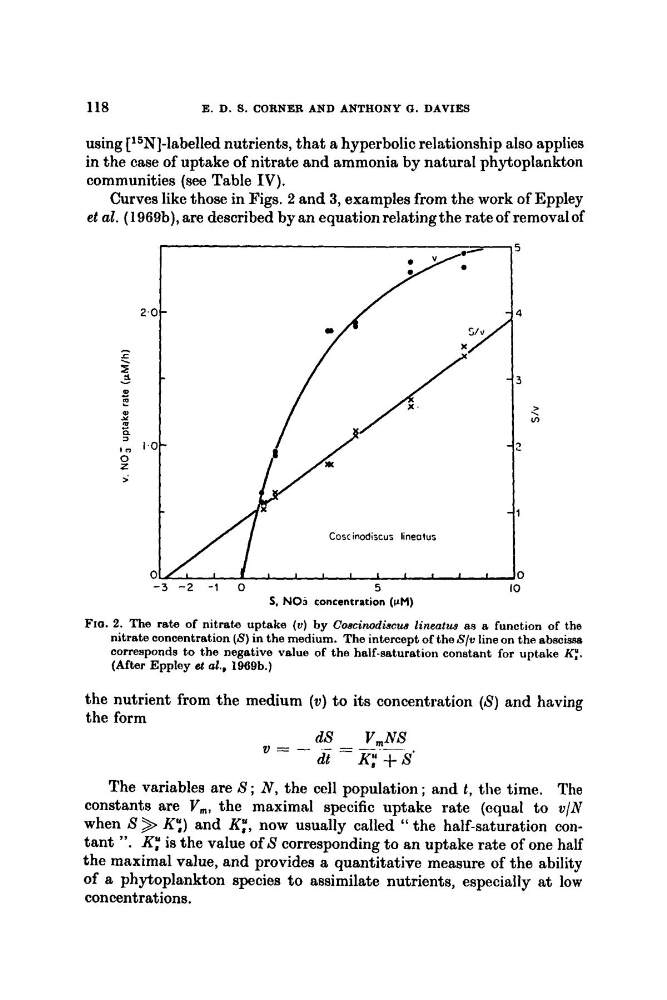
Curves like those in Figs. 2 and 3, examples from the work of Eppley
et al. (1969b), are described by an equation relating the rate of removal of
5, NO3 concentration (VM)
FIG. 2. The rate of nitrate uptake ( a ) by Coscimdiscm Eineaitcs as a function of the
nitrate concentration (8) in the medium. The intercept of the S/u line on the abscissa
corresponds to the negative value of the half-saturation constant for uptake K i .
(After Eppley et d., 1969b.)
the nutrient from the medium (v) to its concentration (S) and having
the form
dS
V,NS
dt
K:f f S'
v = -
-
The variables are S ; N, the cell population ; and t , the time. The
constants are V,, the maximal specific uptake rate (equal to v/N
when S > K:) and K,", now usually called " the half-saturation contant ". K: is the value ofS corresponding to an uptake rate of one half
the maximal value, and provides a quantitative measure of the ability
of a phytoplankton species t o assimilate nutrients, especially at low
concentrations.
E. D. S. CORNER AND ANTHONY Q. DAVIES
using [15N]-labelled nutrients, that a hyperbolic relationship also applies
in the case of uptake of nitrate and ammonia by natural phytoplankton
communities (see Table IV).
Curves like those in Figs. 2 and 3, examples from the work of Eppley
et al. (1969b), are described by an equation relating the rate of removal of
5, NO3 concentration (VM)
FIG. 2. The rate of nitrate uptake ( a ) by Coscimdiscm Eineaitcs as a function of the
nitrate concentration (8) in the medium. The intercept of the S/u line on the abscissa
corresponds to the negative value of the half-saturation constant for uptake K i .
(After Eppley et d., 1969b.)
the nutrient from the medium (v) to its concentration (S) and having
the form
dS
V,NS
dt
K:f f S'
v = -
-
The variables are S ; N, the cell population ; and t , the time. The
constants are V,, the maximal specific uptake rate (equal to v/N
when S > K:) and K,", now usually called " the half-saturation contant ". K: is the value ofS corresponding to an uptake rate of one half
the maximal value, and provides a quantitative measure of the ability
of a phytoplankton species t o assimilate nutrients, especially at low
concentrations.