

iis
' E. D. 9. CORNER AND ANTHONY CI. DAVIES
collected from the tropical Pacific Ocean (though they could not
positively associate the enzyme exclusively with the phytoplankton).
Further, the simultaneous uptake of ammonia and nitrate which would
be expected under natural conditions has been observed by Dugdale
and Goering (1967) who used [16N]-labelling to follow the assimilation
of these nutrients by phytoplankton populations obtained from several
sea areas. In all cases, both iiutrients were taken up simultaneously
though the average of the specific ratcsof dark and lightnitrate uptake,
NO; (expressed in terms of particulate nitrogen concentration instead
of cell population), was always lower than the average of the specific
rates of ammonia uptake, B N H ~ .
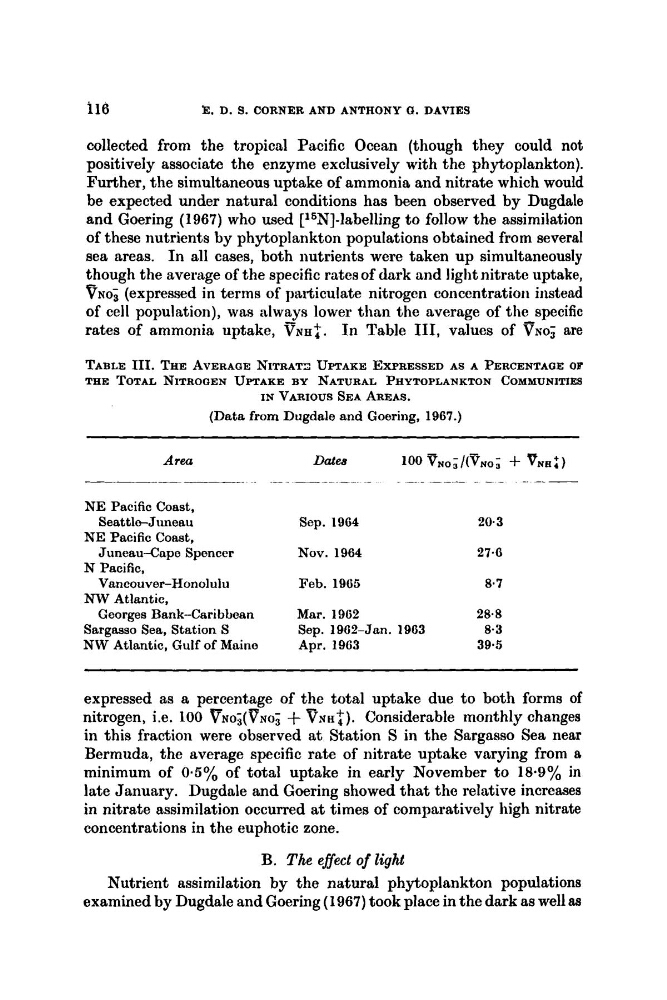
In Table 111, values of ~ N O J are
TABLE 111. THE AVERAGE NITRATZ UPTAKE EXPRESSED AS A PERCENTAQE OF
THE TOTAL NITROGEN UPTAKE BY NATURAL PHYTOPLANKTON COMMUNITIES
IN V~RIOUS SEA AREAS.
(Data from Dugdale and Goering, 1967.)
Area
.
NE Pacific Coast,
Seattle- Juneau
NE Pacific Coast,
Juneau-Cape Spencer
N Pacific,
Vancouver-Honolulu
NW Atlantic,
Georges Bank-Caribbean
Sargasso Sea, Station S
NW Atlantic, Gulf of Maine
Sep. 1964
20.3
Nov. 1964
27.6
Feb. 1965
8.7
Mar. 1962
28.8
Sep. 19G2-Jan. 1963
8.3
Apr. 1963
39.5
expressed as a percentage of the total uptake due to both forms of
nitrogen, i.e. 100 ~ N N O ; ( ~ N O ;
+ ~ N H : ) . Considerable monthly changes
in this fraction were observed at Station S in the Sargasso Sea near
Bermuda, the average specific rate of nitrate uptake varying from a
minimum of 0.5% of total uptake in early November to 18.9% in
late January. Dugdale and Goering showed that the relative increases
in nitrate assimilation occurred at times of comparatively high nitrate
concentrations in the euphotic zone.
B. The effect of light
Nutrient assimilation by the natural phytoplankton populations
examined by Dugdale and Goering (1967) took place in the dark as well &B
' E. D. 9. CORNER AND ANTHONY CI. DAVIES
collected from the tropical Pacific Ocean (though they could not
positively associate the enzyme exclusively with the phytoplankton).
Further, the simultaneous uptake of ammonia and nitrate which would
be expected under natural conditions has been observed by Dugdale
and Goering (1967) who used [16N]-labelling to follow the assimilation
of these nutrients by phytoplankton populations obtained from several
sea areas. In all cases, both iiutrients were taken up simultaneously
though the average of the specific ratcsof dark and lightnitrate uptake,
NO; (expressed in terms of particulate nitrogen concentration instead
of cell population), was always lower than the average of the specific
rates of ammonia uptake, B N H ~ .
In Table 111, values of ~ N O J are
TABLE 111. THE AVERAGE NITRATZ UPTAKE EXPRESSED AS A PERCENTAQE OF
THE TOTAL NITROGEN UPTAKE BY NATURAL PHYTOPLANKTON COMMUNITIES
IN V~RIOUS SEA AREAS.
(Data from Dugdale and Goering, 1967.)
Area
.
NE Pacific Coast,
Seattle- Juneau
NE Pacific Coast,
Juneau-Cape Spencer
N Pacific,
Vancouver-Honolulu
NW Atlantic,
Georges Bank-Caribbean
Sargasso Sea, Station S
NW Atlantic, Gulf of Maine
Sep. 1964
20.3
Nov. 1964
27.6
Feb. 1965
8.7
Mar. 1962
28.8
Sep. 19G2-Jan. 1963
8.3
Apr. 1963
39.5
expressed as a percentage of the total uptake due to both forms of
nitrogen, i.e. 100 ~ N N O ; ( ~ N O ;
+ ~ N H : ) . Considerable monthly changes
in this fraction were observed at Station S in the Sargasso Sea near
Bermuda, the average specific rate of nitrate uptake varying from a
minimum of 0.5% of total uptake in early November to 18.9% in
late January. Dugdale and Goering showed that the relative increases
in nitrate assimilation occurred at times of comparatively high nitrate
concentrations in the euphotic zone.
B. The effect of light
Nutrient assimilation by the natural phytoplankton populations
examined by Dugdale and Goering (1967) took place in the dark as well &B