

110
E. D. S. CORNER AND ANTHONY a. DAVJES
based upon the idea that a mass of water at the sea surface should be in
equilibrium with the atmospheric oxygen, the solubility of which is a
function of temperature and salinity. When this mass of water sinks
below waters of lower density, the oxygen content is presumed t o
remain constant in the absence of biological activity. Any difference
between the measured oxygen content of the water and that expected
for water of the same salinity and temperature is called the “ apparent
oxygen utilization ” and represents the oxygen used for the remineralization of organic matter (AOU positive), or the oxygen produced
during photosynthesis (AOU negative) or, possibly, the sum of the two.
The AOU should thus be stoichiometrically related to changes in the
nitrogen and phosphorus concentrations in the same water mass which,
in turn, should reflect the atomic ratios in the plankton.
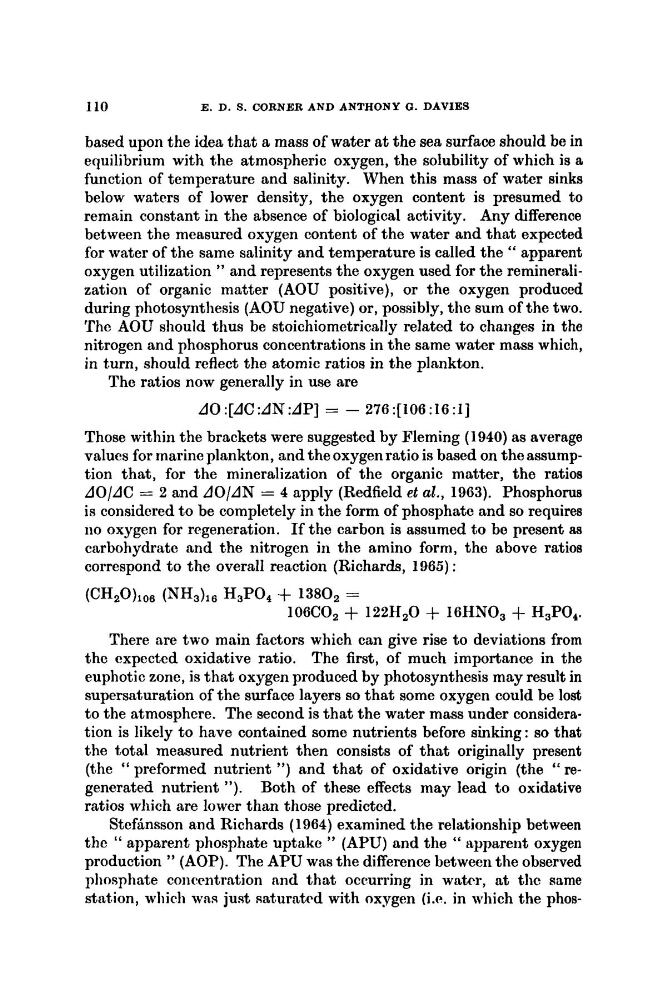
The ratios now generally in use are
dO:[dC:dN:AP] = - 276:[106:16:1]
Those within the brackets were suggestcd by Fleming (1940) as average
values for marine plankton, and the oxygen ratio is based on the assumption that, for the mineralization of the organic matter, the ratios
dO/dC = 2 and dO/dN = 4 apply (Redfield et al., 1963). Phosphorus
is considered to be completely in the form of phosphatc and so requires
110 oxygen for regeneration. If the carbon is assumed to be present &s
carbohydrate and the nitrogen in the amino form, the above ratios
correspond to the overall reaction (Richards, 1965) :
(CH20)106 (NH3)16 H 3 P 0 4
+ 13802 =
106C0, + 122H20 + 16HN03 + H,P04.
There are two main factors which can give rise to deviations from
the expected oxidative ratio. The first, of much importance in the
euphotic zone, is that oxygen produced by photosynthesis may result in
supersaturation of the surface layers so that some oxygen could be lost
to the atmosphere. The second is that the water mass under consideration is likely to have contained some nutrients before sinking: so that
the total measured nutrient then consists of that originally present
(the “ preformed nutrient ”) and that of oxidative origin (the ‘‘ regenerated nutrient ”). Both of these effects may lead to oxidative
ratios which are lower than those predicted.
Stefhnsson and Richards (1964) examined the relationship between
the ‘‘ apparent phosphate uptake ” (APU) and the “ apparent oxygen
production ” (AOP). The APU was the difference between the observed
phosphate conrentration and that occurring in water, at the same
station, which w a s just saturatcd with oxygen (i.c. in which the phos-
E. D. S. CORNER AND ANTHONY a. DAVJES
based upon the idea that a mass of water at the sea surface should be in
equilibrium with the atmospheric oxygen, the solubility of which is a
function of temperature and salinity. When this mass of water sinks
below waters of lower density, the oxygen content is presumed t o
remain constant in the absence of biological activity. Any difference
between the measured oxygen content of the water and that expected
for water of the same salinity and temperature is called the “ apparent
oxygen utilization ” and represents the oxygen used for the remineralization of organic matter (AOU positive), or the oxygen produced
during photosynthesis (AOU negative) or, possibly, the sum of the two.
The AOU should thus be stoichiometrically related to changes in the
nitrogen and phosphorus concentrations in the same water mass which,
in turn, should reflect the atomic ratios in the plankton.
The ratios now generally in use are
dO:[dC:dN:AP] = - 276:[106:16:1]
Those within the brackets were suggestcd by Fleming (1940) as average
values for marine plankton, and the oxygen ratio is based on the assumption that, for the mineralization of the organic matter, the ratios
dO/dC = 2 and dO/dN = 4 apply (Redfield et al., 1963). Phosphorus
is considered to be completely in the form of phosphatc and so requires
110 oxygen for regeneration. If the carbon is assumed to be present &s
carbohydrate and the nitrogen in the amino form, the above ratios
correspond to the overall reaction (Richards, 1965) :
(CH20)106 (NH3)16 H 3 P 0 4
+ 13802 =
106C0, + 122H20 + 16HN03 + H,P04.
There are two main factors which can give rise to deviations from
the expected oxidative ratio. The first, of much importance in the
euphotic zone, is that oxygen produced by photosynthesis may result in
supersaturation of the surface layers so that some oxygen could be lost
to the atmosphere. The second is that the water mass under consideration is likely to have contained some nutrients before sinking: so that
the total measured nutrient then consists of that originally present
(the “ preformed nutrient ”) and that of oxidative origin (the ‘‘ regenerated nutrient ”). Both of these effects may lead to oxidative
ratios which are lower than those predicted.
Stefhnsson and Richards (1964) examined the relationship between
the ‘‘ apparent phosphate uptake ” (APU) and the “ apparent oxygen
production ” (AOP). The APU was the difference between the observed
phosphate conrentration and that occurring in water, at the same
station, which w a s just saturatcd with oxygen (i.c. in which the phos-