

PARTICULATE ORGANIC MATTER I N SEA WATER
57
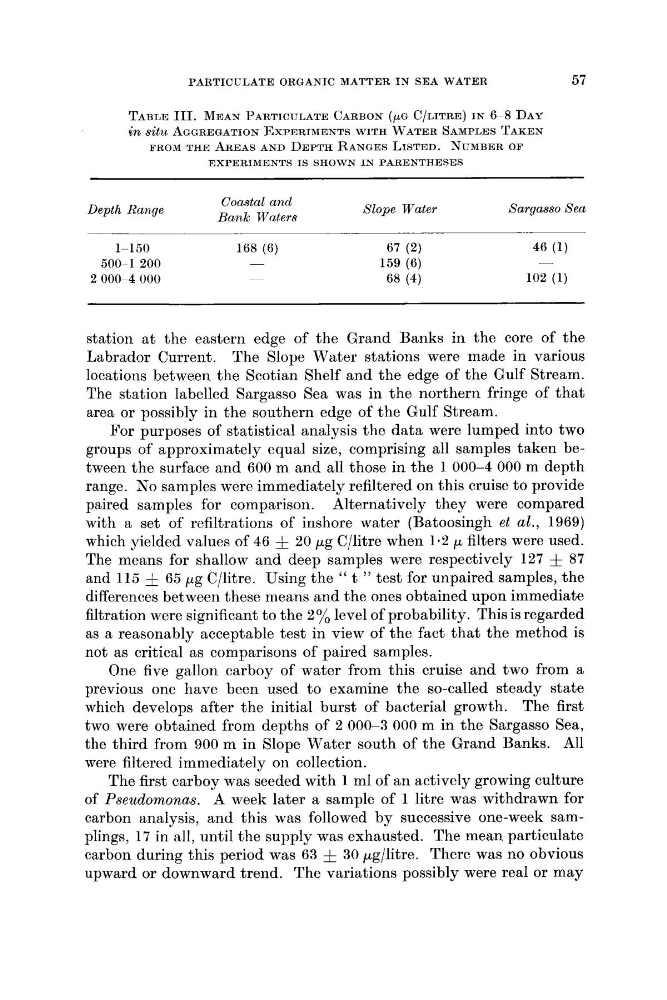
TABLE 111. MEAN PARTICULATE CARBON ( p C/LITRE) IN 6-8 DAY
dn SitU AGGREGATION EXPERIMENTS WITH WATER SAMPLES TAKEN
FROM THE AREAS AND DEPTH RANGES LISTED. NUMBER OF
EXPERIMENTS IS SHOWN IN PARENTHESES
Slope Water
Sargasso Sea
Coastal and
Bank Waters
Depth Range
1-150
168 (6)
67 (2)
46 (1)
~
102 ( 1 )
2 000-4 000
68 (4)
500-1 200
-
159 (6)
-
station at the eastern edge of the Grand Banks in the core of the
Labrador Current. The Slope Water stations were made in various
locations between the Scotian Shelf and the edge of the Gulf Stream.
The station labelled Sargasso Sea was in the northern fringe of that
area or possibly in the southern edge of the Gulf Stream.
For purposes of statistical analysis the data were lumped into two
groups of approximately equal size, comprising all samples taken between the surface and 600 m and all those in the 1 000-4 000 m depth
range. No samples were immediately refiltered on this cruise to provide
paired samples for comparison. Alternatively they were compared
with a set of refiltrations of inshore water (Batoosingh et al., 1969)
which yielded values of 46 f 20 pg C/litre when 1.2 p filters were used.
The means for shallow and deep samples were respectively 127 f 87
and 115
65 pg C/litre. Using the " t " test for unpaired samples, the
differences between these means and the ones obtained upon immediate
filtration were significant to the 2% level of probability. This is regarded
as a reasonably acceptable test in view of the fact that the method is
not as critical as comparisons of paired samples.
One five gallon carboy of water from this cruise and two from a
previous one have been used to examine the so-called steady state
which develops after the initial burst of bacterial growth. The first
two were obtained from depths of 2 000-3 000 m in the Sargasso Sea,
the third from 900 m in Slope Water south of the Grand Banks. All
were filtered immediately on collection.
The first carboy was seeded with 1 ml of an actively growing culture
of Pseudomona,s. A week later a sample of 1 litre was withdrawn for
carbon analysis, and this was followed by successive one-week samplings, 17 in all, until the supply was exhausted. The mean particulate
carbon during this period was 63 f 30 pg/litre. There was no obvious
upward or downward trend. The variations possibly were real or may
57
TABLE 111. MEAN PARTICULATE CARBON ( p C/LITRE) IN 6-8 DAY
dn SitU AGGREGATION EXPERIMENTS WITH WATER SAMPLES TAKEN
FROM THE AREAS AND DEPTH RANGES LISTED. NUMBER OF
EXPERIMENTS IS SHOWN IN PARENTHESES
Slope Water
Sargasso Sea
Coastal and
Bank Waters
Depth Range
1-150
168 (6)
67 (2)
46 (1)
~
102 ( 1 )
2 000-4 000
68 (4)
500-1 200
-
159 (6)
-
station at the eastern edge of the Grand Banks in the core of the
Labrador Current. The Slope Water stations were made in various
locations between the Scotian Shelf and the edge of the Gulf Stream.
The station labelled Sargasso Sea was in the northern fringe of that
area or possibly in the southern edge of the Gulf Stream.
For purposes of statistical analysis the data were lumped into two
groups of approximately equal size, comprising all samples taken between the surface and 600 m and all those in the 1 000-4 000 m depth
range. No samples were immediately refiltered on this cruise to provide
paired samples for comparison. Alternatively they were compared
with a set of refiltrations of inshore water (Batoosingh et al., 1969)
which yielded values of 46 f 20 pg C/litre when 1.2 p filters were used.
The means for shallow and deep samples were respectively 127 f 87
and 115
65 pg C/litre. Using the " t " test for unpaired samples, the
differences between these means and the ones obtained upon immediate
filtration were significant to the 2% level of probability. This is regarded
as a reasonably acceptable test in view of the fact that the method is
not as critical as comparisons of paired samples.
One five gallon carboy of water from this cruise and two from a
previous one have been used to examine the so-called steady state
which develops after the initial burst of bacterial growth. The first
two were obtained from depths of 2 000-3 000 m in the Sargasso Sea,
the third from 900 m in Slope Water south of the Grand Banks. All
were filtered immediately on collection.
The first carboy was seeded with 1 ml of an actively growing culture
of Pseudomona,s. A week later a sample of 1 litre was withdrawn for
carbon analysis, and this was followed by successive one-week samplings, 17 in all, until the supply was exhausted. The mean particulate
carbon during this period was 63 f 30 pg/litre. There was no obvious
upward or downward trend. The variations possibly were real or may