

52
ClOCDOX A. EILEP
The rather surprising finding that particles form spontaneously in
filtered sea water deserves study in an attempt to determine the processes that are involved and to try to find out whether this is a phenomenon that is likely to occur in nature. The writer began such a
study several years ago. At the same time other experiments were
underway in an attempt to find out something about rates of utilization
of particles produced in situ or by experimental bubbling. As it turned
out, all of these converged into a single problem.
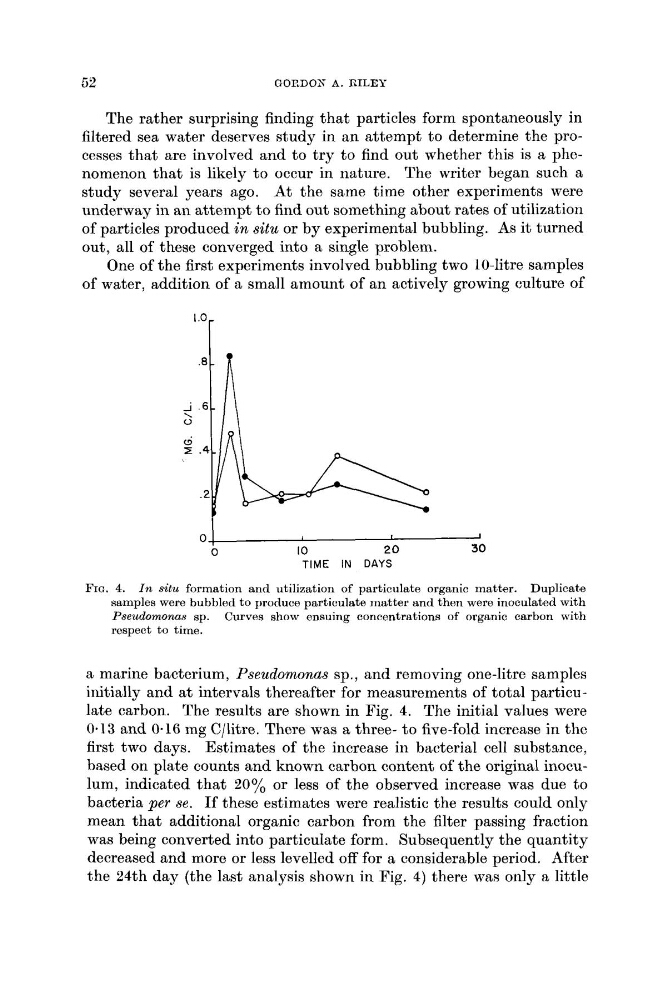
One of the first experiments involved bubbling two 10-litre samples
of water, addition of a small amount of an actively growing culture of
0 1
I
I
0
10
20
30
TIME IN DAYS
FIG. 4. I n situ formation and utilization of particulate organic matter. Duplicate
samples were bubbled to produce particulate matter and then were inoculated with
Pseudomonas sp. Curves show ensuing concentrations of organic carbon with
respect to time.
a marine bacterium, Pseudomonas sp., and removing one-litre samples
initially and at intervals thereafter for measurements of total particulate carbon. The results are shown in Fig. 4. The initial values were
0.13 and 0-16 mg C/litre. There was a three- to five-fold increase in the
first two days. Estimates of the increase in bacterial cell substance,
based on plate counts and known carbon content of the original inoculum, indicated that 20% or less of the observed increase was due to
bacteria per se. If these estimates were realistic the results could only
mean that additional organic carbon from the filter passing fraction
was being converted into particulate form. Subsequently the quantity
decreased and more or less levelled off for a considerable period. After
the 24th day (the last analysis shown in Fig. 4) there was only a little
ClOCDOX A. EILEP
The rather surprising finding that particles form spontaneously in
filtered sea water deserves study in an attempt to determine the processes that are involved and to try to find out whether this is a phenomenon that is likely to occur in nature. The writer began such a
study several years ago. At the same time other experiments were
underway in an attempt to find out something about rates of utilization
of particles produced in situ or by experimental bubbling. As it turned
out, all of these converged into a single problem.
One of the first experiments involved bubbling two 10-litre samples
of water, addition of a small amount of an actively growing culture of
0 1
I
I
0
10
20
30
TIME IN DAYS
FIG. 4. I n situ formation and utilization of particulate organic matter. Duplicate
samples were bubbled to produce particulate matter and then were inoculated with
Pseudomonas sp. Curves show ensuing concentrations of organic carbon with
respect to time.
a marine bacterium, Pseudomonas sp., and removing one-litre samples
initially and at intervals thereafter for measurements of total particulate carbon. The results are shown in Fig. 4. The initial values were
0.13 and 0-16 mg C/litre. There was a three- to five-fold increase in the
first two days. Estimates of the increase in bacterial cell substance,
based on plate counts and known carbon content of the original inoculum, indicated that 20% or less of the observed increase was due to
bacteria per se. If these estimates were realistic the results could only
mean that additional organic carbon from the filter passing fraction
was being converted into particulate form. Subsequently the quantity
decreased and more or less levelled off for a considerable period. After
the 24th day (the last analysis shown in Fig. 4) there was only a little