

PARTICULATE ORGANIC MATTER IN SEA WATER
45
417 and 438 pg. No measurements of dissolved organic carbon were
made, but these amounts were not markedly less than some of the
figures for total dissolved organic carbon in oceanic waters as determined by wet oxidation methods (for example, see Duursnia, 1960).
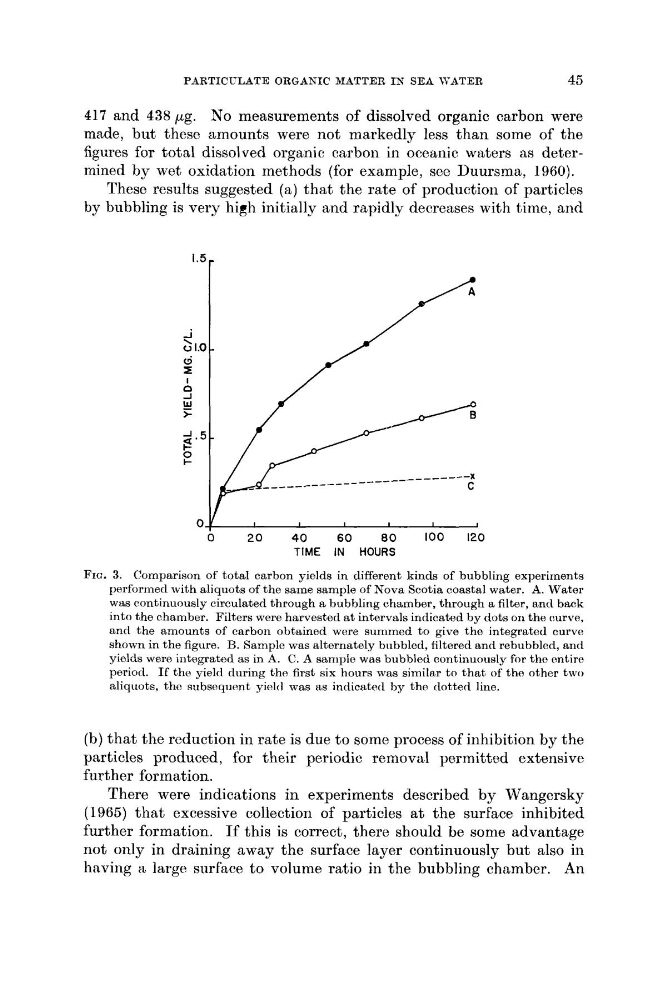
These results suggested (a) that the rate of production of particles
by bubbling is very high initially and rapidly decreases with time, and
/
0
20
40
60
00
I00
120
TIME IN HOURS
Fm. 3. Comparison of total carbon yields in different kinds of bubbling experiments
performed with aliquots of the same sample of Nova Scotia coastal water. A. Water
was continuously circulated through EL bubbling chamber, through a filter, and back
into the chamber. Filters were harvested a t intervals indicated by dots on the curve,
and the amounts of carbon obtained were summed to give the integrated curve
shown in the figure. B. Sample was alternately bubbled, filtered and rebubbled, and
yields were integrated as in A. C. A sample was bubbled continuously for the entire
period. If the yield during the first six hours was similar t n that of the other two
aliquots, the subsequent yield was as indicated by the dotted line.
(b) that the reduction in rate is due to some process of inhibition by the
particles produced, for their periodic removal permitted extensive
further formation.
There were indications in experiments described by Wangersky
(1965) that excessive collection of particles at the surface inhibited
further formation. If this is correct, there should be some advantage
not only in draining away the surface layer continuously but also in
having a large surface to volume ratio in the bubbling chamber. An
45
417 and 438 pg. No measurements of dissolved organic carbon were
made, but these amounts were not markedly less than some of the
figures for total dissolved organic carbon in oceanic waters as determined by wet oxidation methods (for example, see Duursnia, 1960).
These results suggested (a) that the rate of production of particles
by bubbling is very high initially and rapidly decreases with time, and
/
0
20
40
60
00
I00
120
TIME IN HOURS
Fm. 3. Comparison of total carbon yields in different kinds of bubbling experiments
performed with aliquots of the same sample of Nova Scotia coastal water. A. Water
was continuously circulated through EL bubbling chamber, through a filter, and back
into the chamber. Filters were harvested a t intervals indicated by dots on the curve,
and the amounts of carbon obtained were summed to give the integrated curve
shown in the figure. B. Sample was alternately bubbled, filtered and rebubbled, and
yields were integrated as in A. C. A sample was bubbled continuously for the entire
period. If the yield during the first six hours was similar t n that of the other two
aliquots, the subsequent yield was as indicated by the dotted line.
(b) that the reduction in rate is due to some process of inhibition by the
particles produced, for their periodic removal permitted extensive
further formation.
There were indications in experiments described by Wangersky
(1965) that excessive collection of particles at the surface inhibited
further formation. If this is correct, there should be some advantage
not only in draining away the surface layer continuously but also in
having a large surface to volume ratio in the bubbling chamber. An