

SCATOLOGICAL STUDIES OF THE BIVALVIA (MOLLUSCA)
if7
in Hiroshima Bay may deposit within a single oyster culture cycle (9
months) 20 tons or more of biodeposits on a dry basis at a conservative
estimate. It is possible that the discrepancy between our findings and
those of Ito and Imai lies in the size of the raft", the number of oysters
held by a single raft"" and in the basis for estimation of faecal production
of a single oystert. In C. virginica, Haven and Morales-Alamo reported
+
p 2.0
U 9
- Faeces
1
-
1
Pseudofaeces
Crassostrea
n I
._ "- l.oH
.i j 0.5
-
a"
8, .
-
0
Oct. Dec. Feb Apr.
n
Month
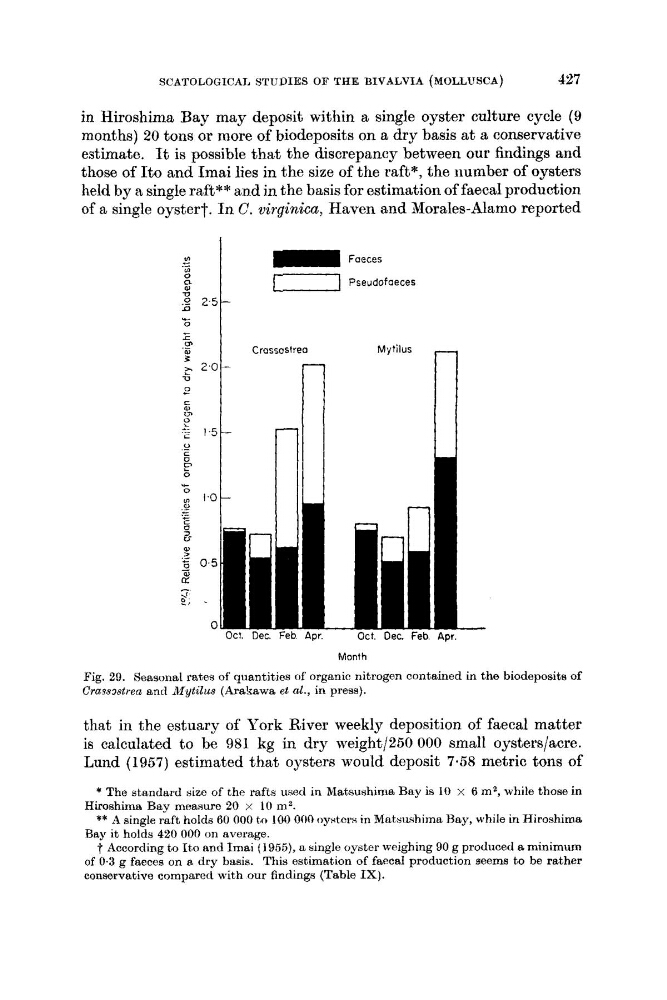
Fig. 29. Seasonal rates of quantities of organic nitrogen contained in the biodeposits of
Crasssstrea and Mytilus (Ara!mwa et al., in press).
that in the estuary of York River weekly deposition of faecal matter
is calculated to be 981 kg in dry weight1250 000 small oysters/acre.
Lund (1957) estimated that oysters would deposit 7.58 metric tons of
* The standard size of the rafts used in Matsushirna Bay is 10 x 6 m2, while those in
Hiroshima Bay rneasurc 20 x 10 m2.
** A single raft holds 60 000 t,o 100 000 oyxt,crs in Matsunhima Ray, while in Hiroshima,
Bay it holds 420 000 on average.
t According to Ito and Imai (1965), a single oyster weighing 90 g produced a minimum
of 0.3 g faeces on R dry basis. This estimation of faecal production seems to be rather
conservative compared with our findings (Table IX).
if7
in Hiroshima Bay may deposit within a single oyster culture cycle (9
months) 20 tons or more of biodeposits on a dry basis at a conservative
estimate. It is possible that the discrepancy between our findings and
those of Ito and Imai lies in the size of the raft", the number of oysters
held by a single raft"" and in the basis for estimation of faecal production
of a single oystert. In C. virginica, Haven and Morales-Alamo reported
+
p 2.0
U 9
- Faeces
1
-
1
Pseudofaeces
Crassostrea
n I
._ "- l.oH
.i j 0.5
-
a"
8, .
-
0
Oct. Dec. Feb Apr.
n
Month
Fig. 29. Seasonal rates of quantities of organic nitrogen contained in the biodeposits of
Crasssstrea and Mytilus (Ara!mwa et al., in press).
that in the estuary of York River weekly deposition of faecal matter
is calculated to be 981 kg in dry weight1250 000 small oysters/acre.
Lund (1957) estimated that oysters would deposit 7.58 metric tons of
* The standard size of the rafts used in Matsushirna Bay is 10 x 6 m2, while those in
Hiroshima Bay rneasurc 20 x 10 m2.
** A single raft holds 60 000 t,o 100 000 oyxt,crs in Matsunhima Ray, while in Hiroshima,
Bay it holds 420 000 on average.
t According to Ito and Imai (1965), a single oyster weighing 90 g produced a minimum
of 0.3 g faeces on R dry basis. This estimation of faecal production seems to be rather
conservative compared with our findings (Table IX).