

SCATOLOGICAL STUDIES OF THE BIVALVIA (MOLLUSCA)
425
temperature below 2-8"C measurable quantities were not produced.
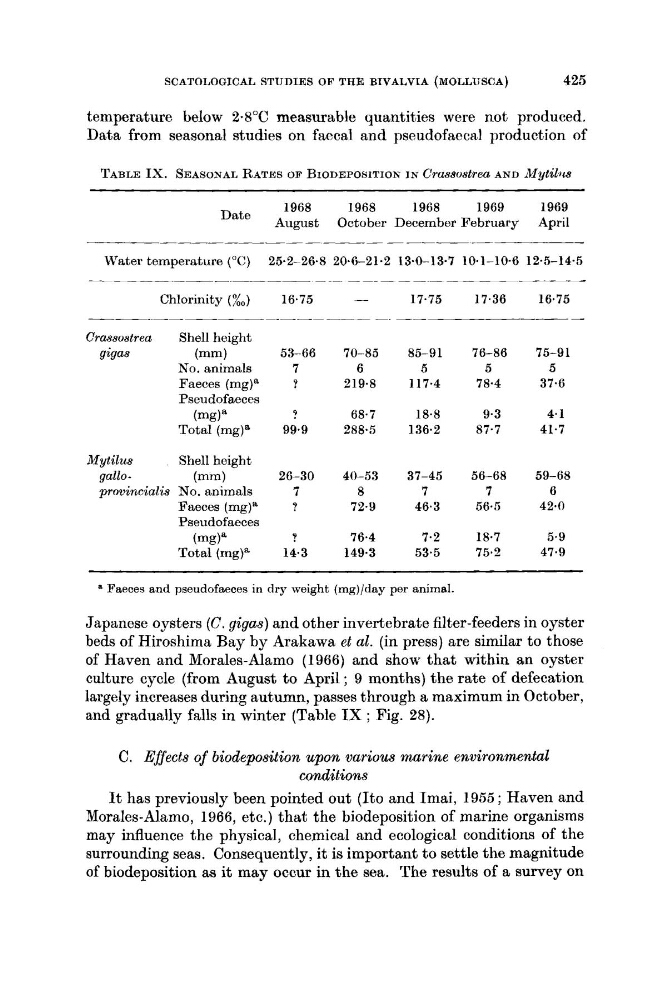
Data from seasonal studies on faecal and pseudofaecal production of
TABLE IX. SEASONAL RATES OF BIODEPOSITION IN Crassostreu AND M y t i l w
1968
1968
1968
1969
1969
Date
August October December February April
Water temperature ("C) 25-2-26.8 20.6-21.2 13.0-13-7 10-1-10-6 12-5-14.5
Chlorinity (X) 16.75
-
17.75
17.36
16.75
Crassostrea
Shell height
gigus
(mm)
53-66
70-85
85-91
76-86
75-91
No. animals
7
6
5
5
5
Faeces (mg)"
?
219.8
117.4
78.4
37.6
Pseiidofaeces
(mg)"
?
68.7
18.8
9.3
4.1
Total (mg)"
99.9
288.5
136.2
87.7
41.7
Mytilus
Shell height
gallo(mm)
26-30
40-53
37-45
56-68
59-68
provincialis No. animals
7
8
7
7
6
Faeces (mg)"
?
72.9
46.3
56.5
42.0
Pseudofaeces
tmg)"
?
76.4
7.2
18.7
5.9
Total (mg)"
14.3
149.3
53.5
75.2
47.9
a Faeces and pseudofaeces in dry weight (mg)/day per animal.
Japanese oysters (G. gigas) and other invertebrate filter-feeders in oyster
beds of Hiroshima Bay by Arakawa et al. (in press) are similar to those
of Haven and Morales-Alamo (1966) and show that within an oyster
culture cycle (from August to April ; 9 months) the rate of defecation
largely increases during autumn, passes through a maximum in October,
and gradually falls in winter (Table IX ; Fig. 28).
C. Effects of biodeposition upon various marine environmental
conditions
It has previously been pointed out (It0 and Imai, 1955 ; Haven and
Morales-Alamo, 1966, etc.) that the biodeposition of marine organisms
may influence the physical, chemical and ecological conditions of the
surrounding seas. Consequently, it is important to settle the magnitude
of biodeposition as it may occur in the sea. The results of a survey on
425
temperature below 2-8"C measurable quantities were not produced.
Data from seasonal studies on faecal and pseudofaecal production of
TABLE IX. SEASONAL RATES OF BIODEPOSITION IN Crassostreu AND M y t i l w
1968
1968
1968
1969
1969
Date
August October December February April
Water temperature ("C) 25-2-26.8 20.6-21.2 13.0-13-7 10-1-10-6 12-5-14.5
Chlorinity (X) 16.75
-
17.75
17.36
16.75
Crassostrea
Shell height
gigus
(mm)
53-66
70-85
85-91
76-86
75-91
No. animals
7
6
5
5
5
Faeces (mg)"
?
219.8
117.4
78.4
37.6
Pseiidofaeces
(mg)"
?
68.7
18.8
9.3
4.1
Total (mg)"
99.9
288.5
136.2
87.7
41.7
Mytilus
Shell height
gallo(mm)
26-30
40-53
37-45
56-68
59-68
provincialis No. animals
7
8
7
7
6
Faeces (mg)"
?
72.9
46.3
56.5
42.0
Pseudofaeces
tmg)"
?
76.4
7.2
18.7
5.9
Total (mg)"
14.3
149.3
53.5
75.2
47.9
a Faeces and pseudofaeces in dry weight (mg)/day per animal.
Japanese oysters (G. gigas) and other invertebrate filter-feeders in oyster
beds of Hiroshima Bay by Arakawa et al. (in press) are similar to those
of Haven and Morales-Alamo (1966) and show that within an oyster
culture cycle (from August to April ; 9 months) the rate of defecation
largely increases during autumn, passes through a maximum in October,
and gradually falls in winter (Table IX ; Fig. 28).
C. Effects of biodeposition upon various marine environmental
conditions
It has previously been pointed out (It0 and Imai, 1955 ; Haven and
Morales-Alamo, 1966, etc.) that the biodeposition of marine organisms
may influence the physical, chemical and ecological conditions of the
surrounding seas. Consequently, it is important to settle the magnitude
of biodeposition as it may occur in the sea. The results of a survey on