

SCATOLOGICAL STUDIES OF THE BIVALVIA (hfOLLUSCA)
12 1
cffect on the rate of faecal discharge during a certain period subsequent
to the operation. Consequently, he suggested that the rate of faecal
discharge of the operated oysters may serve as a useful index in
evaluating the period of post-operative care.
B. Daily and seasonal aspects of biodeposition
Daily aspects: Loosanoff and Nomejko (1946) demonstrated that t'he
feeding activities in Ostrea edulis L. had no relationship to the period
of light and darkness, whereas in P.,martensii, Okawa ( I 959) obtained
1969. Aug. 23-24
c
Crassostrea
..Exp. No. I $ 40
a
5 20
d o
c
Night
1968 Oct, 29-30 0 Daytime
Crassosfrea
c
i
EXP. NO 2 5 40
U
.E c 2 0
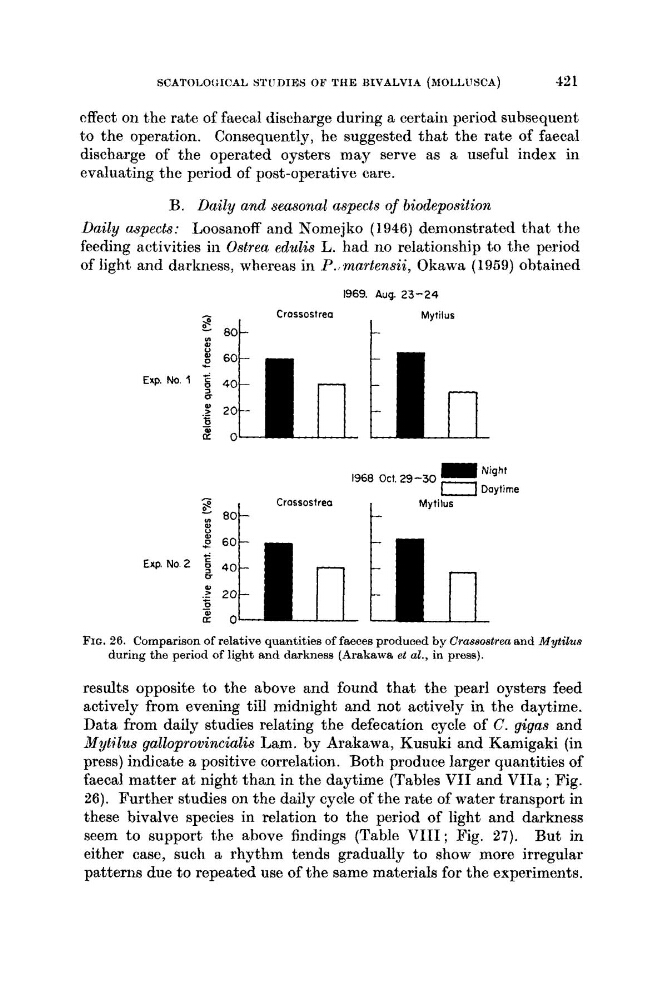
FIG. 26. Comparison of relative quantities of faeces produced by Crassostrea and Mytilus
during the period of light and darkness (Arakawa et al., in press).
results opposite to the above and found that the pearl oysters feed
actively from evening till midnight and not actively in the daytime.
Data from daily studies relating the defecation cycle of C. gigas and
Mytilus galloprovincialis Lam. by Arakawa, Kusuki and Kamigaki (in
press) indicate a positive correlation. Both produce larger quantities of
faecal matter at night than in the daytime (Tables VII and VIIa ; Fig.
26). Further studies on the daily cycle of the rate of water transport in
these bivalve species in relation to the period of light and darkness
seem to support the above findings (Table V I I I ; Fig. 27). But in
either case, such a rhythm tends gradually to show more irregular
patterns due to repeated use of the same materials for the experiments.
12 1
cffect on the rate of faecal discharge during a certain period subsequent
to the operation. Consequently, he suggested that the rate of faecal
discharge of the operated oysters may serve as a useful index in
evaluating the period of post-operative care.
B. Daily and seasonal aspects of biodeposition
Daily aspects: Loosanoff and Nomejko (1946) demonstrated that t'he
feeding activities in Ostrea edulis L. had no relationship to the period
of light and darkness, whereas in P.,martensii, Okawa ( I 959) obtained
1969. Aug. 23-24
c
Crassostrea
..Exp. No. I $ 40
a
5 20
d o
c
Night
1968 Oct, 29-30 0 Daytime
Crassosfrea
c
i
EXP. NO 2 5 40
U
.E c 2 0
FIG. 26. Comparison of relative quantities of faeces produced by Crassostrea and Mytilus
during the period of light and darkness (Arakawa et al., in press).
results opposite to the above and found that the pearl oysters feed
actively from evening till midnight and not actively in the daytime.
Data from daily studies relating the defecation cycle of C. gigas and
Mytilus galloprovincialis Lam. by Arakawa, Kusuki and Kamigaki (in
press) indicate a positive correlation. Both produce larger quantities of
faecal matter at night than in the daytime (Tables VII and VIIa ; Fig.
26). Further studies on the daily cycle of the rate of water transport in
these bivalve species in relation to the period of light and darkness
seem to support the above findings (Table V I I I ; Fig. 27). But in
either case, such a rhythm tends gradually to show more irregular
patterns due to repeated use of the same materials for the experiments.