

410
KOHMAN Y. ARAKAWA
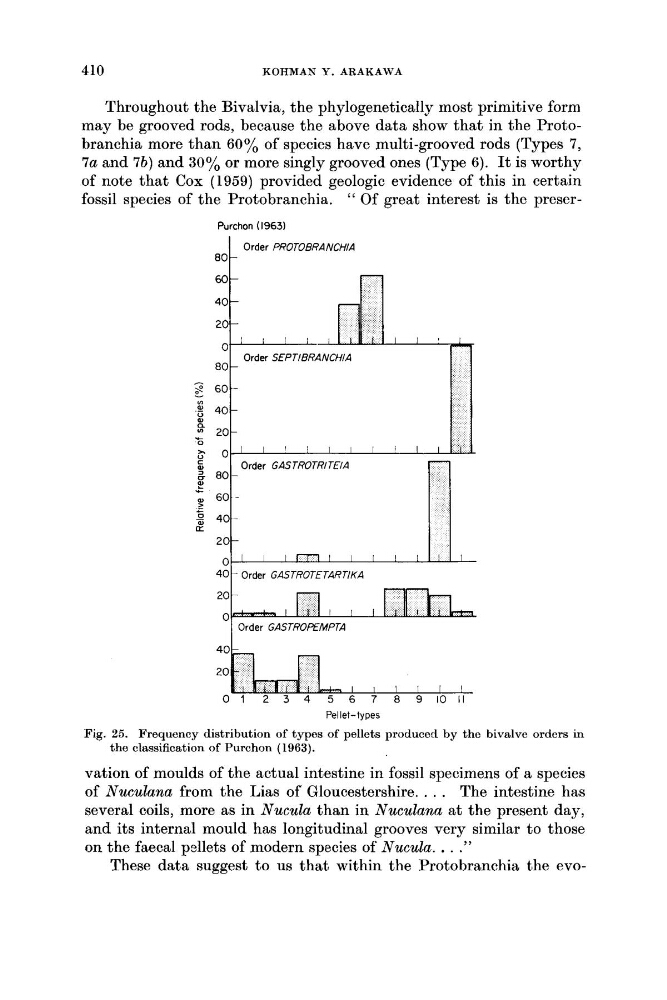
Throughout the Bivalvia, the phylogenetically most primitive form
may be grooved rods, because the above data show that in the Protobranchia more than 60% of species have multi-grooved rods (Types 7,
7a and 7 b ) and 30% or more singly grooved ones (Type 6). It is worthy
of note that Cox (1959) provided geologic evidence of this in certain
fossil species of the Protobranchia. " Of great interest is the preserPurchon (1963)
8ol Order PROTOBRANCHIA
461- Order GASTROTETARTIKA
20
n
" 1 Order GASTROPEMPTA
40
20
0 1 2 3 4 5 6 7 8 9 1011
Pel let- types
Fig. 25. Frequency distribution of types of pellets produced by the bivalve orders in
the classification of Purchon (1963).
vation of moulds of the actual intestine in fossil specimens of a species
of Nuculana from the Lias of Gloucestershire. . . . The intestine has
several coils, more as in Nucula than in Nucubna at the present day,
and its internal mould has longitudinal grooves very similar to those
on the faecal psllets of modern species of Nucula. . . ."
These data suggest to us that within the Protobranchia the evo-
KOHMAN Y. ARAKAWA
Throughout the Bivalvia, the phylogenetically most primitive form
may be grooved rods, because the above data show that in the Protobranchia more than 60% of species have multi-grooved rods (Types 7,
7a and 7 b ) and 30% or more singly grooved ones (Type 6). It is worthy
of note that Cox (1959) provided geologic evidence of this in certain
fossil species of the Protobranchia. " Of great interest is the preserPurchon (1963)
8ol Order PROTOBRANCHIA
461- Order GASTROTETARTIKA
20
n
" 1 Order GASTROPEMPTA
40
20
0 1 2 3 4 5 6 7 8 9 1011
Pel let- types
Fig. 25. Frequency distribution of types of pellets produced by the bivalve orders in
the classification of Purchon (1963).
vation of moulds of the actual intestine in fossil specimens of a species
of Nuculana from the Lias of Gloucestershire. . . . The intestine has
several coils, more as in Nucula than in Nucubna at the present day,
and its internal mould has longitudinal grooves very similar to those
on the faecal psllets of modern species of Nucula. . . ."
These data suggest to us that within the Protobranchia the evo-