

406
KOHMAN Y. ARAKAWA
relationships between bivalves. Moore (1931) and Moore and Kruse
(1956) considered the various forms of pellets to be modifications of the
unsculptured rod, oval or ellipsoidal pellets being produced by way of
the constricted rod. Kornicker (1962) disproved Moore's idea and provided a fairly reasonable hypothesis that the various types of pellets
may be simplifications of the sculptured rod, because of the predomiDoll (1894)
I
- 8 I Order ANOMALOD€SMAC€A
60 Order TELEODESMACEA
t
Pellet-types
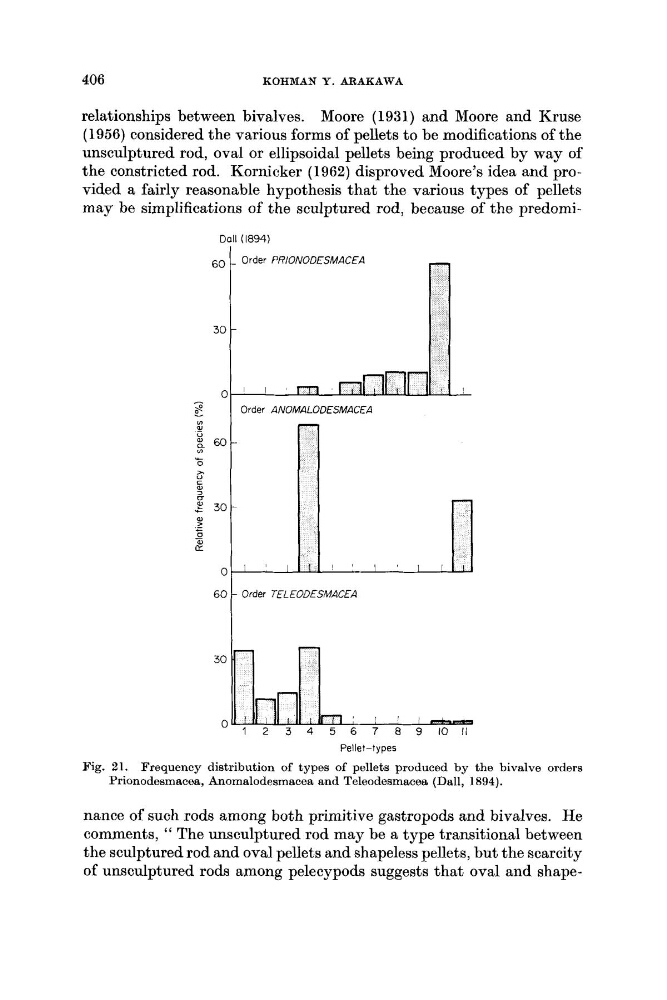
Fig. 21. Frequency distribution of types of pellets produced by the bivalve orders
Prionodesmacea, Anomalodesmacea and Teleodesmacea (Dall, 1894).
nance of such rods among both primitive gastropods and bivalves. He
comments, " The unsculptured rod may be a type transitional between
the sculptured rod and oval pellets and shapeless pellets, but the scarcity
of unsculptured rods among pelecypods suggests that oval and shape-
KOHMAN Y. ARAKAWA
relationships between bivalves. Moore (1931) and Moore and Kruse
(1956) considered the various forms of pellets to be modifications of the
unsculptured rod, oval or ellipsoidal pellets being produced by way of
the constricted rod. Kornicker (1962) disproved Moore's idea and provided a fairly reasonable hypothesis that the various types of pellets
may be simplifications of the sculptured rod, because of the predomiDoll (1894)
I
- 8 I Order ANOMALOD€SMAC€A
60 Order TELEODESMACEA
t
Pellet-types
Fig. 21. Frequency distribution of types of pellets produced by the bivalve orders
Prionodesmacea, Anomalodesmacea and Teleodesmacea (Dall, 1894).
nance of such rods among both primitive gastropods and bivalves. He
comments, " The unsculptured rod may be a type transitional between
the sculptured rod and oval pellets and shapeless pellets, but the scarcity
of unsculptured rods among pelecypods suggests that oval and shape-