

SCATOLOQICAL STUDIES OF THE BIVALVIA (MOLLUSCA)
365
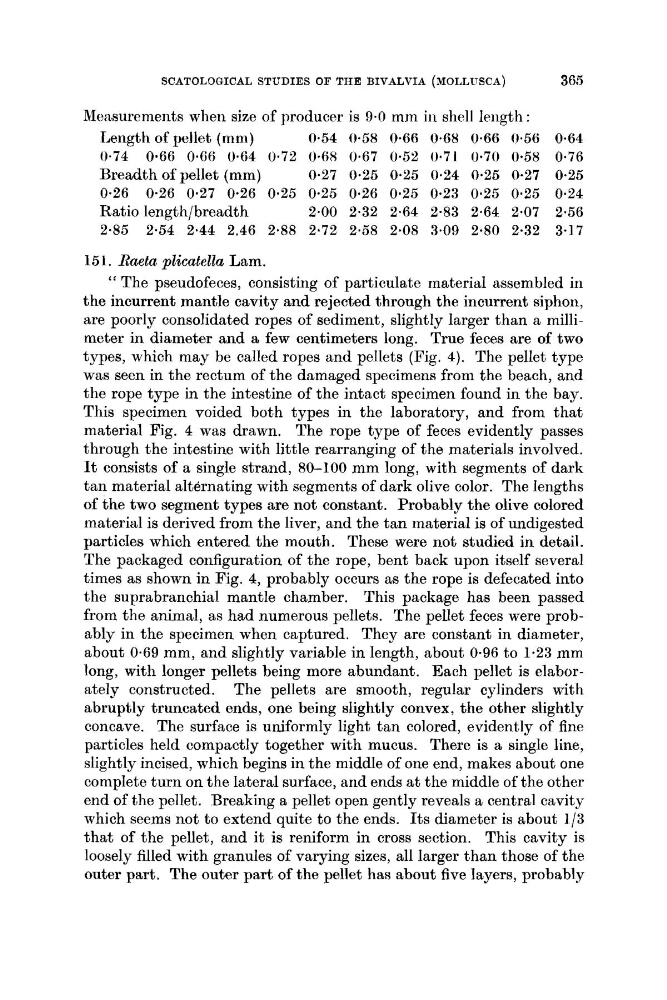
R;leasurements when size of producer is 9.0 mm in shell length :
Length of pellet (mm)
0.54 0.58 04i6 0.68 0.66 0.56 0.64
0.74 0.66 0.66 0.64 0.72 0.68 0.67 0.58 0 . 7 1 0.70 0.58 0.76
Breadth of pellet (mm)
0.27 0.25 0.25 0.24 0.25 0.27 0.25
0.26 0.26 0.27 0.26 0.25 0.25 0.26 0.25 0.23 0.25 0.25 0.24
Ratio length/breadth
2.00 2.32 2.64 2.83 2.64 2.07 2.56
2.85 2.54 2.44 2.46 2.88 2.72 2.58 2.08 3.09 2.80 2.32 3.17
15 1. Raeta plicatella Lam.
'' The pseudofeces, consisting of particulate material assembled in
the incurrent mantle cavity and rejected through the incurrent siphon,
are poorly consolidated ropes of sediment, slightly larger than a millimeter in diameter and a few centimeters long. True feces are of two
types, which may be called ropes and pellets (Fig. 4). The pellet type
was seen in the rectum of the damaged specimens from the beach, and
the rope type in the intestine of the intact specimen found in the bay.
This specimen voided both types in the laboratory, and from that
material Fig. 4 was drawn. The rope type of feces evidently passes
through the intestine with little rearranging of the materials involved.
It consists of a single strand, 80-100 mm long, with segments of dark
tan material alternating with segments of dark olive color. The lengths
of the two segment types are not constant. Probably the olive colored
material is derived from the liver, and the tan material is of undigested
particles which entered the mouth. These were not studied in detail.
The packaged configuration of the rope, bent back upon itself several
times as shown in Fig. 4, probably occurs as the rope is defecated into
the suprabranchial mantle chamber. This package has been passed
from the animal, as had numerous pellets. The pellet feces were probably in the specimen when captured. They are constant in diameter,
about 0.69 mm, and slightly variable in length, about 0.96 to 1-23 mm
long, with longer pellets being more abundant. Each pellet is elaborately constructed. The pellets are smooth, regular cylinders with
abruptly truncated ends, one being slightly convex, the other slightly
concave, The surface is uniformly light tan colored, evidently of fine
particles held compactly together with mucus. There is a single line,
slightly incised, which begins in the middle of one end, makes about one
complete turn on the lateral surface, and ends at the middle of the other
end of the pellet. Breaking a pellet open gently reveals a central cavity
which seems not to extend quite to the ends. Its diameter is about 113
that of the pellet, and it is reniform in cross section. This cavity is
loosely filled with granules of varying sizes, all larger than those of the
outer part. The outer part of the pellet has about five layers, probably
365
R;leasurements when size of producer is 9.0 mm in shell length :
Length of pellet (mm)
0.54 0.58 04i6 0.68 0.66 0.56 0.64
0.74 0.66 0.66 0.64 0.72 0.68 0.67 0.58 0 . 7 1 0.70 0.58 0.76
Breadth of pellet (mm)
0.27 0.25 0.25 0.24 0.25 0.27 0.25
0.26 0.26 0.27 0.26 0.25 0.25 0.26 0.25 0.23 0.25 0.25 0.24
Ratio length/breadth
2.00 2.32 2.64 2.83 2.64 2.07 2.56
2.85 2.54 2.44 2.46 2.88 2.72 2.58 2.08 3.09 2.80 2.32 3.17
15 1. Raeta plicatella Lam.
'' The pseudofeces, consisting of particulate material assembled in
the incurrent mantle cavity and rejected through the incurrent siphon,
are poorly consolidated ropes of sediment, slightly larger than a millimeter in diameter and a few centimeters long. True feces are of two
types, which may be called ropes and pellets (Fig. 4). The pellet type
was seen in the rectum of the damaged specimens from the beach, and
the rope type in the intestine of the intact specimen found in the bay.
This specimen voided both types in the laboratory, and from that
material Fig. 4 was drawn. The rope type of feces evidently passes
through the intestine with little rearranging of the materials involved.
It consists of a single strand, 80-100 mm long, with segments of dark
tan material alternating with segments of dark olive color. The lengths
of the two segment types are not constant. Probably the olive colored
material is derived from the liver, and the tan material is of undigested
particles which entered the mouth. These were not studied in detail.
The packaged configuration of the rope, bent back upon itself several
times as shown in Fig. 4, probably occurs as the rope is defecated into
the suprabranchial mantle chamber. This package has been passed
from the animal, as had numerous pellets. The pellet feces were probably in the specimen when captured. They are constant in diameter,
about 0.69 mm, and slightly variable in length, about 0.96 to 1-23 mm
long, with longer pellets being more abundant. Each pellet is elaborately constructed. The pellets are smooth, regular cylinders with
abruptly truncated ends, one being slightly convex, the other slightly
concave, The surface is uniformly light tan colored, evidently of fine
particles held compactly together with mucus. There is a single line,
slightly incised, which begins in the middle of one end, makes about one
complete turn on the lateral surface, and ends at the middle of the other
end of the pellet. Breaking a pellet open gently reveals a central cavity
which seems not to extend quite to the ends. Its diameter is about 113
that of the pellet, and it is reniform in cross section. This cavity is
loosely filled with granules of varying sizes, all larger than those of the
outer part. The outer part of the pellet has about five layers, probably